A mock FDA inspection is a simulated regulatory audit that reproduces the scope, pace, and pressure of a real FDA visit so an organization can find gaps in people, records, and systems before an investigator does. Run one before a pre-approval inspection, after receiving findings elsewhere, or on a routine cadence to keep readiness sharp. The exercise only earns its cost if it stresses behavior under pressure, not just document existence.
TL;DR:
>
- Mock FDA inspections should focus on testing staff's ability to retrieve records quickly and answer questions accurately under pressure, not just verifying paperwork.
- Practice scenarios should mirror real inspection logistics, including front-room/back-room roles, to expose retrieval delays and communication failures.
- Including vendor records and electronic audit trails in scope ensures a comprehensive assessment of data integrity and compliance readiness.
- Distribute findings and assign clear owners with deadlines, and track recurrence rates to measure whether ongoing mock exercises reduce systemic issues.
- Regularly rotate inspectors, combine remote and onsite formats, and integrate mock results into broader risk management and CAPA processes for continuous improvement.
Table of Contents
- What Is a Mock FDA Inspection, and Why Does It Matter?
- Choosing the Right Mock Scenario: Types and Scope
- How Do You Design a Realistic Mock Inspection?
- What Does a Typical Mock Inspection Timeline Look Like?
- Common Mistakes That Undermine a Mock Inspection
- Testing Data Integrity and Computerized Systems
- Remote vs. Onsite vs. Hybrid Mock Inspections
- Turning Findings Into Measurable Improvement
- Where Automated Validation Platforms Fit in Mock Readiness
- Preparing Employees and Management for a Mock FDA Inspection
- Integrating Mock Inspections Into Compliance Strategy
- Best Practices for Continuous Improvement After a Mock Inspection
- Who Should Run Your Mock Inspection, and What Training Do They Need?
- What Leadership Gets Wrong About Inspection Readiness
- How Qualitum Supports Inspection Readiness
- Sources
- FAQ
What Is a Mock FDA Inspection, and Why Does It Matter?
A mock FDA inspection is a rehearsal, not a checklist audit. It exists to answer one question: if an investigator walked in tomorrow, would your people, your records, and your systems hold up? The core purpose is gap identification before regulators arrive, and that distinction from a standard internal audit matters more than most quality teams admit.
An internal audit checks whether procedures exist and match records. A mock inspection checks whether staff can retrieve those records fast, answer questions accurately without a script, and escalate correctly when they don't know something. That's a behavioral test, not a paperwork test. The pressure is the point.
Who should be in the room:
- QA and regulatory affairs to run the front room and manage investigator flow.
- Operations and manufacturing supervisors who face direct questioning about deviations and batch records.
- IT or validation staff who handle electronic record and audit-trail requests.
- Site or plant leadership who need to see how their teams perform under scrutiny.
The mock's value comes from watching real reactions, not from confirming a binder is complete.
Choosing the Right Mock Scenario: Types and Scope
Not every mock inspection needs to simulate the same regulatory posture. Matching the scenario to your actual risk profile is what separates a useful exercise from an expensive theater exercise.
Common mock types and what typically triggers them:
- Pre-Approval Inspection (PAI) mock — run ahead of a submission tied to a specific product or manufacturing line.
- GMP mock — routine readiness check for commercial manufacturing sites, often annual.
- GCP mock — for sponsors and CROs ahead of clinical trial inspections or sponsor audits.
- GLP mock — for nonclinical labs supporting safety and toxicology data.
- BIMO-focused mock — targets clinical investigator sites and sponsor oversight records.
- Data-integrity-focused mock — narrower scope, heavy emphasis on electronic records and audit trails.
Scope decisions matter as much as type. A facility-wide mock spreads resources thin and often produces shallow findings. A scoped exercise, focused on one product line, one system, or one high-risk process, tends to surface sharper, more actionable gaps. Common scope elements include deviations, CAPA, change control, batch records, validation, complaints, supplier oversight, and management review, and the strongest mocks pull at least two or three of those threads at once.
Don't forget outsourced activities. If a contract lab, contract manufacturer, or key vendor touches the process under review, include their records and, where possible, their personnel in the document-request cycle. Investigators don't stop at your walls, and your mock shouldn't either.
How Do You Design a Realistic Mock Inspection?
The mechanics of the exercise determine whether it diagnoses real weaknesses or just makes everyone feel busy for two days. Real FDA inspections run on a two-room structure, and a mock should mirror that front-room/back-room split to rehearse the logistics that actually break down under pressure.
Role assignments to fill before day one:
- Mock investigator — plays the FDA role, asks questions, requests documents, sets the pace.
- Front-room facilitator — manages investigator interaction, relays requests to the back room.
- Document log coordinator — tracks every request with timestamps.
- Runners — physically or digitally retrieve records from departments.
- Scribe — documents everything said, verbatim where possible, for later review.
- Back-room lead — reviews documents before they go forward, flags issues, coaches staff between sessions.
The document-request cycle is where most organizations discover their real retrieval speed. Log five fields for every request: time requested, who received it, time retrieved, document match quality, and any escalation needed. That log becomes one of the most valuable artifacts of the entire exercise, because it exposes handoff failures a simple pass/fail checklist never would.
Trip-wire questions do the same work on the interview side. Instead of asking "do you have a procedure for this," ask staff to walk through what they actually did, step by step. Score answers on three dimensions: did the account match the written procedure, did the person stay within their role's boundaries, and did they escalate rather than guess when they hit the edge of their knowledge.
Pro Tip: Rotate who plays the mock investigator every cycle. A fresh questioner asks different trip-wire questions than last year's, and stale scripts are the fastest way to turn a diagnostic exercise into theater.
A mock built this way tests retrieval speed, document quality, answer discipline, role boundaries, and escalation rules simultaneously, which is exactly the combination a real inspection will test.
What Does a Typical Mock Inspection Timeline Look Like?
Most organizations run the full cycle, kickoff through remediation sprint, within a few weeks. Compressing it further usually means skipping prep work that staff need to perform well; stretching it out risks losing organizational focus.
| Phase | Duration | Key activity |
|---|---|---|
| Kickoff | Days 1 to 2 | Define scope, assign roles, brief leadership |
| Preparation | Days 3 to — | Staff briefings, document staging, mock-team rehearsal |
| Mock inspection days | Days 8 to — | Opening meeting, walkthrough, document requests, interviews, exit meeting |
| Findings and reporting | Days 11 to — | Draft findings report, risk-rank issues |
| Remediation sprint | Days 15 to — | CAPA assignment, targeted fixes, retest planning |
The deliverables at the end are what justify the exercise:
- Findings report, written in the same factual, traceable register as a real Form 483.
- Risk-ranked issue tracker that sorts findings by likelihood and severity, not just discovery order.
- Coaching notes for individuals and departments that need targeted skill-building.
- Remediation plan with named owners and deadlines.
Findings should feed directly into your CAPA system rather than becoming an informal to-do list. Write each one so it's specific, traceable to the exact record or interview response that generated it, and measurable enough that you can confirm closure later rather than just marking it "addressed."
Common Mistakes That Undermine a Mock Inspection
Most mock inspections that fail to produce value fail for the same handful of reasons, and every one of them is fixable.
Frequent errors:
- Using a predictable script that staff have seen before, which tests memorization instead of readiness.
- Playing too polite, letting staff off the hook on follow-up questions a real investigator wouldn't.
- Ignoring electronic records entirely and focusing only on paper batch records.
- Writing a findings report that never gets tracked to closure.
Corrective practices:
- Apply real pressure: interrupt, ask the same question three different ways, push on inconsistencies.
- Always include vendor records and at least one Part 11 electronic-record test in scope.
- Assign a named owner and deadline to every finding before the debrief ends.
At the program level, rotate who plays the auditor role each cycle, schedule periodic unannounced replays of your weakest areas, and track remediation velocity as a formal metric, not an afterthought.
Pro Tip: If your last three mocks produced the same three findings, the problem isn't the mock. It's that closure isn't actually happening. Fix the CAPA loop before you schedule another exercise.
Testing Data Integrity and Computerized Systems
Data integrity and 21 CFR Part 11 compliance sit near the top of every investigator's checklist, which makes them a mandatory focus area for any mock inspection rather than an optional add-on.
Specific system tests worth running:
- Audit-trail retrieval — can staff pull a complete, unedited audit trail for a specific batch or record within minutes, not hours?
- Versioning checks — can the team show which version of a document or system configuration was active on a given date?
- Access control review — do permission levels match job roles, and can staff explain who approved access changes?
- Timestamp integrity — are system clocks synchronized across instruments, and can staff explain discrepancies if asked?
Simulate the request the way an investigator actually makes it: ask for raw data, not a summary report, and ask for it live, on screen, without advance notice. The most common failure mode is a multi-day delay because nobody on staff knows how to run the audit-trail query without pulling in an IT specialist who isn't in the room. A Part 11 readiness checklist helps standardize what "complete" looks like before the mock ever starts, and reviewing your audit-trail review procedures beforehand cuts down on exactly this kind of scramble.
Remote vs. Onsite vs. Hybrid Mock Inspections
Remote mock inspections have become a legitimate option, not a compromise. Organizations regularly run remote or hybrid mocks using secure document sharing platforms, live video interviews, and simulated electronic document requests, and for testing retrieval speed and interview discipline, remote works nearly as well as onsite.
Where remote falls short is floor-level observation: gowning practice, equipment handling, environmental monitoring behavior, and the small procedural shortcuts staff take when nobody official is watching in person. Reserve those checks for onsite visits or a hybrid model that pairs remote document and interview testing with a targeted floor walkthrough.
For secure remote execution:
- Use a validated, access-controlled platform for document sharing, never email attachments.
- Run interviews on video, not audio only, so the mock team can observe body language and hesitation.
- Time every remote document request the same way you would onsite, using the same log fields.
Hybrid formats often deliver the best balance for organizations managing multiple sites with limited travel budgets.
Turning Findings Into Measurable Improvement
A mock inspection that doesn't close its own findings isn't functioning as a readiness tool; it's functioning as a report nobody acts on.
- Risk-rank every finding by likelihood of recurrence and regulatory severity, then assign a named owner and a hard deadline, not a vague "Q2" target.
- Set a retest cadence. High-risk findings get a targeted replay within 60 to 90 days; lower-risk items can wait for the next full cycle.
- Track three metrics going forward: findings closed rate, mean time to remediation, and recurrence rate across cycles.
Recurrence rate is the metric most programs ignore, and it's the one that actually proves whether the mock program is reducing risk or just generating paperwork. If the same finding shows up in three consecutive mocks, the CAPA isn't working, regardless of how quickly it was technically "closed." Reviewing an audit readiness checklist between cycles helps keep this discipline consistent across sites and teams.
Where Automated Validation Platforms Fit in Mock Readiness
Retrieval speed is usually the first thing that breaks in a mock inspection, and it's often a documentation problem, not a training problem. When validation evidence lives across disconnected systems, spreadsheets, and email threads, even well-trained staff struggle to produce a clean, traceable record on demand.
Platforms built for agentic validation authoring change that equation directly:
- Every record gets checked against ALCOA+ principles at the moment it's written and again at review, not retroactively during an audit scramble.
- A live traceability matrix means retrieval during a mock request cycle is a lookup, not a hunt through file servers.
- Authoring time drops significantly when validation documentation, from URS through PQ, is agent-generated rather than manually assembled.
A practical starting point is a targeted gap check on one critical system, followed by a small pilot to measure retrieval time and authoring savings before rolling out further.
Preparing Employees and Management for a Mock FDA Inspection
Preparation works differently for frontline staff and for leadership, and treating them the same way is a common miscalculation.
Frontline employees need practice, not lectures. Run short, frequent briefings on how to answer questions honestly and directly, how to say "I don't know, let me check with my supervisor" without embarrassment, and how the document-request process actually flows. Staff who've never seen a document request come in cold tend to freeze or overexplain, both of which read poorly to an investigator. A few short rehearsal sessions, even ten minutes at a shift huddle, build enough muscle memory to avoid that freeze.
Management preparation looks different. Site leaders need to understand their role isn't to answer every question themselves; it's to stay visible, support their teams, and avoid the instinct to jump in and take over an answer a supervisor was already handling correctly. Leadership overreach during interviews is a subtle failure mode: it signals to the mock investigator, and to a real one, that staff aren't trusted to speak for their own work.
Both groups benefit from seeing a sample findings report before the exercise, so the language and format aren't a surprise. And both need a clear signal from the top that the mock is diagnostic, not disciplinary. Staff who fear punishment for an honest mistake during a mock will hide problems rather than surface them, which defeats the entire purpose of running one.
Integrating Mock Inspections Into Compliance Strategy
A mock inspection that stands alone as an annual event, disconnected from everything else in the quality system, delivers a fraction of its potential value. The exercise works best as one node in a continuous readiness loop, not a once-a-year fire drill.
That means tying mock inspection scope directly to your risk assessment process, so the areas with the highest deviation rates or the most recent CAPA activity get tested first. It means feeding mock findings into the same CAPA and management review cycles that handle every other quality signal, rather than routing them into a separate, lower-visibility tracker. And it means scheduling mocks around real triggers: a new product launch, a site transfer, a recent 483 at a sister facility, not just a fixed calendar date.
Compliance leaders who treat mock inspections as a strategic input, alongside supplier audits, internal audits, and complaint trending, get more out of each exercise because the findings connect to a broader risk picture instead of sitting in isolation. That connection also makes it easier to justify the resource cost of running mocks regularly to leadership who might otherwise see them as a discretionary expense.
Best Practices for Continuous Improvement After a Mock Inspection
The gap between organizations that get real value from mock inspections and those that don't usually comes down to what happens in the weeks after the exit meeting, not during the exercise itself.
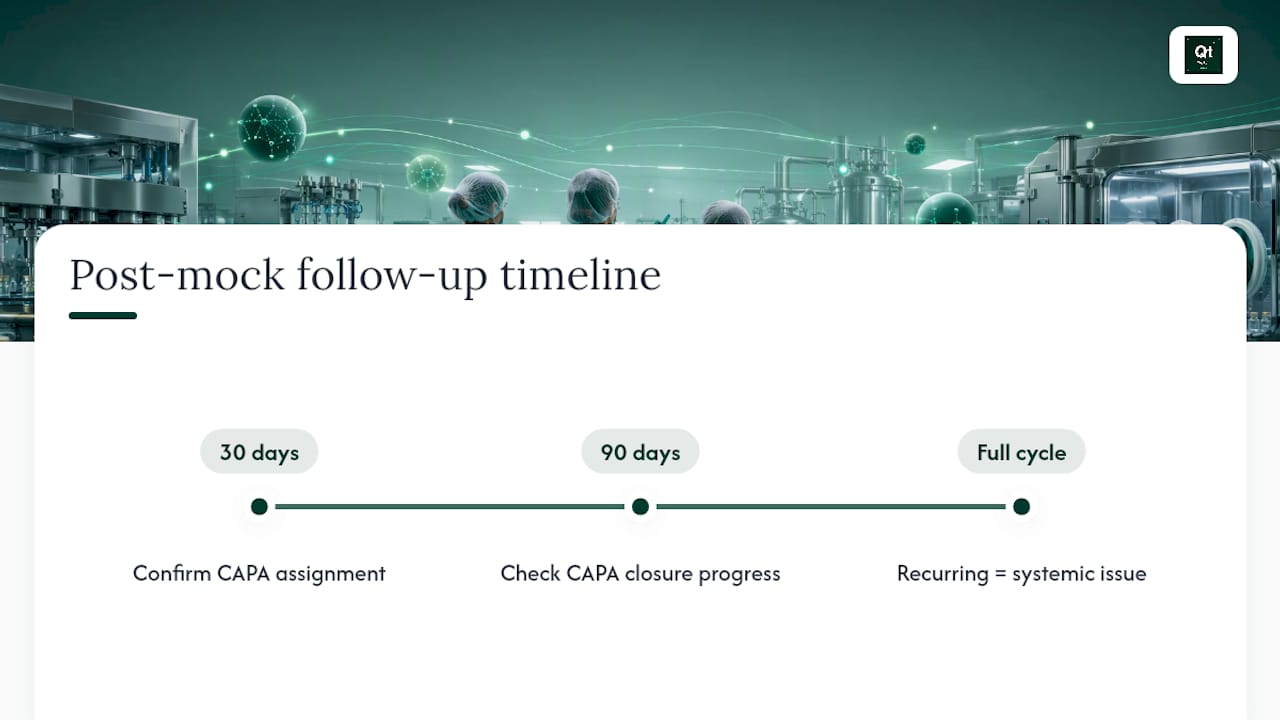
Build a formal review cadence: 30 days after the mock to confirm CAPA assignments are moving, 90 days to check on closure progress, and a full cycle later to test whether the same findings resurface. That last check matters most. A finding that keeps reappearing across cycles points to a systemic issue the first CAPA didn't actually fix, not a training gap that a memo will solve.
Keep a running comparison of findings across cycles rather than treating each mock as a fresh start. Patterns that show up in year two and year three tell you where your quality system has a structural weakness, not just an isolated lapse. Feed that pattern data into management review so leadership sees trends, not just individual incidents.
Finally, vary the mock format itself over time. Alternate scoped, narrow exercises with broader facility-wide ones. Mix announced mocks, which test document readiness and process discipline, with unannounced spot checks, which test whether readiness holds up without preparation time. A program that only ever runs the same format eventually starts training staff to perform for that specific format rather than building genuine, transferable readiness.
Who Should Run Your Mock Inspection, and What Training Do They Need?
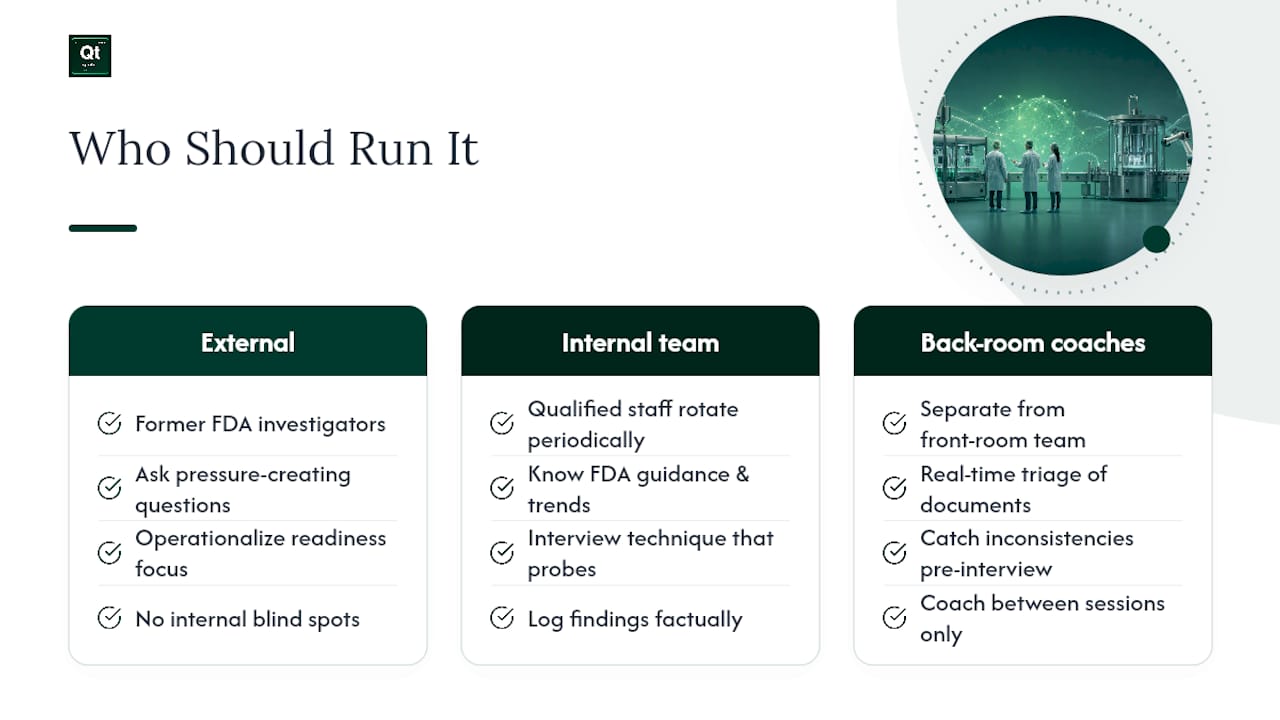
The credibility of a mock inspection rests almost entirely on who's asking the questions. A mock investigator who lacks real inspection experience tends to ask softer questions and accept vaguer answers than an actual FDA investigator would, which quietly degrades the entire exercise.
Many organizations bring in former FDA investigators specifically because they know which questions actually create pressure and which document requests expose real gaps. The advice from former regulatory investigators consistently emphasizes operationalizing readiness rather than training staff to recite scripted answers, testing spontaneous recall and escalation behavior under genuine pressure instead.
If you're building an internal mock team rather than bringing in outside investigators, qualification should cover a few specific competencies: familiarity with current FDA inspection guidance and enforcement trends, interview technique that probes past a first answer, and the discipline to log findings factually rather than softening them for internal politics. Rotate the internal team periodically so the same two or three people don't become the permanent "mock investigators," since institutional blind spots build up fast when the same people design every exercise.
Whoever runs it, the back-room coaching staff need separate training from the front-room team. Their job is real-time triage: deciding what documents are ready to go forward, catching inconsistencies before they reach the mock investigator, and coaching staff between sessions without coaching them during a live interview.
What Leadership Gets Wrong About Inspection Readiness
Most organizations treat the mock inspection itself as the finish line. It isn't. The exercise is only as good as what happens to the findings afterward, and that's a leadership problem, not a QA problem.
I'd argue the biggest lever isn't a better mock script. It's whether leadership actually resources remediation and sponsors replays of weak areas instead of letting the report gather dust until next year. Rotate roles, record sessions for training, and keep that document-request log every cycle. The metrics build themselves once you do.
— Matt
How Qualitum Supports Inspection Readiness
Preparing for a mock or real FDA inspection often exposes the same bottleneck: validation evidence that exists but takes too long to find, format, or defend under questioning. Qualitum is built for exactly that gap. Its agentic validation platform authors URS through PQ documentation with every record checked against ALCOA+ at write-time and review-time, and organizations report authoring-time savings that materially shorten CSV cycles.

Where this fits into your next mock: run a gap check on one critical system before you schedule the exercise, then measure how much faster your team retrieves and defends that system's records against a mock investigator's requests. The Validate·AI platform page details the specific authoring and traceability features that support this, and if you'd rather see it applied to your own systems first, start with a free validation gap report or book a working session to walk through where automation would save the most retrieval time before your next inspection cycle.
Sources
For primary-source detail, consult FDA's training and continuing education portal for investigator-facing courses, the 8 Essential Steps for a Successful Mock FDA Inspection guide, and how healthcare brands prevent enforcement actions for remediation examples.
- 8 Essential Steps for a Successful Mock FDA Inspection
- Running a Mock FDA Inspection: Roles, Document Requests, and Trip-Wire Questions
FAQ
What Are the Four Types of FDA Inspections?
FDA inspections generally fall into four categories: Pre-Approval Inspections (PAI) tied to a pending submission, routine surveillance GMP inspections, for-cause inspections triggered by complaints or prior findings, and BIMO inspections focused on clinical investigator sites and sponsor oversight.
What Is a Mock Inspection?
A mock inspection is a simulated regulatory audit that reproduces the format, pace, and scrutiny of a real FDA inspection so an organization can identify gaps in records, systems, and staff readiness before regulators arrive.
What Is a Mock Audit?
A mock audit is often used interchangeably with mock inspection, though "audit" sometimes implies a narrower, internally focused review; a true mock FDA inspection specifically rehearses the front-room/back-room dynamics and interview pressure of an actual regulatory visit.
Is the FDA Still Doing Inspections?
Yes, FDA continues conducting routine, for-cause, and pre-approval inspections across pharmaceutical, biotech, and medical device facilities, making ongoing inspection readiness, including mock exercises, a standing requirement rather than a one-time project.
How Often Should We Run a Mock FDA Inspection?
Most regulated facilities benefit from regular full mock inspections, with targeted replays of high-risk areas scheduled periodically after significant findings, product launches, or site changes.
Recommended
- QMS Linked ALCOA+ Validation Metrics for Heads of Validation
- Data Integrity by Design: A Pharma QA Playbook
- Part 11 Compliance: Inspection-Ready Checklist for QA Teams
- Qualification vs Validation: A Practical Guide for Pharma QA
FAQ
What Are the Four Types of FDA Inspections?
FDA inspections generally fall into four categories: Pre-Approval Inspections (PAI) tied to a pending submission, routine surveillance GMP inspections, for-cause inspections triggered by complaints or prior findings, and BIMO inspections focused on clinical investigator sites and sponsor oversight.
What Is a Mock Inspection?
A mock inspection is a simulated regulatory audit that reproduces the format, pace, and scrutiny of a real FDA inspection so an organization can identify gaps in records, systems, and staff readiness before regulators arrive.
What Is a Mock Audit?
A mock audit is often used interchangeably with mock inspection, though "audit" sometimes implies a narrower, internally focused review; a true mock FDA inspection specifically rehearses the front-room/back-room dynamics and interview pressure of an actual regulatory visit.
Is the FDA Still Doing Inspections?
Yes, FDA continues conducting routine, for-cause, and pre-approval inspections across pharmaceutical, biotech, and medical device facilities, making ongoing inspection readiness, including mock exercises, a standing requirement rather than a one-time project.
How Often Should We Run a Mock FDA Inspection?
Most regulated facilities benefit from regular full mock inspections, with targeted replays of high-risk areas scheduled periodically after significant findings, product launches, or site changes.