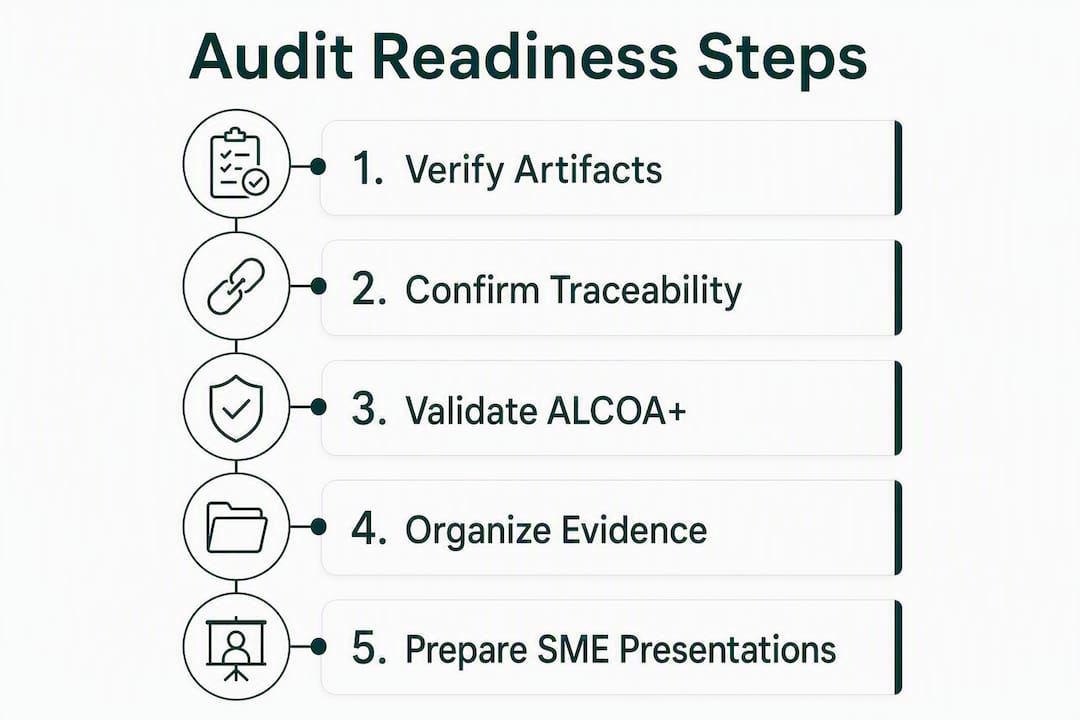
Your audit readiness checklist starts with one non-negotiable deliverable: a defensible, bidirectional Requirements Traceability Matrix (RTM) paired with ALCOA+-enforced CSV evidence that auditors can retrieve, read, and verify on the spot. Before anything else, pull an RTM extract, a 90-day audit-trail export, and a Validation Summary Report (VSR). Those three documents tell the inspection story. Everything else in this guide supports them.
Three immediate actions for this week:
- Export a 90-day audit-trail slice from every GxP-critical system and confirm it is readable and complete.
- Generate a sampled RTM extract showing at least five URS-to-executed-result chains, including one deviation.
- Locate and version-stamp your current VSR so it is retrievable within minutes, not hours.
Under FDA 21 CFR Part 11, electronic records and signatures must be trustworthy, reliable, and equivalent to paper. ALCOA+ (Attributable, Legible, Contemporaneous, Original, Accurate, plus Complete, Consistent, Enduring, Available) is the framework that proves they are. Qualitum, as an automated validation platform, enforces ALCOA+ checks at write-time and review-time so teams are not reconstructing compliance under pressure.
Table of Contents
- What does your audit readiness checklist cover?
- What validation artifacts must be complete before an audit?
- How should you prepare your RTM for inspector scrutiny?
- How do you operationalize ALCOA+ in computerized systems?
- What deviation and CAPA evidence do auditors expect?
- How should you structure the audit kickoff presentation?
- How do you package evidence for rapid retrieval?
- Who owns what during the audit?
- What IT and system controls should you verify before the audit?
- What should you do immediately after the audit?
- How does Qualitum reduce audit preparation burden?
- Key Takeaways
- The gaps that actually cost teams during audits
- Authoritative US-focused references for audit preparation
- Qualitum: audit-ready validation without the manual burden
What does your audit readiness checklist cover?
| Artifact Family | Priority | Owner | Retrieval Time | Remediation Effort |
|---|---|---|---|---|
| RTM (bidirectional, sampled) | Critical | CSV/QA Owner | < 30 min | High if gaps exist |
| Audit-trail exports (90-day) | Critical | IT Lead | < 1 hr | Medium |
| IQ/OQ/PQ executed records | Critical | Validation Lead | < 1 hr | High if unsigned |
| Validation Summary Report (VSR) | Critical | QA Owner | < 30 min | Medium |
| URS, FS, DS/CS | Critical | System Owner | < 1 hr | High if underspecified |
| Risk Assessment (ICH Q9) | Important | Validation Lead | < 1 hr | Medium |
| Change control records | Important | QA/IT | < 1 hr | Low–Medium |

| CAPA/deviation records | Important | QA Owner | < 2 hr | High if open |
| Backup/restore test evidence | Important | IT Lead | < 1 hr | Medium |
| Periodic review records | Important | CSV Owner | < 1 hr | Medium |
| Training records | Optional | HR/QA | < 2 hr | Low |
Auditors will ask for the critical-tier artifacts first. "Show me" evidence means signed PDFs, immutable exports with checksums, and screenshots tied to timestamps, not folder paths.
What validation artifacts must be complete before an audit?
GAMP 5 defines the V-model lifecycle: URS drives design, design drives testing, and testing closes back to URS. Every artifact in that chain must be present, approved, and linked.
Core artifacts and their must-have fields:
- URS: Unique ID, version, approval signatures with dates, explicit acceptance criteria for each requirement, and RTM cross-reference.
- Functional Spec (FS) / Design or Config Spec (DS/CS): Traceability to URS IDs, version control, and named approver.
- Risk Assessment (ICH Q9): Risk score per requirement (H/M/L), control measures, and residual risk sign-off.
- IQ/OQ/PQ Protocols: Acceptance criteria per test step, pre-execution approvals, and deviation cross-references.
- Executed Test Records: Actual results, pass/fail, tester signature with date/time, and deviation or CAPA ID where applicable.
- VSR: Narrative of what was validated, what failed, how issues were resolved, and what residual risks remain. The VSR ties the validation story together for inspectors.
- Change Control Records: Impact assessment, test evidence, and approval chain.
- Periodic Review Records: Scheduled review dates, findings, and sign-off.
Three common mistakes that create immediate findings: an underspecified URS with no measurable acceptance criteria, executed records missing tester signatures, and deviations not cross-referenced in the RTM.
How should you prepare your RTM for inspector scrutiny?
Regulatory auditors expect the RTM to prove bidirectional traceability: every URS maps forward to a test case and executed result, and every executed result traces back to the originating URS. A gap in either direction is a finding.
Minimum RTM columns:
| URS ID | Requirement | Risk (H/M/L) | FS/DS Ref | Test Case ID | Executed Result | Timestamp | Deviation/CAPA | Status |
|---|---|---|---|---|---|---|---|---|
| URS | System shall restrict access by role | H | FS | Test Case | Pass | timestamp | — | Closed |
| URS | Audit trail shall capture old/new values | H | FS | Test Case | Pass | timestamp | — | Closed |
| URS | Batch release shall require dual sign-off | H | FS | Test Case | Fail | timestamp | deviation | Closed/CAPA |
Pro Tip: Prepare 5–10 representative RTM lines before the audit, including at least one deviation row and one edge-case requirement. Open the kickoff with a single slide titled "How to read our RTM" so the inspector understands your traceability logic before asking questions.
How do you operationalize ALCOA+ in computerized systems?
ALCOA+ is not a policy statement. It is a set of verifiable technical controls, and auditors will ask for live evidence of each attribute.
- Attributable: Unique user IDs per person, no shared logins, and role-based access control logs.
- Legible: Readable exports in PDF or CSV; dynamic systems must produce static, timestamped snapshots.
- Contemporaneous: Entries timestamped at creation; NTP/time-sync logs proving server clocks are synchronized.
- Original: Raw data retained in its native format; no overwriting without an audit-trail entry.
- Accurate: Calculation verification tests in OQ; instrument calibration records linked to executed results.
- Complete/Consistent/Enduring/Available: Validated backup/restore with documented restore tests, retention schedules, and disaster-recovery summaries.
Auditors will request audit-trail exports showing who changed what, when, and what the old value was. They will also ask for NTP configuration screenshots and a backup/restore test summary with checksums. If your team cannot retrieve and interpret an ATR export during the inspection, that inability itself becomes a finding.
Pro Tip: Run a documented retrieval drill 30 days before the audit: simulate an inspector's request for a 90-day ATR slice from your most critical GxP system. Time it, document it, and fix any gaps before the real inspection.
What deviation and CAPA evidence do auditors expect?
Auditors want a complete investigation record, not just a closed status. That means a documented root-cause analysis, a risk assessment of the deviation's impact, evidence that corrective actions were implemented, and measurable effectiveness checks.
The most common data-integrity risk is procedural, not intentional. Missing rules for extension requests and template control create late submissions and unjustified retrospective edits that look deliberate to an inspector. Document every extension: the reason, the approver, the new target date, and the link back to the affected executed record and RTM line.
Red-flag behaviors that undermine credibility during an audit: retroactive signoffs without documented justification, CAPAs with no measurable effectiveness criteria, and investigation timelines that exceeded procedural deadlines with no extension request on file. A Springer Nature analysis of FDA Form 483 observations found that failure to follow SOPs accounted for 34% of cited violations, failure to maintain contemporaneous documentation accounted for 21%, and insufficient investigation before batch release accounted for 14%.
How should you structure the audit kickoff presentation?
Starting with a kickoff presentation that explains your risk-based validation approach prevents auditors from drawing incorrect assumptions about scope or intent. Keep it to five slides.
- Slide 1: Systems in scope, GAMP category summary, and a system inventory table with risk scores and validation status.
- Slide 2: Risk-based validation approach, explaining how validation depth scaled with patient-safety risk.
- Slide 3: Evidence map showing where critical records reside (RTM, ATR, VSR, CAPA).
- Slide 4: "How to read our RTM" — one visual showing a single URS-to-result chain.
- Slide 5: Key owners and contacts with roles.
Pro Tip: Rehearse the kickoff with your escort team. Inspectors notice when presenters cannot answer follow-up questions about their own slides. One dry run, documented, is worth more than a polished deck.
How do you package evidence for rapid retrieval?
Evidence packaging is where many teams lose time they cannot recover. A well-indexed evidence folder lets any escort retrieve a requested artifact in under five minutes.
- Use a master evidence index: artifact family, RTM ID, owner, file type, export hash, file path, and retrieval instructions.
- Export audit trails as read-only PDFs with embedded checksums; never provide a live database view as primary evidence.
- For dynamic systems, prepare timestamped screenshots tied to specific test executions and RTM IDs.
- For remote audits: maintain a secure shared folder with a controlled index, pre-export common ATR time windows, and rehearse screen-sharing logistics before the inspection date.
Who owns what during the audit?
| Role | Responsibility |
|---|---|
| System Owner | Explains design decisions and system scope |
| QA/CSV Owner | Retrieves RTM, VSR, and change-control records |
| Document Owner | Provides approved versions of protocols and SOPs |
| IT Lead | Handles ATR exports, backup/restore evidence, and NTP logs |
| Audit Escort | Manages logistics, tracks requests, and controls information flow |
| Executive Contact | Available for escalation; does not attend routine sessions |
Pro Tip: Give each SME a one-page memory aid listing their top five documents and the direct RTM IDs they are most likely to be asked about. Coach them to answer concisely and point immediately to the documented evidence rather than explaining from memory.
What IT and system controls should you verify before the audit?
An inspector who asks "what happened when this record was deleted?" and receives a blank stare at the terminal has already formed a conclusion. Prepare your IT team to demonstrate audit-trail integrity live: pull a deletion event, show the old value, the user ID, and the timestamp, without hesitation.
IT evidence to verify before the inspection:
- Production vs. test environment segregation, documented and enforced.
- Validated version IDs deployed in production, matching change-control approval records.
- User account review log showing periodic access reviews with dates and approvers.
- NTP/time-sync configuration screenshots for all GxP system tiers.
- A documented backup/restore test: files restored, checksum verified, date, and approver.
- High-risk change ticket sample: impact assessment, regression test evidence, and approval chain.
GAMP 5 categorization determines which systems require full IQ/OQ/PQ and which can be validated with lighter evidence. Have that categorization decision documented and defensible.
What should you do immediately after the audit?
The 48 hours after an audit close-out are when findings harden into commitments. Assign an owner and a target close date to every observation before the inspector leaves the building. Prioritize by risk: data-integrity findings first, procedural gaps second, documentation corrections third.
Post-audit action template:
- Assign each finding an owner, risk tier, and target close date within 48 hours.
- Schedule re-verification or re-testing for any executed record or control that was found deficient.
- Review retention schedules and ATR SOPs to prevent recurrence.
- Update periodic-review cadence if the audit revealed gaps in scheduled reviews.
- Operationalize continuous readiness: quarterly retrieval drills, annual RTM audits, and integrated CAPA-to-validation workflows.
How does Qualitum reduce audit preparation burden?
Manual validation documentation is the quiet tax on every audit cycle. Teams spend weeks reconstructing traceability, formatting exports, and chasing signatures, time that compounds with every new system or change control. Qualitum's agentic validation platform addresses this directly.
- Automated RTM generation with live bidirectional links from URS through executed results.
- ALCOA+ checks enforced at write-time and review-time, not retroactively.
- Prebuilt IQ/OQ/PQ protocol templates that include acceptance criteria fields and RTM linkage by default.
- Automated evidence export for ATR and backup tests, with immutable checksums.
A typical workflow: an RTM line is created when a URS is authored, linked automatically to the test case when the protocol is generated, and exported with a timestamped, signed PDF and checksum when the test executes. The entire chain is audit-ready without manual assembly. Qualitum reports over 70% time savings in validation authoring, which translates directly into faster audit preparation cycles. Contact the Qualitum team to start a pilot and see how the platform maps to your specific system inventory.
Key Takeaways
A defensible audit requires a bidirectional RTM, ALCOA+-enforced audit trails, complete IQ/OQ/PQ executed records, and a VSR that tells a coherent validation story inspectors can follow without assistance.
| Point | Details |
|---|---|
| RTM is the first ask | Prepare a sampled RTM extract with 5–10 lines, including a deviation row, before the inspection. |
| ALCOA+ requires live evidence | ATR exports, NTP logs, and backup/restore test records must be retrievable in under one hour. |
| Deviations need full investigation records | Root cause, risk assessment, corrective action, and measurable effectiveness evidence are all required. |
| Kickoff narrative prevents scope drift | A five-slide kickoff explaining your risk-based approach sets context and limits incorrect assumptions. |
| Qualitum automates the evidence chain | The platform generates RTM links, enforces ALCOA+ at write-time, and exports audit-ready evidence automatically. |
The gaps that actually cost teams during audits
The most common audit failures are not missing documents. They are documents that exist but cannot be retrieved, linked, or explained under pressure. An RTM that lives in a spreadsheet with broken hyperlinks, an ATR export that requires a database administrator to generate, a VSR that describes what was planned rather than what was executed: these are the patterns that produce Form 483 observations.
Inspection readiness is about demonstrating that validation, CAPA, and data-integrity systems hold together as a coherent story across departments, not isolated records in folders. The teams that perform best under inspection are the ones that have rehearsed retrieval, not just organized files.
When time is limited before an audit, triage in this order: fix traceability gaps in the RTM first, confirm ATR exports are readable and complete second, and document any open extensions or late entries with approvals third. Coaching SMEs matters too. A subject-matter expert who answers "I'd have to check" and then points immediately to the signed executed record is far more credible than one who answers from memory and cannot locate the document.
Authoritative US-focused references for audit preparation
Every regulatory interpretation in your audit narrative should trace to a primary source. Auditors notice when teams cite internal SOPs as the basis for regulatory decisions.
- ISPE GAMP 5 — The industry standard for risk-based CSV, V-model lifecycle, and software categorization. Use it to justify scoping decisions and validation depth.
- FDA Form 483 trend analysis (Springer Nature) — Empirical data on the most frequently cited GxP violations, useful for prioritizing your pre-audit gap analysis.
Use these references in your audit narrative to show that your validation approach is grounded in recognized industry standards, not internal convention.
Qualitum: audit-ready validation without the manual burden

The gap between a compliant validation program and an audit-ready one is almost always an execution problem, not a knowledge problem. Teams know what is required. The challenge is producing defensible, retrievable, bidirectional evidence at the speed an inspection demands, without a two-week fire drill every time an auditor arrives.
Qualitum is built for exactly that situation. The platform generates agent-authored validation artifacts (URS through VSR), enforces ALCOA+ at every write and review step, maintains a live RTM with bidirectional links, and exports audit-trail evidence with immutable checksums. For pharmaceutical, biotech, and medical device teams managing multiple GxP systems, it replaces the manual documentation cycle with a traceable, defensible record that is ready before the inspector asks.
Visit qualitum.ai to request a pilot scoped to your system inventory and see how the platform maps to the checklist items above.