A write-once audit trail is an append-only, tamper-resistant record of system activity stored on hardware- or platform-backed immutable storage, such as WORM media or S3 Object Lock, and cryptographically validated so it holds up as evidence. It exists to answer one question under pressure: did this record exist, unaltered, before the investigation started? Standards bodies including NIST, PCI DSS, HIPAA, and FDA Part 11 all lean on this kind of evidence when they assess whether your systems can be trusted.
TL;DR:
>
- Immutable audit trails must only include the essential fields like user ID, event verb, UTC timestamp, success flag, request ID, and before-and-after states to support reconstruction and consistency.
- Using hardware WORM appliances or cloud Object Lock in compliance mode ensures records are truly tamper-proof, but correct configuration and application-layer enforcement are critical to avoid gaps.
- Implement cryptographic patterns such as hash chaining and Merkle trees to detect alterations, while sequencing and crypto-shredding help maintain order and address data erasure rights.
- Regular automated testing of the storage configuration, along with proper access controls and clock synchronization, is vital to demonstrate to auditors that the audit trail remains unaltered.
- Relying solely on policy statements without cryptographic enforcement is insufficient; proof artifacts like configuration exports, validation logs, and access role listings are essential during audits.
Table of Contents
- What Belongs in a Write-Once Audit Trail?
- Why Does Immutability Matter for Compliance and Forensics?
- Which Storage Approach Actually Delivers Write-Once Guarantees?
- How Do You Build Tamper-Proof Audit Pipelines?
- What Operational Controls Keep an Audit Trail Defensible?
- How Do You Prove Immutability to an Auditor?
- What Mistakes Most Often Break an Immutable Audit Trail?
- What Does a Practical Implementation Checklist Look Like?
- The Case for Automating Audit Trail Integrity
- Get Audit-Ready Without the Manual Rebuild
- Sources
- FAQ
What Belongs in a Write-Once Audit Trail?
An immutable audit log is only as useful as the fields it captures. Log too little and you cannot reconstruct what happened. Log too much and you drown the record in noise that hides the events that actually matter. The NIST Computer Security Resource Center glossary defines an audit trail as a chronological record of system activity that supports reconstruction and examination of events. That definition sets the bar: every field you capture should serve reconstruction, not just documentation.
A minimum viable event record needs to answer who, what, when, and with what result, every time, in the same shape. That consistency is what lets a review tool or a human auditor scan a year of entries without guessing what each field means.
- Stable user or system ID: not a display name that can change, but a durable identifier that survives account renames and role changes.
- Standardized event verb: a fixed vocabulary (CREATE, APPROVE, DELETE, EXPORT, LOGIN_FAILURE) instead of free-text descriptions that vary by developer.
- UTC timestamp: captured at the source, not at the point of ingestion, and always in a single time zone to avoid ambiguity.
- Success or failure flag: a denied action tells you as much as an approved one, sometimes more.
- Request or trace ID: the thread that ties one user action to every downstream system call it triggered.
- Before and after state: required for any field change that affects a regulated record, such as a batch release status or a signature approval.
The reason standardized verbs and stable IDs matter so much comes down to how audit trails get used later. Nobody reads a log line by line during a normal week. They get pulled during an investigation, a deviation review, or a regulatory inspection, often months after the event happened. If "approve" appears as "Approve," "APPROVED," and "approve_record" across three services, you have three verbs to reconcile before you can even start answering the auditor's question.
Not every log needs write-once protection. Debug logs and performance metrics can live in ordinary mutable storage with normal retention. But three categories almost always belong on immutable infrastructure: system-level security events (logins, permission changes, configuration edits), transaction records that affect regulated outcomes (batch releases, financial postings, patient record changes), and any action taken by a privileged account. Those three categories are where auditors focus first, and where a gap is hardest to explain away.
Why Does Immutability Matter for Compliance and Forensics?
Auditors do not ask "do you have logs?" They ask three sharper questions: is the record complete, is it accurate, and could anyone have altered it without leaving a trace? Immutability is the direct answer to the third question, and it is what turns a log file into evidence rather than a claim.
NIST SP 800-92 and the associated AU-9(1) control describe writing audit information to hardware-enforced write-once media specifically to protect it from unauthorized modification, including modification by the people who administer the system. That last point is the one organizations underestimate. A database administrator with full table privileges can, in principle, edit or delete audit rows. Whether they ever would is irrelevant to an auditor. The control gap exists the moment the capability exists.
An audit log that privileged users can alter is not trustworthy, no matter how good the intentions behind the access. Integrity has to be structural, not procedural.
Regulatory frameworks translate this principle differently depending on the domain, but the underlying expectation is consistent. PCI DSS treats audit trail protection as a core requirement for any system that touches cardholder data. HIPAA's security rule guidance from HHS expects audit controls that protect electronic protected health information from undetected tampering. FDA Part 11 frames the expectation around electronic records and signatures, where inspection readiness depends on demonstrating that a record has stayed unchanged since it was signed.
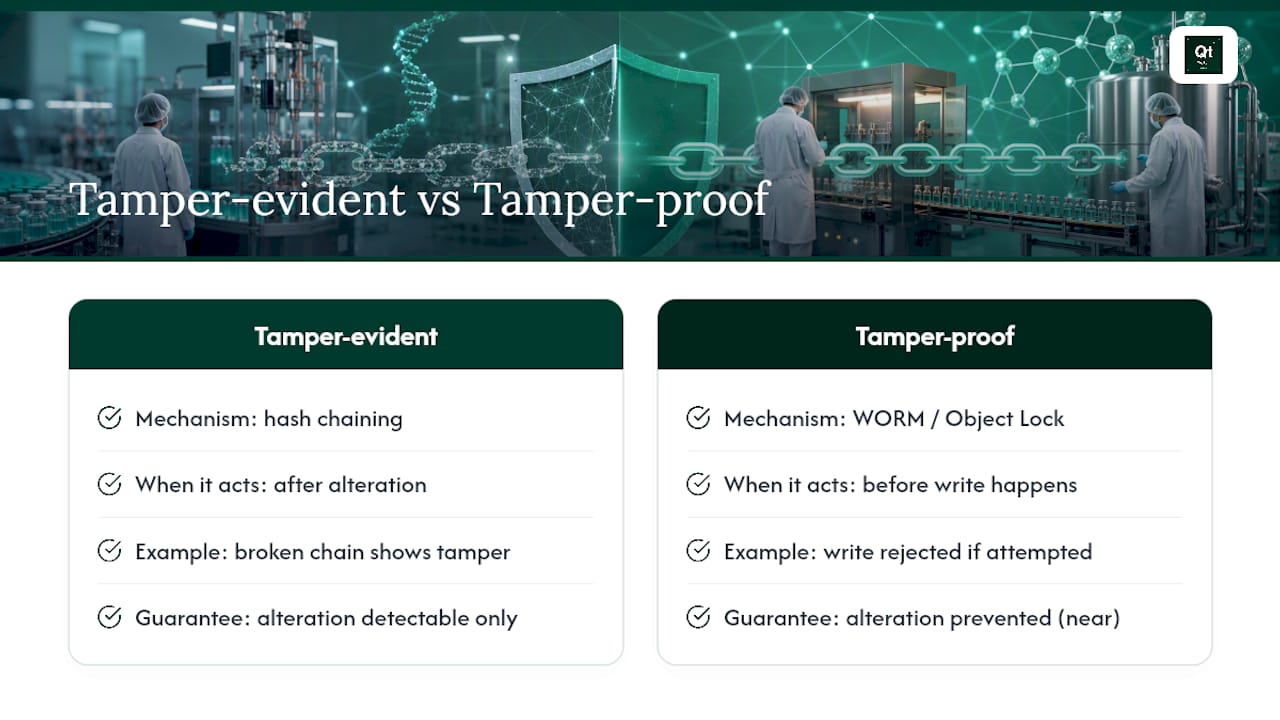
Here is the distinction that trips up teams building their first immutable pipeline: tamper-evident and tamper-proof are not the same guarantee. Hash chaining is tamper-evident. If someone alters a record, the chain breaks and you can detect it, but the alteration already happened. WORM hardware or a properly configured Object Lock policy is tamper-proof, or close to it. The write is rejected before it happens. A mature audit trail architecture uses both. Hashing proves nothing was changed after the fact; write-once storage prevents the change from being possible in the first place.
Which Storage Approach Actually Delivers Write-Once Guarantees?
Three storage models dominate this space, and each carries a different burden of proof.
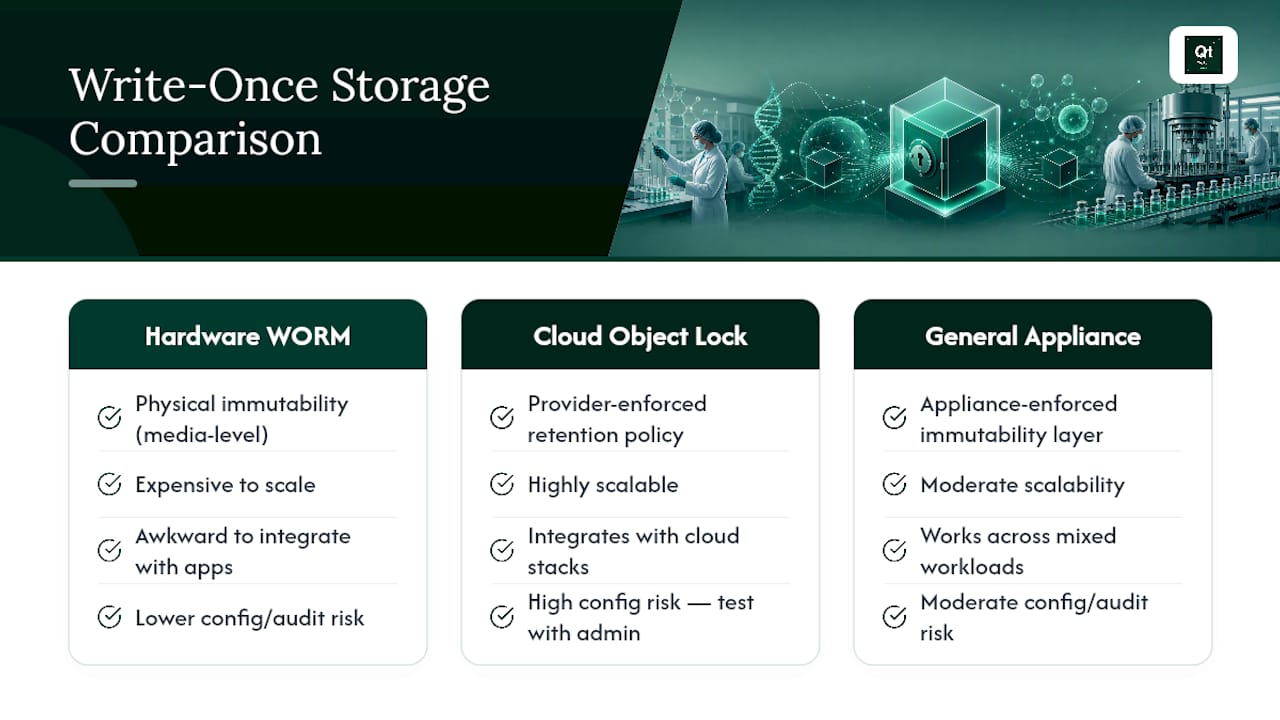
Hardware WORM appliances write data to physical media that cannot be rewritten, a pattern that predates cloud computing and still shows up in highly regulated on-premises environments. The guarantee is physical, which auditors find easy to trust, but the appliances are expensive to scale and awkward to integrate with modern application stacks.
Cloud Object Lock, such as S3 Object Lock in Compliance Mode, gives you the same write-once behavior without hardware. Once a retention policy is set in Compliance Mode, Microsoft's documentation on immutable blob storage and equivalent AWS guidance both confirm that not even the account root user can shorten the retention period or delete the object before it expires. That is a meaningfully stronger guarantee than Governance Mode, where privileged accounts can still override the lock.
General-purpose immutable storage appliances sit between the two, often used by organizations that want write-once behavior across mixed workloads without committing to a single cloud vendor.
The shared-responsibility line matters more than most teams realize before their first audit. A cloud provider guarantees the storage layer will reject overwrite attempts once a policy is applied. The provider does not guarantee that your application actually routes every audit event to that protected bucket, that the retention policy is set correctly, or that no bypass path exists through a different write route. Practitioner mappings of AWS CloudTrail to compliance frameworks show this pattern repeatedly: the storage feature is sound, but the audit failure happens in the configuration layer above it, where a bucket policy was misapplied or a secondary write path skipped the lock entirely.
Pro Tip: Test your Object Lock configuration by attempting a delete with your most privileged administrator account, not a test account. If that delete succeeds, your compliance mode isn't actually enforced, and you need to find out before an auditor does.
Roughly a third of the immutability failures practitioners report trace back to this exact gap: correct storage settings undermined by an application layer that never enforced them consistently. Storage immutability alone is insufficient if the log-routing layer can be bypassed or replayed around it.
How Do You Build Tamper-Proof Audit Pipelines?
Storage-level immutability answers "can this be overwritten." Engineering patterns answer "can this be detected as altered, and can I prove the order events happened in." Four patterns show up repeatedly in mature implementations.
Hash chaining links each new record to a hash of the previous one, so altering any historical entry breaks every hash that follows it. Pair this with periodically signed digest files, and you get a verifiable checkpoint you can hand to an auditor without exposing the whole log.
Merkle trees solve a scaling problem hash chains create on their own. Anchoring millions of individual events with individual proofs is impractical, but a Merkle root lets you anchor an entire batch with a single cryptographic proof, then verify any individual record's inclusion against that one root later.
Sequencer or serializer patterns address a subtler problem: asynchronous writers racing to append to the same hash chain can create ordering conflicts, since each new entry needs to reference the correct previous hash. A single sequencer, often backed by a database-side sequence, resolves the race condition without forcing every writer into a single-threaded bottleneck.
Crypto-shredding handles the collision between immutable logs and data-subject erasure rights. Sensitive fields get encrypted under a per-subject key rather than written in plaintext; destroying that key renders the field unrecoverable while the hash-chained log structure stays intact. EDPB guidance on blockchain and GDPR treats this as a workable mitigation, but flags that whether key destruction legally satisfies "erasure" varies by jurisdiction and deserves a legal review before you rely on it.
| Pattern | Primary strength | Primary trade-off |
|---|---|---|
| Hash chaining | Detects any historical alteration immediately | Requires strict write ordering |
| Merkle tree anchoring | Scales verification to millions of records | Adds batching latency before anchoring |
| Sequencer/serializer | Preserves correct order across async writers | Can become a throughput bottleneck if not scaled |
| Crypto-shredding | Reconciles immutability with erasure requests | Legal status of "erasure" is jurisdiction-dependent |
The synchronous-versus-asynchronous decision comes down to what you can afford to lose. A synchronous trigger that writes the audit record before the business transaction commits guarantees completeness. Nothing happens without a log entry. An async outbox pattern trades that guarantee for lower latency and higher throughput, accepting a small window where a crash could lose an unwritten record. For anything touching a regulated transaction, that trade-off usually resolves in favor of synchronous writes, even at a latency cost.
What Operational Controls Keep an Audit Trail Defensible?
Engineering patterns build the trail. Operations keep it trustworthy day to day, and this is where most defensibility gaps actually show up during an inspection.
- Set retention to the strictest applicable rule, then stop. If FDA Part 11 record retention and a state data-privacy statute both apply, retain for whichever period is longer, but resist the urge to retain everything indefinitely "just in case." Excess retention of personal data creates its own privacy exposure under frameworks like GDPR.
- Enforce insert-only access at the database or access-control layer, not just in application code. A row-level security policy or a database role with INSERT-only grants closes the gap that application-layer validation alone leaves open.
- Separate WORM administration from application administration. The person who can adjust a retention policy on the storage bucket should not be the same person whose actions the log is recording.
- Log every access to the audit store itself. An audit trail that nobody watches for its own unusual access patterns is missing a layer of protection auditors specifically look for.
- Synchronize every system clock to UTC and monitor for drift. A five-minute clock discrepancy between two servers can make a sequence of events look out of order, which undermines the entire chronological reconstruction the NIST definition depends on.
- Alert on bulk exports and unusual read patterns against the audit store. Exfiltration attempts often show up first as an unusual export volume, long before any tampering attempt would.
Pro Tip: Run a monthly clock-drift report across every system that writes to your audit trail. Time synchronization failures are one of the quietest ways an otherwise solid immutable log loses credibility during forensic review, because a broken timeline is almost as damaging as a missing one.
Retention and access separation work together more than most policies acknowledge. A practical data integrity playbook treats retention scoping and role separation as one control, not two, because a retention policy set correctly but administered by the wrong role is still a gap waiting to be found.
How Do You Prove Immutability to an Auditor?
Auditors do not accept a policy document as proof that your audit trail is immutable. They want evidence that the immutability was tested and held. That distinction shapes everything in this section.
Start with attempted modify and delete tests, run against the storage layer using your most privileged accounts, not a limited test user. Attempt to edit a record. Attempt to delete one before its retention period expires. Attempt to shorten the retention window itself. Every attempt should fail, and every failure should generate a system error message with its own timestamp. Keep those error messages. They are your strongest single piece of evidence, because they show the control working under an adversarial test rather than a hypothetical description of how it should work.
Beyond the modify/delete tests, auditors and internal reviewers consistently ask for four categories of supporting artifacts:
- Configuration exports or screenshots showing the Object Lock or WORM setting as actually applied, not as documented in a change request.
- Log-validation outputs, meaning the results of running your hash-chain or digest verification process against the live log, showing it passed.
- An architecture diagram that shows the WORM store positioned as the system of record, with every writer path into it labeled.
- IAM or access-role listings showing who can read, write, or administer the audit store, and confirming no role holds unintended delete or update permissions.
One insight from teams who have been through repeated inspections: audit trail reviews go faster when this evidence is generated automatically on a schedule rather than assembled manually right before an inspection. A quarterly automated verification run, with its output stored alongside the configuration snapshot from that same date, turns "we believe this is immutable" into "here is the test we ran last quarter and the proof it passed." Auditors consistently rate automated, dated evidence more highly than a policy statement asserting the same control, because a policy statement describes intent while a test result describes what actually happened.
What Mistakes Most Often Break an Immutable Audit Trail?
Four failure patterns account for most of the immutability claims that collapse under scrutiny.
Audit tables built with full CRUD privileges. A table designed for insert-only use but deployed with UPDATE and DELETE grants intact is not actually immutable, no matter what the application logic promises. Fix it by revoking those grants at the database level and verifying the revocation with a failed-update test, not just a code review.
Logging everything. Teams often assume more logging equals better compliance, but capturing every field-level read and routine status check buries the events an investigator actually needs under noise, and multiplies the personal data you are now obligated to protect and retain. Practitioners consistently recommend scoping logged events to authentication, authorization changes, access to sensitive data, and lifecycle actions, then leaving high-volume, low-value events out entirely.
Relying on policy language instead of cryptographic or hardware enforcement. A written statement that "audit records are not to be modified" is a policy, not a control. Without a hash chain, a signed digest, or hardware-backed WORM enforcement behind it, that statement has nothing stopping a determined or careless administrator.
Failing to preserve proof artifacts between audits. Configuration snapshots and test outputs that only exist in someone's inbox or a shared drive folder get lost, overwritten, or misplaced right when they matter most. Store them in a separate immutable location of their own, ideally the same class of storage protecting the audit trail they document.
What Does a Practical Implementation Checklist Look Like?
Building a defensible write-once audit trail is a sequence, not a single project milestone.
- Scope and map every in-scope audit trail, matching each one to its governing retention requirement before you touch storage architecture.
- Select a storage approach (hardware WORM, cloud Object Lock, or an immutable storage appliance) and document the exact immutability configuration applied.
- Implement append-only enforcement and event sequencing, closing off UPDATE and DELETE paths at the database and access-control layer.
- Run immutability tests against the live configuration and preserve the failure outputs as your first evidence artifact.
- Automate periodic re-testing on a fixed schedule and keep every result accessible in a format an auditor can review without your help.
- Coordinate with Legal or your data protection officer on personal-data capture strategy, deciding in advance where crypto-shredding applies and documenting that decision.
| Checklist stage | Primary output | Who typically owns it |
|---|---|---|
| Scope and retention mapping | Retention matrix by system | Compliance/QA |
| Storage selection and configuration | Immutability configuration document | IT/Security |
| Append-only enforcement | Revoked-privilege verification | Database/platform team |
| Immutability testing | Modify/delete test results | Security/QA |
| Automated re-testing | Recurring verification logs | IT/Security |
| Legal coordination on PII | Crypto-shredding decision record | Legal/DPO |
Treat this checklist as a loop, not a line. The re-testing stage feeds back into scoping every time a new system enters the regulated environment.
The Case for Automating Audit Trail Integrity
Most of the failure patterns in this article share a root cause: a manual process assumed a control existed that nobody had actually verified. That is the gap Qualitum was built to close. Its four-layer audit trail architecture maps directly onto the controls above, tying capture, immutable storage, cryptographic validation, and access governance into a single inspection-ready system rather than four separate manual checks someone has to remember to run.
The differentiator worth taking seriously is timing. Every record gets checked against ALCOA+ principles at write-time and again at review-time, rather than discovered as a gap during a pre-audit scramble. That approach is behind the platform's reported reduction of over 70% in authoring time for validation documentation, because teams stop rebuilding evidence they should have captured automatically the first time.
The uncomfortable truth conventional wisdom skips over: policy documents and good intentions have never been what protects an audit trail. Structural enforcement does, and structural enforcement is exactly what most teams underinvest in until an inspector asks a question nobody can answer with a test result in hand.
— Matt
Get Audit-Ready Without the Manual Rebuild
[The platform] gives regulated life-sciences teams a faster path to inspection-ready audit trails than the manual authoring cycle most quality teams are still running. Instead of engineers, QA, and validation staff independently assembling configuration exports, test logs, and traceability documents by hand, an agent-authored platform builds and checks that evidence automatically, against ALCOA+ principles, at the moment each record is written.

For pharmaceutical, biotech, and medical device organizations already mapping their audit trails against NIST, FDA Part 11, or HIPAA expectations, automation compounds. Faster authoring means faster CSV cycles, and evidence that stays defensible without a scramble before every inspection window. If your team wants a clear picture of where your current audit trail setup has gaps against auditor expectations, request a free validation gap report or book a working session with Qualitum to see the four-layer architecture applied to your own systems.
Sources
- NIST Computer Security Resource Center (glossary)
- FDA — Part 11: Electronic Records; Electronic Signatures — Scope and Application
- Microsoft Learn — Immutable storage for Azure blobs
FAQ
Can You Give an Example of an Audit Trail?
A pharmaceutical batch release record showing who approved the release, the UTC timestamp, the prior approval status, and the new status is a common example, especially when stored on write-once infrastructure with a hash-chained integrity check.
What Does "Audit Trail" Mean?
An audit trail is a chronological, NIST-defined record of system activity detailed enough to reconstruct and examine what happened, when, and by whom.
What Are Common Audit Trail Mistakes?
The most frequent failures are audit tables left with full CRUD privileges instead of insert-only access, logging so much activity that real signals get lost in noise, and relying on written policy instead of cryptographic or hardware-enforced immutability.
What Is Another Term for "Audit Trail"?
Common equivalents include audit log, activity log, and security compliance trail; when the record is stored on write-once infrastructure, it is often called an immutable audit log or permanent transaction log.
Recommended
- Audit Trail Management: Four Layer Architecture for Regulated Teams
- Audit Trail Review: Inspection-Ready Guide for QA Teams
- What Is a Validation Traceability Matrix and Why Auditors Demand One
- Audit Readiness Checklist for Validation and QA Leaders
FAQ
Can You Give an Example of an Audit Trail?
A pharmaceutical batch release record showing who approved the release, the UTC timestamp, the prior approval status, and the new status is a common example, especially when stored on write-once infrastructure with a hash-chained integrity check.
What Does "Audit Trail" Mean?
An audit trail is a chronological, NIST-defined record of system activity detailed enough to reconstruct and examine what happened, when, and by whom.
What Are Common Audit Trail Mistakes?
The most frequent failures are audit tables left with full CRUD privileges instead of insert-only access, logging so much activity that real signals get lost in noise, and relying on written policy instead of cryptographic or hardware-enforced immutability.
What Is Another Term for "Audit Trail"?
Common equivalents include audit log, activity log, and security compliance trail; when the record is stored on write-once infrastructure, it is often called an immutable audit log or permanent transaction log.