Audit trail management is the practice of capturing, protecting, and reviewing a chronological record of who did what, when, where, and how across a computer system, so that record can withstand an inspection or reconstruct an incident. The NIST glossary frames it as the backbone of accountability. For pharma, biotech, medical device, and financial services teams, the single most important takeaway is this: an audit trail that isn't tamper evident and actively reviewed under frameworks like 21 CFR Part 11 or SEC Rule 17a-4 offers little real protection when regulators or investigators come asking.
TL;DR:
>
- Audit trails must record the actor, timestamp, action, target object, data changes, and business justification, with tamper-evident protections like hashing or signatures.
- Proper management involves separate secure storage, strict retention policies, role-based access controls, encryption, and regular testing to ensure inspection readiness.
- Review processes should be automated and documented with anomaly alerts and regular drills, as unreviewed logs are as unreliable as no logs at all.
- Regulatory frameworks like 21 CFR Part 11 and SEC Rule 17a-4 require immutable, secure, and reconstruction-capable audit trails, aligned with legal retention windows.
- Automated platforms can reduce manual effort, ensure evidence integrity, and maintain continuous compliance by integrating ALCOA+ principles into all stages of audit trail handling.
Table of Contents
- What Is an Audit Trail, and What Must It Record?
- Why Audit Trail Management Matters Beyond Compliance
- What Are the Main Types of Audit Trails?
- What Do Part 11 and SEC Rules Require of an Audit Trail?
- How to Implement Audit Trail Management: An Architecture Checklist
- What Operational Habits Keep an Audit Trail Inspection Ready?
- How Should Retention, Archiving, and Purging Work Over Time?
- What Technical Patterns Make an Audit Trail Genuinely Tamper Resistant?
- What Modern Validation Platforms Change About Audit Trail Management
- How Qualitum Closes Audit Trail Gaps Without Slowing Teams Down
- Sources
- FAQ
What Is an Audit Trail, and What Must It Record?
An audit trail is only as useful as its weakest field. If a system logs that "a record changed" without saying who changed it or what the value was beforehand, you have a timestamp with no evidentiary weight. Regulated teams need a consistent schema across every system that touches GxP or financial data, not a patchwork of logs that vary by application.
At minimum, every audit trail entry should capture:
- Actor identity: the authenticated user or service account that performed the action, not a shared login.
- Timestamp: synchronized to a common time source, down to the second (or finer, for high-frequency transaction systems).
- Action type: create, read, update, delete, export, approve, or void.
- Target object: the specific record, field, or document affected.
- Before and after values: the actual data state change, not just a flag that a change occurred.
- Reason or linked evidence: a comment, deviation number, or change control reference tying the action to its business justification.
Tamper evidence is what separates a log file from an audit trail. Append-only writes prevent silent edits after the fact. Hashing or digital signatures let you prove, mathematically, that a record hasn't been altered since it was written. And because inspectors and auditors don't read raw database tables, the trail needs a human-readable export path, whether that's a PDF report, a CSV extract, or a formatted screen view an investigator can review without IT assistance. Traceability matters just as much as capture: an auditor should be able to follow one event from the system log back to the specific batch record, protocol, or transaction it touched, without a translation layer in between.
Why Audit Trail Management Matters Beyond Compliance
Treating audit trails as a checkbox for inspectors misses most of their value. A well-managed trail does three jobs at once: it satisfies the regulator, it shortens the incident response clock, and it removes hours of manual digging from every internal review.
The compliance angle is the most visible. Inspectors expect to see computer-generated, time-stamped records they can pull on demand, and retention windows tied to the strictest applicable rule (a topic worth its own section below) mean the evidence has to survive years, sometimes over a decade, without gaps.
The forensic angle gets less attention until something breaks. When a deviation occurs, an unauthorized change surfaces, or a financial record gets disputed, the audit trail is the only unbiased witness in the room. Investigators reconstruct sequences of events from it: who accessed a record before a discrepancy appeared, whether an approval happened before or after a batch was released, whether a trade was modified after execution.
The operational payoff compounds over time:
- Audits move faster because evidence retrieval is automated rather than assembled by hand from spreadsheets and screenshots.
- Deviation investigations close sooner because the sequence of events is already documented.
- Process transparency improves internal trust, since managers can see exactly how a decision or release was reached.
What Are the Main Types of Audit Trails?
Not every system needs the same logging depth, and treating all events as equally important is how teams end up drowning in noise while missing the entries that actually matter. Prioritizing by type helps focus effort where regulatory and operational risk is highest.
- System-level audit trails track infrastructure events: server logins, configuration changes, service restarts, and privilege escalations. Example events: an administrator changing a firewall rule, a failed root login attempt, a scheduled patch deployment.
- Application-level audit trails capture activity inside a specific software tool, such as a laboratory information management system or an electronic quality management system. Example events: a user modifying a specification limit, a workflow status change, a report regeneration.
- Transaction audit trails record discrete business events with financial or regulatory consequence. Example events: a trade execution, a batch release approval, a purchase order modification.
- Document audit trails follow a controlled document through its lifecycle. Example events: draft creation, review sign-off, version supersession, retirement.
- Read-access audit trails log who viewed sensitive data, not just who changed it. Example events: opening a patient record, exporting a controlled formula, querying a restricted financial ledger.
In pharma, biotech, and medical device environments, application-level and transaction trails are usually non-negotiable because they map directly to GxP record requirements. Document trails matter just as much wherever SOPs, batch records, or design history files carry legal weight. Read-access trails often get skipped, which is a mistake covered in more detail later in this piece.
What Do Part 11 and SEC Rules Require of an Audit Trail?
Regulatory language rarely spells out a specific software architecture, but it does specify outcomes your architecture has to produce. Three frameworks dominate for regulated life sciences and financial firms, and the strictest applicable one should set your baseline.
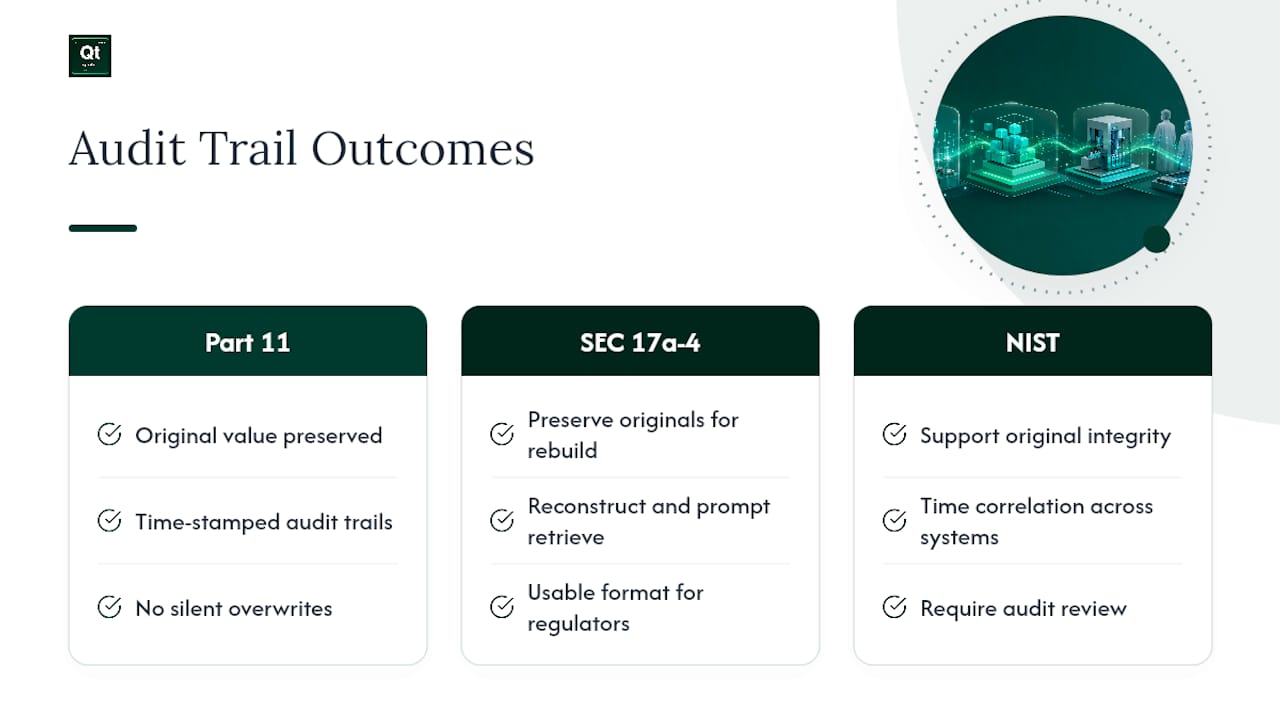
21 CFR Part 11 governs electronic records and signatures for FDA-regulated industries. It expects computer-generated, time-stamped audit trails that record operator entries and actions, and it expects those trails to be secure enough that record changes don't obscure previously recorded information. In practice, that means Part 11 audit trail requirements rule out silent overwrites and demand that the original value remain visible alongside the new one, forever.
SEC Rule 17a-4 (and the parallel 18a-6 for security-based swap dealers) governs recordkeeping for broker-dealers and related financial entities. The SEC's 2022 rule amendments added an audit-trail alternative to the traditional write-once-read-many (WORM) storage mandate. Firms that choose the audit-trail path must preserve records in a way that permits accurate recreation of the originals and supports prompt download, in a format regulators can actually use, on request. That flexibility is real, but it comes with a stricter operational burden: your audit trail has to prove it can reconstruct the record it's tracking, not merely log that something happened to it.
NIST guidance rounds out the picture with the operational side of the coin. NIST's audit and accountability guidance treats an unreviewed audit trail as a control gap. Logging an event does nothing if no one, human or automated, ever looks at it. NIST also stresses time correlation across systems, since an audit trail that can't be lined up against other logs by a common clock loses most of its forensic value.
Retention windows vary by framework, and the right answer is whichever rule applies to you is strictest. Financial recordkeeping rules under Sarbanes-Oxley commonly run several years; healthcare data under HIPAA and payment data under PCI DSS carry their own multi-year expectations; and financial resilience rules like the EU's DORA add operational resilience record-keeping on top. Encode the longest applicable window into policy rather than defaulting to whatever your database's storage tier makes convenient. Qualitum's Part 11 compliance checklist breaks these expectations down by control point for teams building or auditing their own system.
How to Implement Audit Trail Management: An Architecture Checklist
Building an audit trail program from scratch (or fixing gaps in one) comes down to four layers: what you capture, where you store it, who can touch it, and how fast you can hand it to an auditor.
- Define the event schema first. Decide on mandatory fields (actor, timestamp, action, before/after values, linked justification) before you write a single integration. Mask or exclude sensitive content, such as full patient identifiers or payment card numbers, at the point of capture rather than trying to redact it later.
- Separate log storage from the primary database. Logs that live in the same database as the records they describe are one compromised admin account away from disappearing. Export events to a dedicated store, ideally with WORM protection or an audit-trail alternative that meets the recreation and download standard SEC Rule 17a-4 sets.
- Apply tiered retention and archiving. Hot storage for recent, frequently queried events; cold or archival storage for records past their active review window but still inside the legal retention period.
- Lock down access with role-based controls. Only a small, defined set of roles should be able to read raw logs, and an even smaller set should be able to modify retention settings. Separation of duties matters here specifically: the person who can change data shouldn't be the person who can edit the log of that change.
- Encrypt logs at rest and in transit, and manage signing keys through a process separate from general system administration.
- Build for inspection readiness from day one. That means human-readable export formats, a traceability matrix connecting each critical process to its supporting log entries, and periodic test restorations to confirm you can actually produce a complete record when asked, not just in theory.
Pro Tip: Run a mock data-recreation drill twice a year: pick a record at random, and time how long it takes your team to produce its full audit trail and reconstruct its state at a given date. If it takes more than an hour, you have a process gap, not a technology gap.
Qualitum's data integrity compliance playbook walks through ALCOA+ controls that map directly onto this checklist, particularly the masking and separation-of-duties steps that most teams underestimate until an inspector asks for proof.
What Operational Habits Keep an Audit Trail Inspection Ready?
Capturing the data is the easy part. Reviewing it consistently, and catching the moment something looks wrong, is where most programs quietly fail.
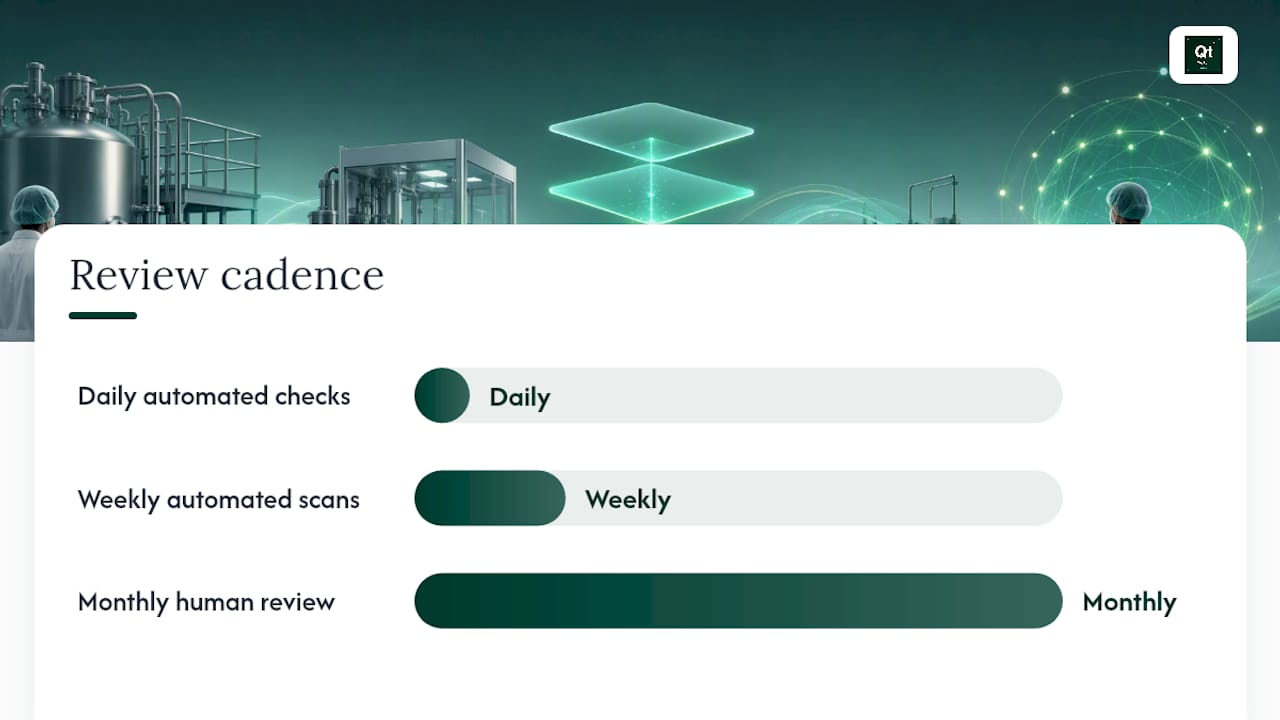
A defensible program needs a documented review cadence, not an ad hoc glance when something feels off. Weekly automated scans for anomalies, paired with a monthly human review of flagged events, is a reasonable baseline for most regulated environments; higher-risk systems may need daily automated checks. NIST's guidance on audit review treats an unreviewed log as a control deficiency in itself, regardless of how well it was captured. An audit trail nobody looks at is not meaningfully different from no audit trail at all.
Configure alerts for:
- Bulk export or read spikes on sensitive record sets.
- Any attempt to edit retention settings or delete archived logs.
- Failed log forwarding between systems (a silent gap is worse than an obvious one).
- Time drift between servers beyond a defined threshold, since drift breaks event correlation across systems.
Common mistakes tend to repeat across organizations. Storing logs in the same database as production records is one. Logging only write events while ignoring reads is another, and it's a bigger gap than most teams realize: sensitive record access without a corresponding write can matter just as much in a forensic reconstruction as the write itself. Missing time synchronization across servers is a third, since it makes correlating events across systems close to impossible during an investigation. And exposing personal or protected health information directly in log fields, rather than referencing it through a masked identifier, creates a privacy problem inside your compliance solution, something HHS's HIPAA Security Rule guidance specifically warns against.
Demonstrating active review to an auditor doesn't require anything exotic: a documented review log, timestamped alert dispositions, and evidence that flagged anomalies were investigated and closed. Qualitum's audit trail review guide outlines what that evidence package should look like for a QA team building it from scratch.
How Should Retention, Archiving, and Purging Work Over Time?
Retention policy has to start with a decision, not a default: identify the strictest legal or regulatory requirement that applies to each record type, and encode that window into system policy rather than leaving it to whatever your storage vendor's default happens to be.
Archiving and purging are where good intentions go wrong most often. Oracle's database documentation recommends scheduled purge jobs paired with archive timestamps, using tools like DBMS_AUDIT_MGMT to move aging records out of active storage without breaking the chain of custody. The archive timestamp matters because it proves exactly when a record moved from active to archival status, which becomes relevant if an inspector later questions why a record wasn't in the "live" system.
- Set an explicit archive threshold (for example, records older than 18 months move to cold storage) tied to your retention policy, not to storage cost pressure.
- Schedule purge jobs only after the full legal retention window has passed, and always export a verified copy before deletion.
- Test restores on a recurring basis. An archive you've never restored from is a theory, not a backup.
Scaling introduces its own trade-offs. Centralized log aggregation makes searching and correlation far easier during an investigation, but it also creates a single high-value target if access controls slip. Compression and tiered storage keep costs manageable as volume grows, and automated integrity checks (periodic hash verification against the original signed values) catch silent corruption before it becomes a finding during an inspection rather than after.
What Technical Patterns Make an Audit Trail Genuinely Tamper Resistant?
Architecture decisions made early determine whether your audit trail can survive a determined insider, not just an honest mistake.
Decoupling log ownership from the systems being logged is the foundational pattern. If the same administrator who can modify production data can also modify or delete its audit trail, the trail proves nothing under real scrutiny. Writing logs to a separate store, owned by a different security identity, closes that gap.
- Hash-chaining links each log entry to the cryptographic hash of the one before it, so altering any single record breaks the chain and reveals the tampering.
- Digital signatures on batches of records add non-repudiation: a signed entry proves who created it and that it hasn't changed since.
- Time synchronization across every logging component, using standard NTP practices, keeps events correlatable across systems during an investigation. A five-minute clock drift between two servers can make a clean sequence of events look like a contradiction.
- Centralized aggregation versus federated storage is a real trade-off, not a solved problem: centralization improves searchability during an inspection, while federated, isolated storage limits the blast radius if one system is compromised.
Most teams get the cryptography right and the ownership separation wrong. A hash chain sitting in the same database an attacker already controls is a false sense of security.
What Modern Validation Platforms Change About Audit Trail Management
The gap most teams underestimate isn't regulatory knowledge. It's the sheer manual effort of generating, checking, and defending evidence fast enough to keep up with system changes. Every hour spent manually authoring validation documentation is an hour not spent reviewing the audit trail itself.
Automation earns its place here by removing that authoring burden without cutting corners on the ALCOA+ checks a record needs to hold up under inspection. When evaluating a platform, look past the demo and ask for real pilot metrics: authoring time reduction, traceability matrix accuracy, and whether evidence exports are genuinely inspection-ready or need rework. Qualitum's own platform was built around exactly that gap between what regulated teams need and what most quality systems make them do by hand.
— Matt
How Qualitum Closes Audit Trail Gaps Without Slowing Teams Down
Most audit trail gaps aren't caused by bad intentions. They're caused by manual documentation eating hours that should go toward review, investigation, and process improvement. Qualitum's agentic validation platform closes that gap directly: every record it generates is ALCOA+ checked at both write-time and review-time, so the evidence is defensible the moment it's created, not patched up before an inspection.

The platform builds live traceability matrices, automates URS-through-PQ documentation, and integrates with the quality management systems your team already runs, so audit trail evidence stops living in scattered spreadsheets and starts living in one inspection-ready record.
If your team wants a clear picture of where your current audit trail practices fall short, request a free validation gap report or book a working session to walk through your specific systems with the Qualitum team.
Sources
- SEC final rule: Amendments related to electronic recordkeeping (17a-4 / 18a-6)
- Oracle Database documentation: Administering the audit trail (2026)
- NIST Glossary: audit trail
FAQ
What Are the 5 Cs of Auditing?
Definitions vary by organization, but a commonly cited version covers criteria, condition, cause, consequence, and corrective action, the elements an auditor documents when writing up a finding. It's a documentation framework for findings, not a technical requirement for audit trail systems themselves.
What Does an Audit Trail Check For?
An audit trail checks for who performed an action, what the action was, when it happened, and what changed as a result, giving auditors and investigators a reconstructable record of system and data activity. Platforms following Part 11 compliance requirements also check that the record itself hasn't been altered since it was created.
What Is an Example of an Audit Trail?
A batch release record showing a QA reviewer's login, the timestamp of their approval, the specification value they confirmed, and a reference to the deviation report they reviewed beforehand is a typical audit trail entry in a pharmaceutical setting. A financial equivalent would log a trade's execution, any post-execution modification, and the identity of who made that change.
What Are Common Audit Trail Mistakes?
The most frequent mistakes are storing logs in the same database as the records they track, logging only write events while ignoring sensitive reads, missing time synchronization across systems, and exposing personal data directly in log fields instead of masking it. Each of these creates a gap that surfaces at the worst possible moment, during an actual inspection or investigation.
How Does Qualitum Support Audit Trail Management?
Qualitum checks every generated record against ALCOA+ principles at both write-time and review-time, and builds live traceability matrices so evidence stays inspection-ready without manual rework. That approach targets the exact audit trail gaps regulated teams struggle to close using manual documentation alone.
Recommended
- Audit Trail Review: Inspection-Ready Guide for QA Teams
- What Is a Validation Traceability Matrix and Why Auditors Demand One
- Audit Readiness Checklist for Validation and QA Leaders
- Data Integrity Compliance for Pharma: A Practical Playbook
FAQ
What Are the 5 Cs of Auditing?
Definitions vary by organization, but a commonly cited version covers criteria, condition, cause, consequence, and corrective action, the elements an auditor documents when writing up a finding. It's a documentation framework for findings, not a technical requirement for audit trail systems themselves.
What Does an Audit Trail Check For?
An audit trail checks for who performed an action, what the action was, when it happened, and what changed as a result, giving auditors and investigators a reconstructable record of system and data activity. Platforms following Part 11 compliance requirements also check that the record itself hasn't been altered since it was created.
What Is an Example of an Audit Trail?
A batch release record showing a QA reviewer's login, the timestamp of their approval, the specification value they confirmed, and a reference to the deviation report they reviewed beforehand is a typical audit trail entry in a pharmaceutical setting. A financial equivalent would log a trade's execution, any post-execution modification, and the identity of who made that change.
What Are Common Audit Trail Mistakes?
The most frequent mistakes are storing logs in the same database as the records they track, logging only write events while ignoring sensitive reads, missing time synchronization across systems, and exposing personal data directly in log fields instead of masking it. Each of these creates a gap that surfaces at the worst possible moment, during an actual inspection or investigation.
How Does Qualitum Support Audit Trail Management?
Qualitum checks every generated record against ALCOA+ principles at both write-time and review-time, and builds live traceability matrices so evidence stays inspection-ready without manual rework. That approach targets the exact audit trail gaps regulated teams struggle to close using manual documentation alone.