FS automation means agent-authored Functional Specifications that stay traceable, from URS through FS to design specification, with audit-ready evidence generated at the moment of writing. The primary payoff is time: authoring cycles shrink dramatically, while ALCOA+ evidence accumulates automatically instead of getting reconstructed before an inspection. Platforms like Qualitum apply this model across the validation lifecycle, treating every FS as a governed, defensible record rather than a static Word document.
TL;DR:
>
- Systems should include controlled templates, live traceability linkages, and prompt qualification records to meet GxP and audit requirements.
- Validating the AI involves defining scope, applying risk tiering, creating a test corpus, and documenting model updates to ensure compliance and reliability.
- Successful pilots focus on narrow document classes, thorough adversarial testing, and strong prompt governance rather than broad scope or neglecting controls.
- Implementing FS automation requires phased planning, system configuration, pilot validation, and continuous evidence capture for audit readiness.
Table of Contents
- What FS Automation Covers and Why It Matters
- Core Capabilities a Validation Team Must Expect
- How to Validate an Automated FS Authoring System
- Implementation Checklist and a Realistic Timeline
- Audit Readiness: What Inspectors Actually Check
- Choosing and Integrating an FS Automation Approach
- Case Studies: What Successful FS Automation Looks Like in Practice
- An Editorial Take: Where Pilots Actually Go Wrong
- What Qualitum Brings to an FS Automation Rollout
- Sources
- FAQ
What FS Automation Covers and Why It Matters
FS automation lives inside a specific chain: a User Requirements Specification generates requirements, each requirement maps to one or more Functional Specification lines, and each FS line traces onward into a Design Specification and eventually a test case. Break that one-to-one link anywhere, and an inspector's first question becomes your last good day. Regulators care about this chain specifically. 21 CFR Part 11, EudraLex Annex 11, and GAMP 5 principles all assume validated systems produce secure records with intact audit trails and traceable decisions, not documents assembled from memory during a fire drill before an audit.
Manual FS authoring breaks down in predictable ways as programs scale:
- Requirement IDs drift out of sync between URS and FS versions, leaving orphaned lines nobody can trace.
- Reviewers copy boilerplate language across specifications, then miss the one clause that needed a real edit.
- Evidence of who wrote what, and when, lives in email threads instead of a defensible record.
- Audit prep becomes a multi-week scramble instead of a byproduct of daily work.
Automating the authoring step, with traceability enforced at write-time, cuts cycle time and closes these data integrity gaps at the source rather than patching them after the fact.
Core Capabilities a Validation Team Must Expect
Not every tool that claims "AI-assisted authoring" is built for a GxP environment. A validation team evaluating FS automation, whether buying a platform or building internal governance around one, should expect a specific capability set.
- Agent-authored templates with version control. The system should draft FS content from controlled prompt libraries tied to a template version, not a loose free-text prompt a user typed that morning.
- End-to-end traceability. Every FS line links back to a specific URS ID and forward to the test case that verifies it, visible in a live traceability matrix rather than a spreadsheet someone updates quarterly.
- ALCOA+ checks at write-time and review-time. Attributable, legible, contemporaneous, original, accurate data checks should run when content is generated, not just when a QA reviewer eventually looks at it.
- Prompt qualification and test corpus records. Every prompt used to generate regulated content needs its own qualification history, backed by a defined test corpus.
- Role-based approvals and e-signatures. Sign-off needs to follow the same access controls and electronic signature rules as any other GxP record.
- Integration APIs for QMS, eTMF, LIMS, and MES. Evidence has to move into your existing systems, not live in an isolated island.
Pro Tip: Ask any vendor to show you a single FS line's full provenance trail, from the originating URS requirement to the prompt version that generated the draft to the reviewer's edit. If they can't produce that in under a minute, the traceability is cosmetic.
How to Validate an Automated FS Authoring System
Validating the tool that writes your FS documents is its own project, and skipping steps here is how "efficient" becomes "indefensible." A regulator-aligned approach follows a fairly consistent sequence.
- Write an intended-use statement. Define exactly which document classes the system authors, what human review is mandatory, and where the AI's role stops.
- Apply model-risk tiering. Map validation depth to influence times consequence: a system drafting a cleaning validation FS for a sterile line needs more scrutiny than one drafting an internal SOP template.
- Assemble a validation plan. Scope, roles, and acceptance criteria go in writing before testing starts, per standard prompt qualification playbook guidance.
- Build a test corpus. Golden, adversarial, and regression test sets should probe both correct outputs and edge cases designed to break the model.
- Run grounding and hallucination tests. Measure how often the system invents content not supported by retrieved source material.
- Capture the evidence pack. Prompt qualification reports, UAT sign-offs, and consolidated test results need to live somewhere inspectors can find them fast.
- Define change control for model updates. Versioning, challenge tests, and roll-back plans matter because foundation models change under vendor control, often without warning.
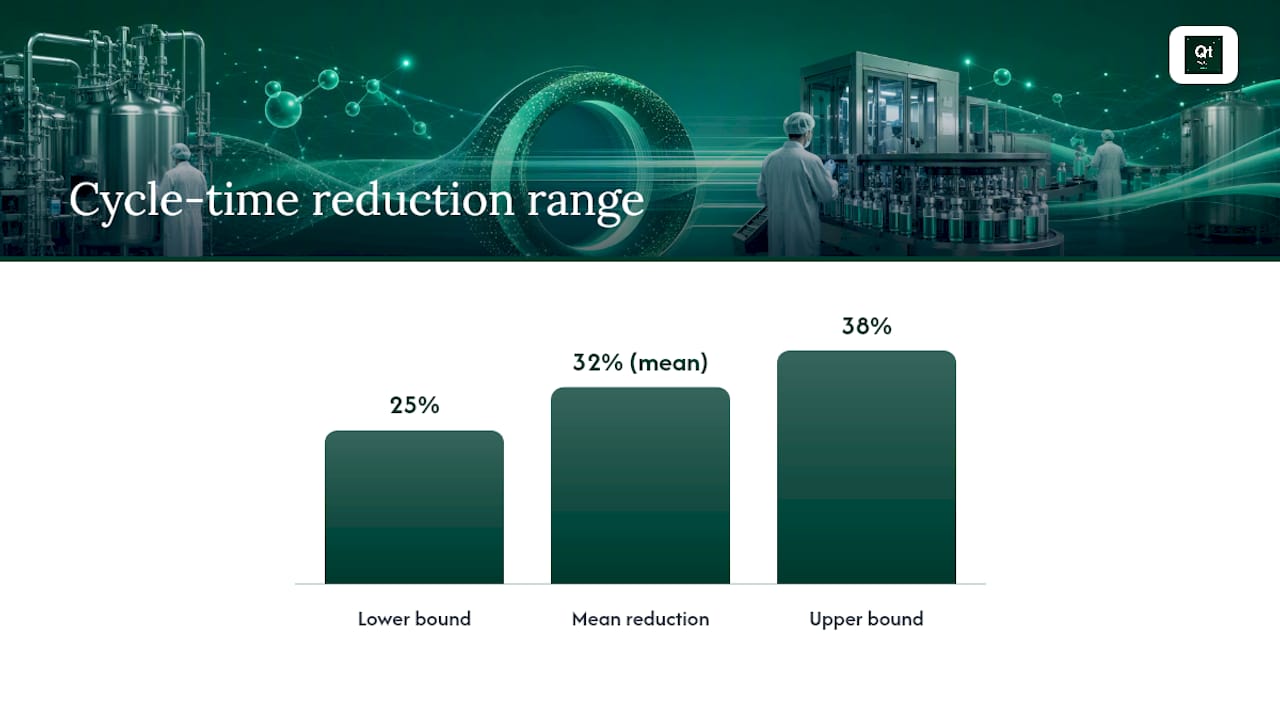
The payoff for doing this rigorously is measurable. Documented human-in-the-loop pilots in GMP validation environments report mean cycle-time reductions of 32%, with a 95% confidence interval of 25% to 38%, alongside improved inter-rater agreement on document review. That is not a marketing number. It is a published pilot result, and it depends entirely on the governance steps above being done properly first.
Implementation Checklist and a Realistic Timeline
Rolling out FS automation works best as a phased project, not a flip of a switch. Start with pre-work: inventory existing URS and FS assets, map the gaps between them, assign stakeholder roles, and write the intended-use scope before configuring anything.
Configuration and integration follow in parallel:
- Build the template library and controlled prompt governance structure.
- Configure the retrieval pipeline that pulls source requirements into the drafting process.
- Connect QMS and eTMF systems, along with identity and access controls.
- Define evidence export formats your quality system can actually ingest.
Pilot validation comes next, scoped to one document class with a defined test corpus, running UAT and measuring success against concrete metrics: authoring cycle time, reviewer hours per document, and error rate against the test corpus. A reference GxP documentation corpus built around paired URS and FS templates can accelerate this configuration step considerably.
Pro Tip: Measure reviewer hours per document, not just total cycle time. Teams often find authoring time drops fast, but reviewer fatigue creeps up if prompt governance is weak, quietly eating the gains you thought you'd banked.
Rollout should be phased by document class, with training scheduled ahead of each expansion and a measurement cadence that reviews cycle time and defect rates monthly for the first two quarters.
Audit Readiness: What Inspectors Actually Check
Inspectors evaluating a GenAI-assisted authoring workflow ask for more than a finished document. They want the full provenance trail behind it: prompt version, model identifier, the specific passages retrieved to ground the response, and every reviewer edit made before approval. This is a meaningfully expanded audit trail compared to traditional CSV documentation, and platforms designed for continuous compliance build this capture in from the start rather than bolting it on later.
A defensible inspection pack typically includes:
- The live requirements traceability matrix (RTM) linking URS, FS, and test evidence.
- Prompt qualification reports and the test corpus results behind them.
- UAT sign-offs and formal change-control history for any model updates.
- Immutable snapshots of retrieved passages and prompt versions, since foundation models can be updated or retired by their vendor without notice.
Continuous evidence capture changes the economics of audit prep entirely. Instead of a scramble to reconstruct six months of decisions the week before an inspection, the evidence already exists, timestamped and immutable. Retention planning still matters here: because a model version might no longer be accessible a year later, retaining reviewer rationale and retrieval snapshots is the only reliable way to reconstruct why a specific FS line reads the way it does.
Choosing and Integrating an FS Automation Approach
Selecting an approach means matching your regulatory obligations and operational complexity to a platform's actual automation maturity, not its marketing copy. A few criteria consistently separate a defensible system from a risky one.
- Lifecycle coverage. Does the platform handle URS through FS through DS as one connected chain, or does it stop at document generation and leave traceability to you?
- ALCOA+ proof, not ALCOA+ claims. Ask to see the actual check running at write-time, not a slide describing the principle.
- AI governance maturity. Prompt qualification, test corpora, and drift monitoring should be built in, not an add-on module you have to configure from scratch.
- Integration flexibility. Evidence needs to flow into your existing QMS, eTMF, or LIMS without a manual export step that reintroduces the errors you were trying to eliminate.
- Security posture and deployment model. SaaS deployments trade convenience for shared infrastructure, while validated private deployments give you tighter data residency control at the cost of more supplier oversight on your side.
Watch for red flags: audit trails that can't be exported in a format your quality system accepts, vague answers about model change control, or an "AI governance" pitch with no test corpus behind it. If a laboratory partner is part of your broader supply chain, comparing accreditation frameworks like AABB, CAP, and ISO 17025 is a useful parallel exercise in how standards bodies define defensible evidence.
Case Studies: What Successful FS Automation Looks Like in Practice
The clearest published signal on FS automation's real-world performance comes from human-in-the-loop pilots in paperless GMP validation settings, where structured AI assistance combined with mandatory human review produced a documented mean cycle-time reduction of 32%, within a 25% to 38% confidence band, and measurably higher agreement between reviewers on document quality. That range matters more than the headline number. It tells you the gains are consistent across different pilot conditions, not a one-off best case that only appears in a vendor's cherry-picked example.
The pattern behind successful rollouts tends to look similar regardless of company size. Teams that scope a pilot to a single document class, build a genuinely representative test corpus that includes adversarial and edge cases, and staff reviewers with enough dedicated time to actually review, rather than rubber-stamp, see the fastest path to measurable ROI. Teams that skip the test corpus step, or treat human review as a formality, tend to see slower adoption and more rework later, because the governance gaps surface during the first real audit instead of during the pilot.
The lesson for a validation manager evaluating this path is straightforward: the technology is not the hard part. The discipline around prompt governance, test corpus design, and reviewer accountability is what determines whether a pilot becomes a durable, inspection-ready program or a one-time efficiency story nobody can reproduce.
An Editorial Take: Where Pilots Actually Go Wrong
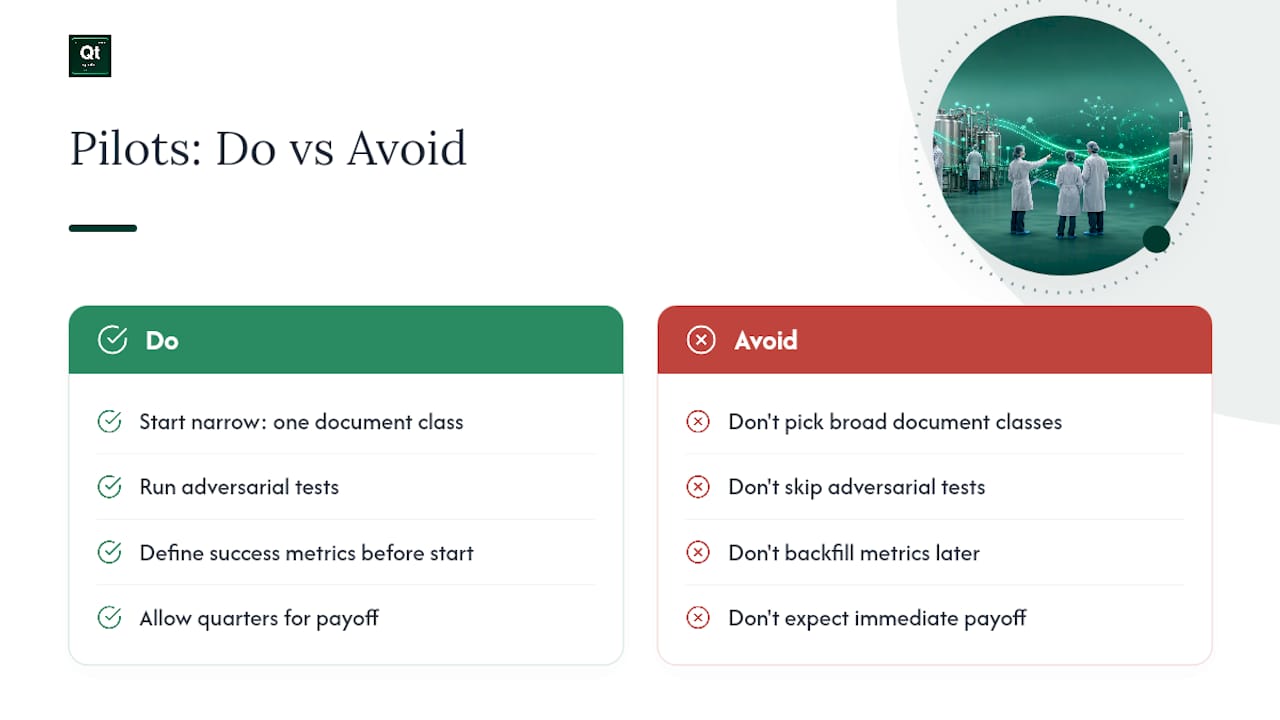
Most FS automation pilots fail for the same reason: teams pick a document class that's too broad, skip the adversarial test cases because they seem like extra work, and give reviewers no more time than they had before. The technology rarely breaks first. Governance does.
Start narrow. One document class, a test corpus that genuinely tries to break the system, and success metrics defined before day one, not backfilled to justify the spend. Expect the real payoff, in reviewer hours and cycle time, to show up over a couple of quarters, not the first week. Teams that treat governance as the product, not an afterthought bolted onto a fast authoring tool, are the ones still running the program a year later.
— Matt
What Qualitum Brings to an FS Automation Rollout
Qualitum is built for the exact gap this article walks through: authoring speed without sacrificing traceable evidence. Its multi-agent system drafts and cross-links FS content directly against your URS, with every record checked against ALCOA+ principles at write-time and again at review-time, so the audit trail exists before anyone asks for it.

Teams running Qualitum report over 70% time savings in authoring, with faster CSV cycles overall because the traceability matrix updates live instead of getting rebuilt manually before every inspection. The platform's Operate·AI and Validate·AI capabilities cover both continuous monitoring and validation authoring, and integration with existing quality management systems means evidence lands where your team already works, not in a separate silo you have to reconcile later.
If your validation program is still authoring FS documents by hand and reconstructing evidence before every audit, a working session is the fastest way to see what a governed pilot actually looks like. Book a working session with Qualitum to scope a pilot document class and see where your current FS authoring loses the most time.
Sources
- JAI | Building Regulatory Confidence with Human-in-the-Loop AI in Paperless GMP Validation
- Building audit-ready AI-driven compliance with CSV and VLM software
- Validating GenAI for Regulatory Document Authoring | Playbook
FAQ
What Is FS Automation in a Validation Context?
FS automation refers to agent-authored Functional Specifications generated within the validation lifecycle, with traceability maintained automatically from URS through FS to test evidence, rather than a manual document-drafting process.
How Much Time Can FS Automation Actually Save?
Published human-in-the-loop pilots in GMP validation report a mean cycle-time reduction of 32%, with a confidence interval of 25% to 38%, and some platforms like Qualitum reports significant time savings in authoring specifically, exceeding typical pilot reductions.
Does FS Automation Satisfy 21 CFR Part 11 and Annex 11?
FS automation can satisfy these frameworks when the system generates secure electronic records, maintains complete audit trails, and enforces controlled electronic signatures, but the platform's design, not the AI itself, determines compliance.
What's the Biggest Risk in Automating FS Authoring?
The biggest risk is weak prompt governance, meaning no defined test corpus, no prompt qualification record, and no drift monitoring, which leaves generated content ungrounded and difficult to defend during an inspection.
How Do You Validate the AI System Itself?
Validating an FS authoring AI requires an intended-use statement, model-risk tiering, a representative test corpus covering golden and adversarial cases, and documented change control for any model updates going forward.
Recommended
- CSV Automation for Validation Teams: A CSA-Aligned Roadmap
- CSA vs CSV for Validation Teams: What QA Needs to Know
- Risk-Based Validation: A Practical Guide for QA Leads
- Audit Readiness Checklist for Validation and QA Leaders
FAQ
What Is FS Automation in a Validation Context?
FS automation refers to agent-authored Functional Specifications generated within the validation lifecycle, with traceability maintained automatically from URS through FS to test evidence, rather than a manual document-drafting process.
How Much Time Can FS Automation Actually Save?
Published human-in-the-loop pilots in GMP validation report a mean cycle-time reduction of 32%, with a confidence interval of 25% to 38%, and some platforms like Qualitum reports significant time savings in authoring specifically, exceeding typical pilot reductions.
Does FS Automation Satisfy 21 CFR Part 11 and Annex 11?
FS automation can satisfy these frameworks when the system generates secure electronic records, maintains complete audit trails, and enforces controlled electronic signatures, but the platform's design, not the AI itself, determines compliance.
What's the Biggest Risk in Automating FS Authoring?
The biggest risk is weak prompt governance, meaning no defined test corpus, no prompt qualification record, and no drift monitoring, which leaves generated content ungrounded and difficult to defend during an inspection.
How Do You Validate the AI System Itself?
Validating an FS authoring AI requires an intended-use statement, model-risk tiering, a representative test corpus covering golden and adversarial cases, and documented change control for any model updates going forward.