CSV automation is the risk-based, CSA-aligned automation of computer system validation activities, requirements, risk assessments, test execution, and evidence capture, so validation evidence stays continuously audit-ready rather than assembled under deadline pressure. The recommended stance for 2026: automate aggressively for low- and medium-risk features, and preserve scripted rigor where patient safety or product quality is directly at stake.
Three regulatory anchors should frame every conversation with your steering committee:
- FDA's Computer Software Assurance (CSA) guidance and its tiered testing model
- EMA's draft revised Annex 11 and the emerging Annex 22 provisions on AI in regulated systems
- ISPE/GAMP's critical-thinking approach to scaling assurance activities to actual process risk
A recent PwC analysis found one client cut validation drafting time by 40% using GPT-enabled baseline scripts. That number is a floor, not a ceiling, for what disciplined automation can deliver.
Key Takeaways
CSV automation succeeds when risk-based testing tiers, live traceability, and ALCOA+ evidence controls work together under a CSA-aligned framework rather than as isolated tools.
| Point | Details |
|---|---|
| Match rigor to risk | Reserve full scripted, automated testing for features touching patient safety or product quality directly. |
| Clean requirements first | Standardize URS documents before onboarding any automation platform to avoid stalled traceability. |
| Automate evidence, not shortcuts | Live traceability and tamper-evident audit trails must exist at write-time, not assembled retroactively. |
| Pilot before scaling | Target one or two systems with defined acceptance metrics before expanding platform-wide. |
| Qualitum's approach | Validate·AI and Operate·AI apply ALCOA+ checks at write-time and review-time across the validation lifecycle. |
Table of Contents
- What Is CSV Automation, Exactly?
- Why Does CSV Automation Matter Now?
- What Should an Automated CSV Solution Actually Deliver?
- How Do You Decide Scripted vs Unscripted Testing?
- What Does a Realistic Implementation Roadmap Look Like?
- How Should Cybersecurity and Vendor Assessment Fit In?
- How Do You Prove Continuous Audit-Readiness?
- What Do Teams Deploying This Actually Find?
- Get Started With Qualitum
- Sources
- FAQ
What Is CSV Automation, Exactly?
CSV automation means automating the mechanics of validating computerized systems: turning user requirements into risk classifications, generating and executing tests against those risks, and capturing evidence that a system does what it's supposed to do. It does not mean scripting the manipulation of .csv data files. That distinction matters because the acronym overlap causes real confusion in vendor conversations, and a validation manager evaluating tools needs to be precise about what "automation" is being sold.
What counts as in-scope:
- Automated traceability linking requirements to risks to tests to evidence
- Automated or semi-automated test execution with electronic evidence capture
- Real-time audit trail generation as validation activities occur
- Automated vendor evidence ingestion (SBOMs, supplier test reports)
Out of scope: file format conversion, data pipeline scripting, or any tooling meant to process .csv files as a data format. CSV automation sits inside your existing quality management system, feeding your electronic document management system rather than replacing either. The validation lifecycle stages (URS, FS, DQ, IQ, OQ, PQ) stay intact. What changes is how much of the authoring, mapping, and evidence assembly happens without a human retyping the same information across five documents.
Why Does CSV Automation Matter Now?
FDA's CSA guidance replaces uniform, document-heavy CSV with a tiered testing taxonomy that scales rigor to risk, and it explicitly endorses leveraging electronic records and automated traceability as legitimate evidence rather than a shortcut around it. That's a meaningful shift from the older assumption that more paperwork equals more assurance.
EMA's draft revised Annex 11 pushes in the same direction. The draft language explicitly encourages effective tools to capture requirements and hold traceability, with Annex 22 extending similar thinking to AI-enabled systems. Regulators are no longer neutral on whether you use digital tools. They're telling you to.
ISPE frames this convergence as Validation 4.0, built on pillars that include digital-tool-based artifacts, risk-based assurance, optimized scripting rigor, automated test execution, and cybersecurity integration. Industry data backs the urgency: PwC found 60% of pharmaceutical executives ran GenAI pilots in 2024, with 32% already scaling GenAI across functions. Validation is not exempt from that momentum, and teams that treat CSA as optional paperwork reduction rather than a genuine methodology shift will fall behind peers who automate deliberately.
Key regulatory signals to bring to your next steering committee meeting:
- CSA's tiered testing model (no test, unscripted, ad hoc, scripted) formally replaces blanket scripted testing
- Annex 11's draft text names automated traceability tools directly
- ISPE ties automated test execution and cybersecurity integration together as a single Validation 4.0 pillar
What Should an Automated CSV Solution Actually Deliver?
Not every automation vendor solves the same problem, and a validation manager evaluating options needs a concrete checklist rather than marketing language. A defensible system delivers on five fronts.
Live traceability matrix. Requirements, risk ratings, tests, and evidence stay linked as a living object, not a spreadsheet frozen at the moment someone exported it. When a requirement changes, the matrix should show exactly which tests and evidence need review.
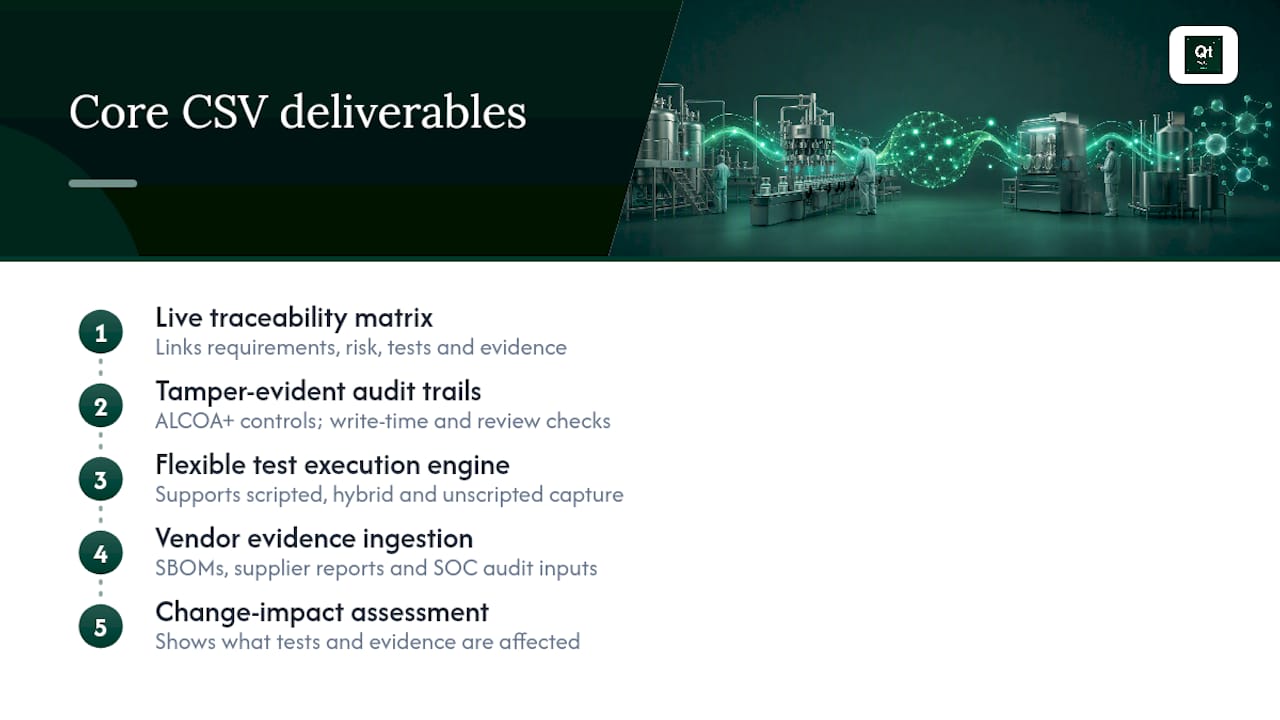
Tamper-evident audit trails with ALCOA+ built in. Data integrity checks that happen at write-time and again at review-time catch problems before they become findings, not after an auditor flags them. ALCOA+, attributable, legible, contemporaneous, original, accurate, plus complete, consistent, enduring, and available, should be a property of the record from the moment it's created.
A test execution engine that handles scripted, hybrid, and unscripted evidence capture. Rigid platforms that only support one testing tier force you back into manual workarounds for anything outside their assumptions.
Vendor evidence ingestion. SBOMs, supplier test reports, and SOC audit results should feed directly into your risk assessment rather than living in a separate vendor management folder nobody cross-references.
Documented change-impact assessment. When a system update lands, the platform should tell you what's affected, not leave you to guess.
Pro Tip: Before you evaluate any automation platform, audit your existing URS documents for consistency. Research from ISPE points to unstructured, ambiguous requirements as the single biggest predictor of automation projects that stall. Clean inputs before you automate, not after.
How Do You Decide Scripted vs Unscripted Testing?
CSA's core contribution isn't a new tool category. It's permission to stop treating every feature as equally risky. The decision comes down to one question: what happens if this feature fails silently?
Apply these rules when classifying a system or feature:
- No documented testing for low-risk administrative features with no direct patient safety or data integrity impact (a report label, a UI color scheme).
- Unscripted or ad hoc testing for configured, off-the-shelf functionality where the vendor already carries testing evidence, like a LIMS report filter using standard query logic.
- Limited scripted testing for features with moderate risk where a subset of critical paths needs documented, repeatable verification.
- Full scripted testing with automated execution for anything touching product quality or patient safety directly, such as a custom control algorithm governing a sterile fill line.
The LIMS filter and the sterile fill algorithm illustrate the split clearly. One is configured software drawing on a vendor's existing test coverage; unscripted testing with a short evidence note is proportionate. The other is custom code controlling a process where a defect could reach a patient; that demands full scripted testing, automated regression execution, and evidence that survives an inspector's scrutiny. Critical thinking, per ISPE, is the mechanism that tells you which tier applies, and documenting that reasoning is itself part of the evidence package, regardless of which tier you land on.
What Does a Realistic Implementation Roadmap Look Like?
Trying to automate every system at once is the most common way these projects die. A phased approach protects your credibility with the steering committee and produces defensible wins early.

Phase 0, discovery. Inventory your computerized systems and apply CSA-style risk classification to each. Deliverable: a risk map showing which systems are candidates for aggressive automation and which need scripted rigor preserved.
Phase 1, focused pilot. Pick one or two systems, not your entire portfolio, and set measurable objectives before you start.
Phase 2, iterative scaling. Extend automation to adjacent systems, build integrations with your QMS and EDMS, and start ingesting vendor evidence pipelines systematically rather than case by case.
Phase 3, governance. Update SOPs to reflect the new process, train validation staff and reviewers, and establish ongoing KPIs rather than treating the rollout as a one-time project.
Set pilot acceptance criteria before you start, not after. Reasonable targets include traceability coverage across 100% of in-scope requirements, complete automated audit trails, and drafting time reduction in the 40–60% range that industry case studies report for organizations applying CSA principles with automation.
Assign a RACI early: validation owns risk classification, QA signs off on evidence sufficiency, IT owns system integration, and a business sponsor owns the budget conversation. Ambiguity here is where pilots quietly stall.
How Should Cybersecurity and Vendor Assessment Fit In?
Automated validation is only as defensible as the vendor evidence behind it, and that means treating cybersecurity as part of validation rather than a parallel workstream. The shared responsibility model matters here: your supplier owes you evidence of how their software was built and tested; you owe your auditor evidence that you evaluated it.
Your vendor evidence checklist should include:
- A software bill of materials (SBOM) identifying third-party components and known vulnerabilities
- Supplier security risk assessments and threat models
- SOC 2 or equivalent reports covering the vendor's operational controls
- Supplier testing artifacts you can cite instead of duplicating their work
Automated SBOM ingestion and change-impact tooling cut unnecessary revalidation directly. When a vendor patches a component, an automated system flags whether that patch touches anything in your risk map, instead of triggering a blanket retest because nobody can quickly rule it out.
How Do You Prove Continuous Audit-Readiness?
Inspectors ask predictable questions: show me your traceability from requirement to test to evidence, show me who approved this change and when, show me your audit trail wasn't edited after the fact. Automated systems answer these on demand instead of triggering a scramble.
Track these KPIs on an ongoing basis:
- Percentage of tests executed through automated evidence capture versus manual
- Time required to produce a full validation summary for a given system
- Number of complete, audit-ready artifacts per system versus systems still carrying gaps
Pro Tip: Package your inspection-ready evidence as a concise executive summary paired with a live traceability export, not a folder of disconnected PDFs. Inspectors respond well to evidence they can trace in minutes rather than reconstruct from scratch.
Ongoing effectiveness monitoring, not a one-time validation event, is what separates teams that pass inspections calmly from teams that treat every audit like a fire drill.
What Do Teams Deploying This Actually Find?
Time savings show up first in drafting, not in testing rigor, which is where teams sometimes overcorrect. The most common failure I've seen described isn't automation itself, it's feeding a platform poorly structured requirements and then blaming the tool when traceability breaks. Vendor evidence gets under-scoped almost as often: teams automate test execution but still manually chase supplier documentation. Fix the inputs first. The efficiency gains follow.
Get Started With Qualitum
Qualitum is built for exactly the shift this article describes: risk-based, CSA-aligned automation that produces evidence you can defend under inspection, not just evidence you can produce faster. Validate·AI handles agent-authored URS, risk assessments, and test protocols with a live traceability matrix that updates as requirements change, and every record passes ALCOA+ checks at write-time and again at review-time. Operate·AI extends that same evidence discipline into ongoing operations, so audit-readiness doesn't decay between validation events.
A typical pilot targets one or two systems and measures drafting time reduction, traceability coverage, and audit trail completeness, the kinds of metrics steering committees look for before approving wider rollout. If you're ready to scope what that looks like for your systems, book a working session with the Qualitum team.
Sources
- How AI is transforming computer system validation: PwC
- Concluding Validation 4.0 with Computer Software Assurance (CSA) and Annex 11 Framework | Pharmaceutical Engineering
- FDA's Computer Software Assurance Guidance: Why CSA Is Replacing CSV (And What Your Team Must Do Now) | Aurora TIC
This article is general information, not a substitute for advice from a qualified doctor. Consult a qualified healthcare professional about your own circumstances before acting on anything here.
FAQ
Is CSV Automation the Same as CSA?
No. CSA is the FDA's risk-based guidance framework; CSV automation is the practical application of tools and platforms that execute CSA principles at scale, including Validate·AI-style agent-authored evidence.
Does Automating Validation Reduce Documentation Quality?
No, done correctly it improves it. Automated systems enforce ALCOA+ checks at write-time, which catches data integrity gaps before they reach a reviewer, rather than diluting rigor.
Which Systems Should I Automate First?
Start with one or two systems where requirements are already well-structured and risk is low to medium. High-risk, custom-coded systems should keep scripted testing intact during your pilot phase.
Can Automated Evidence Satisfy an FDA Inspector?
Yes, when it demonstrates clear traceability from requirement to risk to test to evidence. FDA's CSA guidance explicitly endorses electronic records and automated traceability as legitimate objective evidence.
How Long Does a CSV Automation Pilot Take?
A focused pilot on one or two systems typically runs six to ten weeks, covering risk classification, automated test execution, and evidence validation before scaling further.
Recommended
- Qualitum · The agentic validation platform for life sciences
- Cleaning validation · Validate·AI · Qualitum
- Book a working session · Qualitum
FAQ
Is CSV Automation the Same as CSA?
No. CSA is the FDA's risk-based guidance framework; CSV automation is the practical application of tools and platforms that execute CSA principles at scale, including Validate·AI-style agent-authored evidence.
Does Automating Validation Reduce Documentation Quality?
No, done correctly it improves it. Automated systems enforce ALCOA+ checks at write-time, which catches data integrity gaps before they reach a reviewer, rather than diluting rigor.
Which Systems Should I Automate First?
Start with one or two systems where requirements are already well-structured and risk is low to medium. High-risk, custom-coded systems should keep scripted testing intact during your pilot phase.
Can Automated Evidence Satisfy an FDA Inspector?
Yes, when it demonstrates clear traceability from requirement to risk to test to evidence. FDA's CSA guidance explicitly endorses electronic records and automated traceability as legitimate objective evidence.
How Long Does a CSV Automation Pilot Take?
A focused pilot on one or two systems typically runs six to ten weeks, covering risk classification, automated test execution, and evidence validation before scaling further.