An effective audit-trail design produces secure, system-generated, tamper-evident records that capture who changed what, when, and why. It enables review-by-exception rather than line-by-line reading, holds up under 21 CFR Part 11 and EU Annex 11 scrutiny, and stays exportable for inspection on demand. Everything else in audit trail design, from timestamp architecture to reviewer sign-off, exists to make that verdict operational.
TL;DR:
>
- Audit trails must capture seven key elements, including user ID, server-generated timestamps, action type, and reason for change, to meet industry and regulatory standards.
- Timestamps should be synchronized through NTP and generated on the server to prevent discrepancies caused by client clock drift or time zone issues.
- Review efforts should focus on high-criticality GxP data with automated filters and risk-based sampling, rather than line-by-line manual review of all entries.
- Validation protocols must test event capture, timestamp accuracy, tamper-evidence mechanisms, and export completeness, with ongoing revalidation after system updates.
- Integration with the broader quality system, clear SOPs, and traceability linking audit trail evidence to validation records enhance inspection readiness and defensibility.
Table of Contents
- Audit Trail Design Elements Inspectors Look For First
- Data Audit Trails vs. System Logs: What Actually Needs Review
- Building a Risk-Based Audit Trail Review Program
- Validation Test Cases That Prove Your Audit Trail Works
- Writing Audit Trail Requirements Into Your URS
- SOP Language: Who Reviews, When, and How That Gets Proven
- Architecture and Storage Choices That Hold Up Under Audit
- Where Audit Trail Programs Break Down
- Connecting Audit Trails to the Rest of Your Quality System
- Automated Tools for Audit Trail Review
- What Actually Separates a Compliant Audit Trail From a Defensible One
- Turning Audit Trail Design Into Inspection-Ready Evidence
- Sources
- FAQ
Audit Trail Design Elements Inspectors Look For First
Inspectors reading an audit trail want to answer one question fast: what changed, and can you prove it. That means the underlying data model matters more than the interface sitting on top of it. A defensible audit trail captures seven elements for every recorded event: the user ID, a server-generated timestamp with time zone, the action type, the record identifier, the original value, the new value, and a reason for change where the action warrants it.
Timestamps deserve their own scrutiny. Client-side clocks drift, get reset, or sit in the wrong time zone, so Part 11 audit trail requirements call for server-generated timestamps synchronized through Network Time Protocol. A workstation clock is not evidence. A server clock synced against a trusted NTP source is.
Tamper-evidence is the second pillar of designing audit logs correctly. Cryptographic hash chains, most commonly SHA-256, let a system prove that no entry has been altered after the fact, and inspectors increasingly ask how that mechanism gets verified during qualification rather than just taking a vendor's word for it.
Design must also guarantee the trail cannot go dark. Key controls include:
- Audit trails enabled at installation, not left as an optional configuration step
- No administrative path that silently disables or pauses logging
- Admin-level actions, including configuration changes, logged with the same rigor as data edits
- Audit records stored separately from the primary data table, never embedded in the same editable file
Data Audit Trails vs. System Logs: What Actually Needs Review
Not every log in a validated system is a GxP audit trail, and treating them as equivalent is how review programs collapse under their own weight. A data audit trail records changes to GxP-relevant records: results, batch data, signatures, master data. A system or technical log records infrastructure events: login attempts, server restarts, network errors, routine background processes. Industry guidance from ISPE's Pharmaceutical Engineering is explicit that these two categories need different review strategies, and that reviewing system logs as though they were GxP trails produces volumes no team can sustain.
Deciding what belongs in routine review comes down to three criteria:
- Intended use. Does the log capture a change to a record used for a regulatory decision, a release, or a submission?
- Risk impact. Would an undetected change here affect patient safety, product quality, or data reliability?
- Detectability. Would this change go unnoticed through any other control, or is the audit trail the only safety net?
Admin and system logs still need attention, just on a different cadence. Periodic system checks, rather than continuous review, are the right mechanism for confirming server health, patch status, and access-control changes. The exception is privileged-user activity that touches GxP data directly, such as a database administrator editing a result table. That activity has to surface in the same review context as ordinary user changes, not get buried in a separate technical log a reviewer never opens.
Pro Tip: Write the scope decision into your audit trail SOP explicitly, system by system. An inspector who asks "why isn't this log reviewed" wants to see a documented risk rationale, not an improvised answer.
Building a Risk-Based Audit Trail Review Program
Reviewing every audit trail entry line by line does not scale, and inspectors do not expect it. What they expect is a documented, risk-based approach to deciding what gets reviewed, how often, and by whom. Start with an ICH Q9-style risk assessment that classifies data by criticality: results that support batch release sit at the top; routine instrument calibration logs sit lower.
That classification drives review-by-exception design. Rather than reading every entry, build validated filters and keyword flags that surface the changes that matter: deleted results, modified specifications, backdated entries, or repeated rejections tied to one user. A harmonized approach to risk-based ATR recommends prioritizing high-impact GxP data for review and leaning on technical prevention controls, like permission restrictions that block deletion outright, wherever they can substitute for manual review.
Frequency should track risk, not calendar convenience. High-criticality data might warrant review with every batch record; lower-risk data might warrant monthly or quarterly sampling.
Reviewer evidence is what turns the process into something defensible:
- A signed reviewer conclusion, not just a checkbox
- A timestamp for when the review occurred
- A direct link between the conclusion and the specific records reviewed
- Documented escalation if the reviewer flags an anomaly
Categories worth prioritizing every time include deleted or voided results, changes made outside normal working hours, and repeated edits to the same field by the same user.
Validation Test Cases That Prove Your Audit Trail Works
An audit trail that has never been formally challenged is a claim, not evidence. IQ, OQ, and PQ protocols need test cases that specifically exercise audit-trail behavior, not just general system function.
- Event capture testing. Create, modify, and delete a record, then confirm every action appears in the trail with the correct user ID, timestamp, old value, and new value.
- Timestamp accuracy testing. Verify the recorded timestamp matches the server clock, not the workstation clock, and confirm NTP synchronization is active.
- Tamper-evidence verification. Attempt to alter an existing entry and confirm the hash chain, a mechanism inspectors now routinely ask about, flags the discrepancy.
- Export completeness testing. Export the audit trail for a defined date range and confirm every logged event is present and human-readable in the output.
- Reviewer evidence capture testing. Confirm the system records that a review occurred, including the reviewer's identity and conclusion.
Protocols should state expected pass/fail criteria in advance, not just observed results after the fact. Every software update, patch, or configuration change needs regression testing against these same cases under change control. Skipping that step after a minor patch is one of the more common gaps inspectors flag during data-integrity audits.
Writing Audit Trail Requirements Into Your URS
Procurement is where audit-trail failures get baked in or avoided. A vague URS produces a vague system, so the requirements need to be explicit and testable rather than aspirational.
Core URS bullets should specify:
- Capture of all seven audit-trail elements: user, timestamp, action, record ID, old value, new value, reason for change
- Immutable, database-level storage separate from primary data tables
- NTP-synchronized, server-side timestamps
- A documented tamper-evidence mechanism, such as cryptographic hashing
- Audit trails enabled by default at installation, with no administrative disable function
- Native filtering, keyword search, and flagging to support review-by-exception
- Export in a readable, copyable format suitable for inspector requests
Suppliers should deliver executed IQ/OQ/PQ documentation covering audit-trail behavior specifically, not just general functional testing. Contract language should also address retention periods, deployment model (including whether the platform runs on the customer's own infrastructure with zero data egress), and export support during inspections.
Pro Tip: Ask suppliers to demonstrate the review-by-exception filters live during a demo, using a dataset with deliberately hidden anomalies. A polished slide deck says nothing about whether the filter actually catches a backdated entry.
SOP Language: Who Reviews, When, and How That Gets Proven
A validated system with no SOP behind it is half a control. The SOP is what tells an inspector, and your own staff, exactly who is accountable for audit trail management day to day.
At minimum, the SOP should name the reviewer role by title, not by individual name, and specify the review frequency tied to the risk classification established earlier. It should define what "review" concretely means: opening the filtered audit trail report, checking flagged entries against source records, and documenting a conclusion, not just glancing at a dashboard.
Evidence of review has to be captured somewhere durable. That typically means a signed statement, electronic or wet-ink depending on your system, tied to a timestamp and a reference to the specific record set reviewed. Annex 11 guidance is direct on this point: audit trails must be enabled and retained, and the review process itself needs documented conclusions, not an assumption that review happened because no one complained.
The SOP should also cover escalation. If a reviewer finds an anomaly, what happens next: a deviation, a CAPA, a hold on the batch. Leaving that step undefined is one of the more common findings in warning letters, because reviewers freeze when the procedure does not tell them what to do with a flag they were trained to catch.
Architecture and Storage Choices That Hold Up Under Audit
Where you store the audit trail matters as much as what it contains. Database-monitored logging, where the trail lives in a protected table separate from the primary data, holds up far better than file-embedded entries that a sufficiently privileged user could theoretically edit alongside the record itself.
Separating GxP data trails from system/technical logs at the architecture level, not just the review level, keeps storage manageable and keeps the two data types from ever getting confused during an inspection walkthrough. Technology Networks' coverage of laboratory data integrity recommends eliminating any backdoor path that would let a privileged account edit records without triggering the same audit capture applied to standard users.
A layered architecture generally works best: a capture layer that intercepts every create, modify, and delete event; a storage layer that holds records immutably, ideally with hash-chain protection; and a presentation layer that supports filtering and export without ever exposing a path to edit the underlying entries. Retention policy should match your predicate rule requirements, which for many GxP records means years, not months, and the storage design has to support that timeline without degrading query performance when someone eventually needs to search it.
Where Audit Trail Programs Break Down
Most audit-trail failures are not exotic. They are the same handful of gaps repeated across companies and inspections.
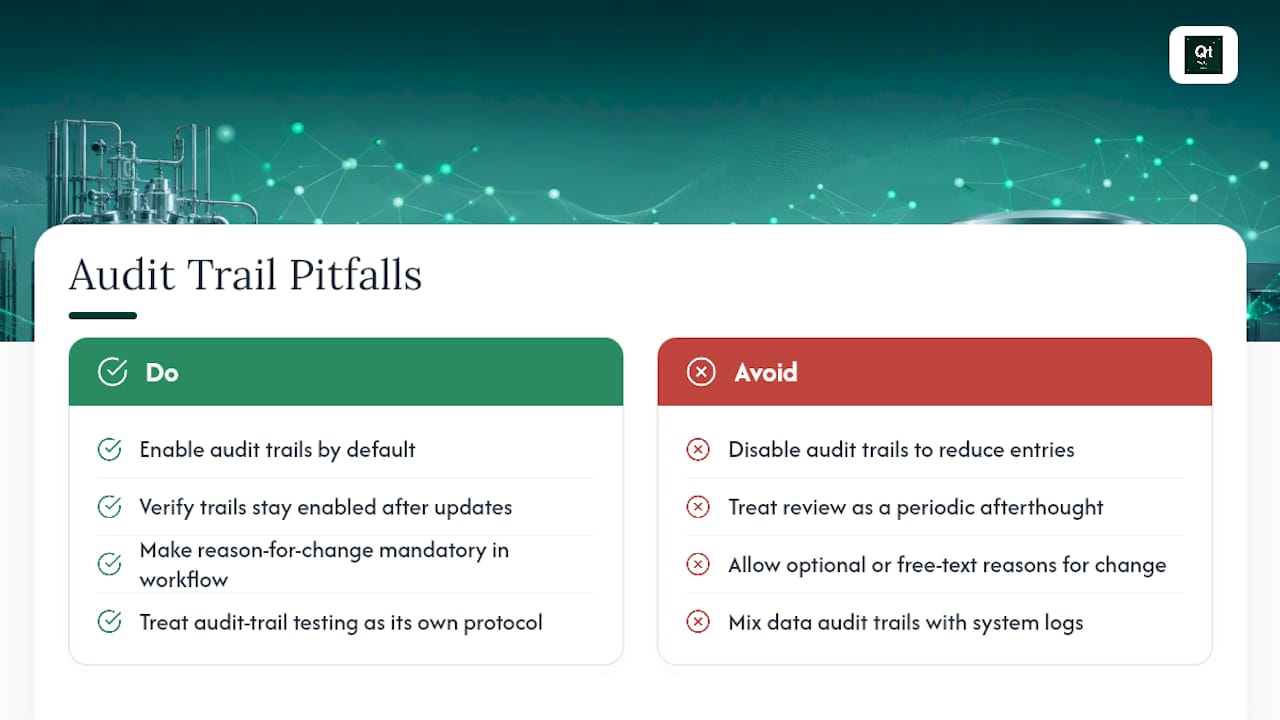
The most common is disabling audit trails, deliberately or through a configuration default, because someone found the volume of entries inconvenient. A close second is treating audit trail review as a periodic afterthought, a "fire drill before an audit" scramble rather than a scheduled, documented activity with defined ownership.
Another frequent gap is inconsistent reason-for-change capture. Some systems allow free-text reasons that never get reviewed for adequacy, while others make the field optional when it should be mandatory for any change to a released record. A related failure is mixing data audit trails with system logs in a single undifferentiated feed, which ISPE's guidance identifies as a direct cause of unmanageable review backlogs and missed anomalies.
Weak validation evidence is the quieter risk. Teams sometimes assume that because the vendor built in an audit trail feature, it does not need dedicated IQ/OQ/PQ testing. That assumption fails the moment an inspector asks for the protocol that proves timestamp accuracy or hash-chain integrity, and there isn't one.
Avoiding these pitfalls comes down to three habits: enable trails by default and verify they stay enabled after every update, build reason-for-change into the workflow rather than the honor system, and treat audit trail testing as its own protocol line item rather than a side effect of general functional qualification.
Connecting Audit Trails to the Rest of Your Quality System
An audit trail that lives in isolation from the rest of the quality system loses most of its value. The real payoff comes from linking audit-trail evidence to the artifacts that already govern your validation and quality operations.
Traceability is the clearest connection point. A live traceability matrix that ties requirements to test cases to audit-trail evidence gives inspectors a single thread to pull, rather than forcing them to reconstruct the link manually across separate documents. Deviation and CAPA systems are another natural integration: when a review flags an anomaly, that flag should route directly into the CAPA workflow instead of sitting in an audit-trail report that nobody escalates.
Integration with the quality management system also matters for signatures and approvals. If your QMS already manages electronic signatures under Part 11, the audit trail should reference those same signature events rather than maintaining a parallel, disconnected log. And for organizations running multiple validated systems, LIMS, MES, ERP, a consistent audit-trail data model across platforms makes cross-system investigations far faster, because reviewers are not relearning a new format every time they move from one system to another.
The goal is a single, connected evidence chain: requirement, test, execution, deviation, audit-trail entry, review conclusion. Each piece should be able to point to the next without a reviewer manually stitching them together after the fact.
Automated Tools for Audit Trail Review
Manual audit-trail review does not scale past a certain data volume, which is why automated review tools have become standard in mature quality programs rather than a nice-to-have.
The core benefit of automation is consistent application of review-by-exception logic. A validated filter applies the same triage rules every time, whether it is reviewed on a Monday morning or the Friday before a holiday, removing the variability that comes from a tired reviewer scanning a long report. Automated flagging also catches patterns a human reviewer would need real effort to spot manually, such as the same user repeatedly editing the same field just below a threshold that would trigger a deviation.
Automated tools also generate the review evidence itself: a signed conclusion, a timestamp, and a direct link to the flagged records, satisfying the documentation requirement without adding manual paperwork on top of the review. That matters because ISPE's practitioner guidance points to poor translation of regulatory principle into everyday procedure, not the absence of regulation, as the persistent gap in most audit-trail programs. Tools that build the SOP's review-and-document steps directly into the workflow close that gap structurally instead of relying on reviewer discipline alone.
The trade-off is validation burden: an automated review tool still needs its own qualification evidence proving the filters and flags behave as intended, which is exactly the kind of test case covered earlier in this guide.
What Actually Separates a Compliant Audit Trail From a Defensible One
Most audit trail programs pass validation on paper and still fall apart in front of an inspector, and the gap almost always sits between "compliant" and "defensible." Compliant means the fields exist. Defensible means a reviewer can pull up any flagged entry and explain, in one sentence, why it was or was not a problem.
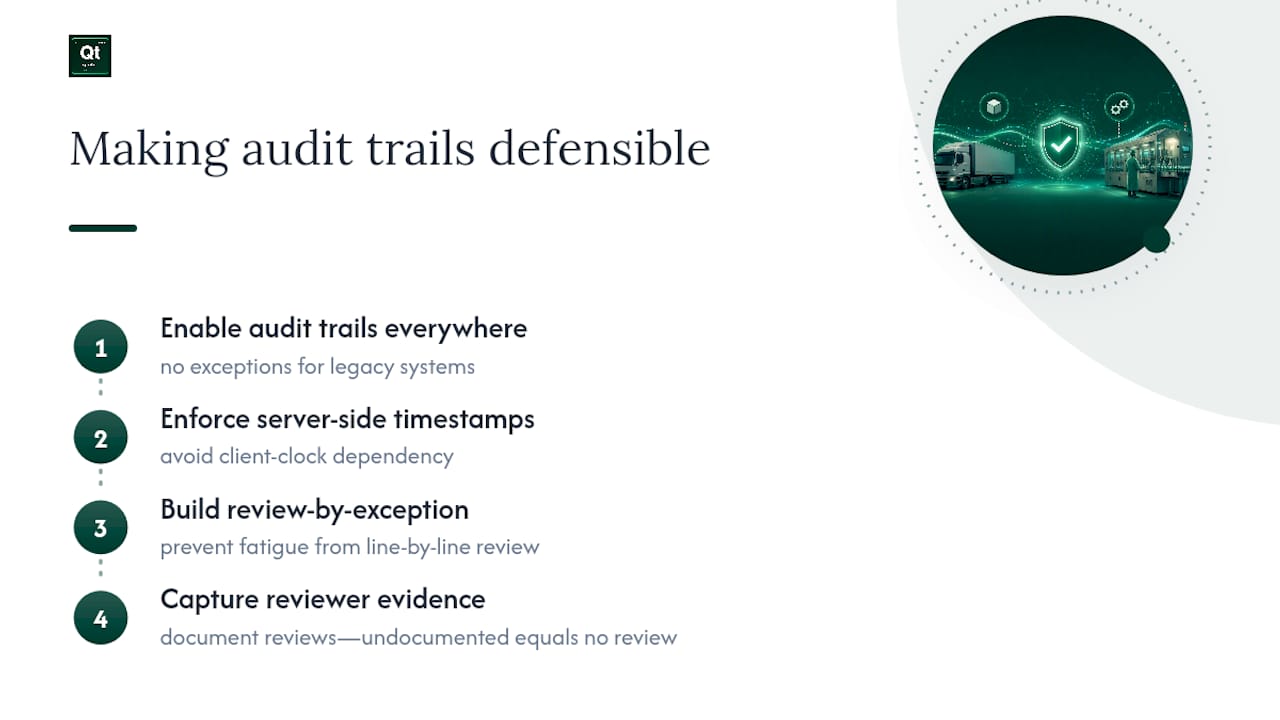
The practical priority order I would give any QA or validation lead building this out: enable audit trails everywhere first, with no exceptions for legacy systems that feel too old to bother. Enforce server-side timestamps second, because a client-clock dependency is the single easiest thing for an inspector to disprove in the room. Build review-by-exception third, because manual line-by-line review is where good programs quietly die from fatigue. Capture reviewer evidence last but never skip it, because an undocumented review is indistinguishable from no review at all during an inspection.
What gets underestimated is how much of this is a documentation and workflow problem, not a technology problem. Qualitum built its platform around exactly that gap: a multi-agent system that removes the manual authoring burden behind validation records, and every record checked against ALCOA+ principles at both write-time and review-time, so the evidence trail exists by construction rather than by reviewer discipline alone.
— Matt
Turning Audit Trail Design Into Inspection-Ready Evidence
There are platforms available that automate the evidence chain required for validation, reducing reliance on manual SOPs and reviews by authorship of evidence directly and applying ALCOA+ principles at multiple stages.

This approach can support significant time savings in authoring by generating defensible, traceable documentation as a default output. Some platforms offer validated private deployment options to keep audit-trail data and validation evidence inside the customer's infrastructure with no forced data egress, and provide exports built for inspection.
If your team is specifying audit-trail requirements for a new system, or trying to close the gap between what your current SOPs promise and what your validation evidence actually proves, explore Validate·AI and Operate·AI or book a working session to see how the platform handles review-by-exception evidence for your specific systems.
Sources
For further reading on the regulatory basis behind this guide: FDA's Part 11 scope and application guidance, ISPE's Pharmaceutical Engineering on audit trail review practice, Annex 11 data integrity guidance, and PharmTech's risk-based ATR framework. For a broader compliance checklist, see RJR Worldwide's USP-grade compliance guide.
- Audit trail review: regulation and practice in GxP environments — ISPE Pharmaceutical Engineering
- Annex 11 / data integrity guidance (source highlight)
FAQ
What Are the Required Elements of an Audit Trail?
A compliant audit trail captures the user ID, a server-generated timestamp, the action taken, the record identifier, the original value, the new value, and a reason for change where applicable. These seven elements are what Part 11 guidance and industry sources treat as the baseline data model for any GxP system.
How Often Should Audit Trails Be Reviewed?
Review frequency should track data criticality, not a fixed calendar rule. High-impact GxP data tied to batch release often needs review with every record, while lower-risk data can follow a documented sampling schedule, an approach PharmTech's risk-based ATR framework recommends over blanket manual review.
Do System Logs Need the Same Review as Data Audit Trails?
No. System and technical logs, like server restarts or login attempts, typically warrant periodic checks rather than routine review, while GxP data audit trails need scheduled, documented review. ISPE's guidance warns that treating both categories the same way produces unmanageable review volumes.
What Validation Testing Does an Audit Trail Need?
Audit trails need dedicated IQ/OQ/PQ test cases covering event capture, server-side timestamp accuracy, tamper-evidence verification, export completeness, and reviewer evidence capture. These tests should run again under change control after any software update, not just at initial qualification.
Can Qualitum Help With Audit Trail Design and Review?
Yes. Qualitum's platform checks every validation record against ALCOA+ principles at write-time and review-time, using an agent-based system designed to produce traceable, defensible evidence for audit trail requirements. Details on its capabilities are available on the Validate·AI platform page.
Recommended
- Audit Trail Management: Four Layer Architecture for Regulated Teams
- Audit Trail Review: Inspection-Ready Guide for QA Teams
- Part 11 Compliance: Inspection-Ready Checklist for QA Teams
- Data Integrity by Design: A Pharma QA Playbook
FAQ
What Are the Required Elements of an Audit Trail?
A compliant audit trail captures the user ID, a server-generated timestamp, the action taken, the record identifier, the original value, the new value, and a reason for change where applicable. These seven elements are what Part 11 guidance and industry sources treat as the baseline data model for any GxP system.
How Often Should Audit Trails Be Reviewed?
Review frequency should track data criticality, not a fixed calendar rule. High-impact GxP data tied to batch release often needs review with every record, while lower-risk data can follow a documented sampling schedule, an approach PharmTech's risk-based ATR framework recommends over blanket manual review.
Do System Logs Need the Same Review as Data Audit Trails?
No. System and technical logs, like server restarts or login attempts, typically warrant periodic checks rather than routine review, while GxP data audit trails need scheduled, documented review. ISPE's guidance warns that treating both categories the same way produces unmanageable review volumes.
What Validation Testing Does an Audit Trail Need?
Audit trails need dedicated IQ/OQ/PQ test cases covering event capture, server-side timestamp accuracy, tamper-evidence verification, export completeness, and reviewer evidence capture. These tests should run again under change control after any software update, not just at initial qualification.
Can Qualitum Help With Audit Trail Design and Review?
Yes. Qualitum's platform checks every validation record against ALCOA+ principles at write-time and review-time, using an agent-based system designed to produce traceable, defensible evidence for audit trail requirements. Details on its capabilities are available on the Validate·AI platform page.