Annex 11 requires that every computerized system used in GMP activities be validated and kept in a validated state through a risk-based lifecycle, with ALCOA+ data integrity, audit trails, supplier oversight, and secure access controls documented throughout. If you manage quality or validation for a regulated manufacturer, the immediate action item is straightforward: confirm each system's validated status and assemble the evidence an inspector would ask for tomorrow, not the evidence you'd need three weeks to build.
TL;DR:
>
- Validation must be maintained throughout a system’s lifecycle, with evidence directly linking requirements to test results and periodic reviews to ensure ongoing compliance.
- Data migrations require validation of both format and meaning, with reconciliation testing to confirm data integrity rather than simple format checks.
- Audit trails must be real-time, immutable, and capable of exporting readable data, with review frequencies based on system criticality rather than fixed schedules.
- Outsourcing does not absolve responsibility; regulated users must have access to validation documentation, audit rights, and ongoing oversight, especially for cloud systems.
- Automated validation platforms can reduce manual effort and support continuous, defensible records, but organizations still own validation decisions and must ensure vendor tools support full inspection access.
Table of Contents
- What Is Annex 11 and What Does It Cover?
- Validation and Lifecycle Management: What Inspectors Actually Expect
- Data Integrity, Audit Trails, and How Often to Review Them
- Supplier, Vendor, and Cloud Service Oversight
- Security, Signatures, Backups, and Decommissioning
- Your Annex 11 Compliance Checklist for Right Now
- How Automated Validation Platforms Cut the Annex 11 Workload
- An Inspector Readiness Perspective from QA
- Get Annex 11 Evidence Without the Manual Authoring Burden
- Sources
- FAQ
What Is Annex 11 and What Does It Cover?
Annex 11 is the EU GMP rulebook for computerized systems, and it applies broadly. It covers manufacturing execution systems, laboratory information systems, clinical trial data-processing tools, and any electronic system that touches a GMP decision, not just the obvious production line software.
Three principles anchor everything else in the annex:
- A system must stay in a validated state across its entire life, not just at go-live.
- Introducing or changing a computerized system can never increase process risk compared to the manual or prior method it replaces.
- Quality Risk Management (QRM) determines how much validation rigor a given system needs, based on its GMP impact rather than a one-size-fits-all checklist.
Getting scope right starts with a clear user requirements specification and a traceability chain linking those requirements to test evidence. Annex 11 vs Part 11 comparisons often miss this: Part 11 focuses narrowly on electronic records and signatures, while Annex 11 governs the whole computerized system lifecycle, including supplier oversight and risk management.
Validation and Lifecycle Management: What Inspectors Actually Expect
Annex 11 compliance checklists tend to overpromise and underspecify. Inspectors don't want a binder full of templates. They want a defensible, traceable story that connects requirements to evidence.
That story has three parts:
- Requirements and design documentation. A user requirements specification (URS), functional specification, and system description that describe what the system does and why, with traceability tying each requirement to a corresponding test.
- Execution evidence. Test plans and executed test scripts, deviation records tied to root cause and resolution, and formal release evidence showing the system was approved for GMP use before it went live.
- Periodic review documentation. Annex 11 expects revisiting validation status on a defined schedule. That review should confirm the system's validated status alongside deviations, training records, security posture, and upgrade history, since any of those can quietly erode a validated state without triggering a formal change control.
Data migrations deserve particular attention here. When you move data between systems, validation must demonstrate that both the format and the meaning of that data survived the move, not just that the fields populated correctly. Reconciliation testing, not just format checks, is what separates a defensible migration from a risky assumption. This is also where a risk-based approach to computerized system validation earns its keep, scaling rigor to the system's actual GMP impact instead of applying maximum effort everywhere.
Data Integrity, Audit Trails, and How Often to Review Them
ALCOA+ is not an abstract acronym QA teams recite in training decks. Every letter maps directly to an Annex 11 obligation: data must be Attributable to a specific user, Legible, Contemporaneous, Original (or a verified true copy), and Accurate, with the "plus" adding complete, consistent, enduring, and available.
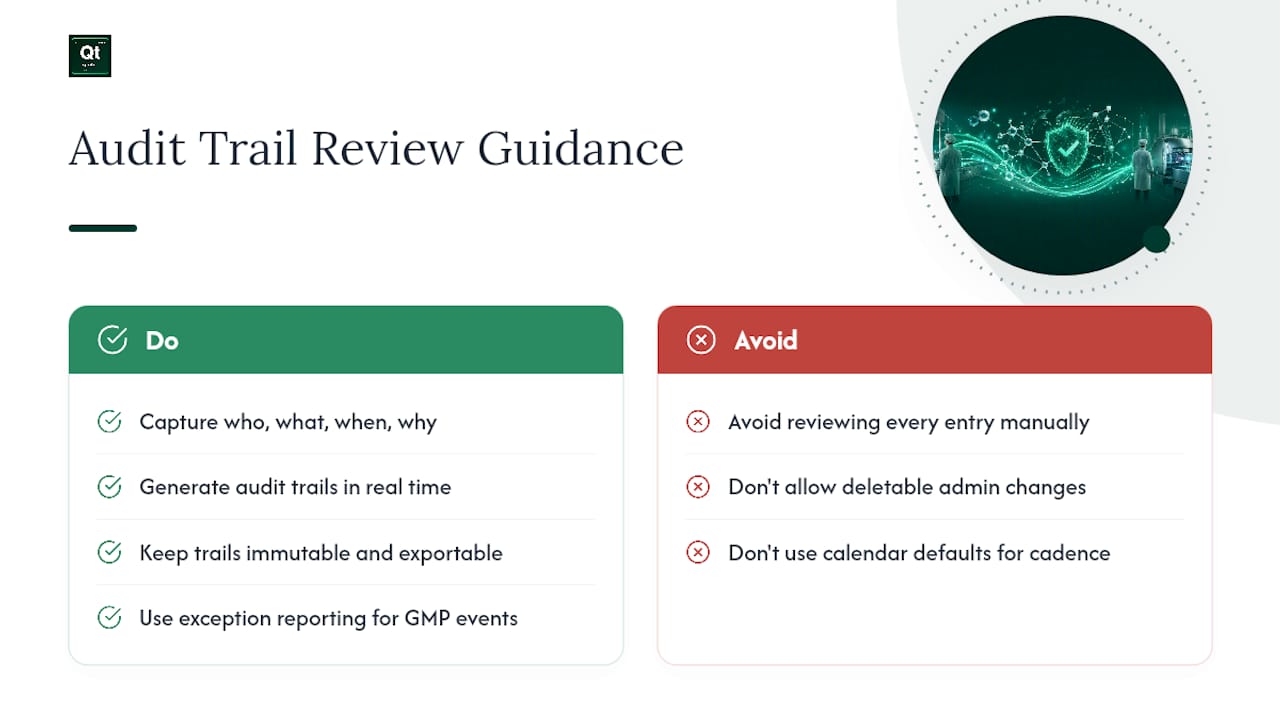
Audit trails are where that mapping gets tested in practice. A compliant audit trail captures who made a change, what changed, when it happened, and ideally why, and it has to be generated in real time rather than reconstructed after the fact. Audit-trail data must also be immutable and exportable into a readable format for inspection, and any administrative action that touches audit-trail configuration should itself leave an entry nobody can quietly delete.
Reviewing every audit-trail entry line by line isn't realistic for high-volume systems, and it isn't what regulators expect. A validated exception-reporting approach, targeting GMP-relevant activities and flagging anomalies rather than scanning every keystroke, satisfies the intent without drowning your team. For a deeper operational model, the four-layer audit trail architecture breaks this down by system criticality.
Pro Tip: Set your audit-trail review frequency based on system criticality, not a calendar default. A batch record system reviewed monthly needs a tighter cadence than a low-risk logging tool reviewed quarterly.
Supplier, Vendor, and Cloud Service Oversight
Outsourcing a system doesn't outsource accountability. Regulators hold the regulated user, not the vendor, responsible for demonstrating a system is validated and controlled, even when the vendor performed the qualification work itself.
That responsibility has to be written into contracts, not assumed:
- Access to validation documentation on demand, not on a vendor's schedule or at additional cost.
- Audit and inspection rights, including the ability to bring a regulator or third-party auditor into scope if needed.
- Evidence retention commitments that outlast the contract term, covering the full record retention period your product requires.
The EMA's notice to sponsors is unambiguous on this point: if a vendor won't grant inspection access or won't produce validation evidence, that system should not be used for clinical trial data or other critical GMP activities. Deciding whether to run a full vendor audit or accept vendor-supplied documentation should track the system's GMP criticality, the same QRM logic that governs everything else in Annex 11.
Security, Signatures, Backups, and Decommissioning
Confidentiality, integrity, and availability of GxP data rest on a handful of controls that inspectors check almost reflexively. Get these wrong and every other compliance effort is built on sand.
Access and identity controls should include:
- Multi-factor authentication for privileged accounts
- Least-privilege access assignments reviewed on a fixed schedule
- Segregation of duties between system administrators and record approvers
- Electronic signatures that are permanently linked to their record and timestamped at the moment of signing, not editable after the fact
Backup and end-of-life practices matter just as much. A backup strategy is only as good as its last successful restore test, and archived records need to stay both readable and attributable for their full retention period. Decommissioning a system safely means migrating or archiving its GxP data with the same rigor you'd apply to a live migration, not just switching it off and hoping the data survives in a forgotten export.
Your Annex 11 Compliance Checklist for Right Now
Most Annex 11 compliance gaps surface only under inspection pressure, which is exactly the wrong time to find them. Building a standing package before that happens beats a fire drill before an audit every time.
- Inventory and classify every computerized system touching GMP data, ranking each by criticality using your QRM framework.
- Assemble the evidence set per system: URS, system description, executed test evidence, open and closed deviation logs, and current supplier contracts with access clauses intact.
- Verify backups with an actual restore test, not a log entry confirming a backup job ran.
- Set and document your audit-trail review cadence by system criticality, and calendar the next periodic review before the current one closes out.
Annex 11 guidance continues to evolve. Ongoing stakeholder consultation on the annex's revision signals tighter vendor access requirements and clearer audit-trail expectations for cloud and AI-driven systems, so a checklist built today should assume oversight only gets stricter, not looser.
How Automated Validation Platforms Cut the Annex 11 Workload
Manual validation authoring is where most Annex 11 compliance programs quietly bleed time. Writing URS documents, tracing requirements to tests, and reconstructing audit-trail review logs by hand is slow, error-prone, and the first thing to slip when deadlines tighten.
Platforms built specifically for this problem change the math:
- Every record gets an ALCOA+ check at both write-time and review-time, catching integrity gaps before they become inspection findings rather than after.
- Agent-authored validation artifacts, from URS through OQ and PQ, generate a live traceability matrix instead of a static document nobody updates.
- Inspector-ready evidence stays assembled continuously, rather than reconstructed under deadline pressure.
Pro Tip: Automation speeds authoring, but it doesn't replace your risk-based validation decisions. You still own the call on system criticality, and you still need contractual assurance that any platform you use supports full inspection access to its own validation evidence.
An Inspector Readiness Perspective from QA
The same three failure points come up in almost every rough inspection: missing validation evidence for a system everyone assumed was "handled," a vendor that can't produce documentation on request, and an audit trail nobody can prove was actually reviewed on schedule.
The fix isn't more paperwork. It's prioritizing critical systems first, documenting the risk rationale behind that prioritization, and keeping one regulator-ready package per critical system, updated continuously instead of assembled the week before an inspection.
— Matt
Get Annex 11 Evidence Without the Manual Authoring Burden
Some automated validation platforms address common challenges in Annex 11 compliance by turning validation from a manual documentation exercise into a continuously maintained, defensible record set. Such platforms may author validation deliverables directly and support ALCOA+ checks at write-time and review-time.

The platform runs as a private deployment inside your own infrastructure, so there's no data egress and no dependency on a specific LLM vendor. That matters directly for the supplier-oversight obligations covered above: human signatures stay authoritative, and the traceability matrix updates live instead of at the next audit cycle. Explore how Validate·AI and Operate·AI handle the validation lifecycle, or book a working session to see how it maps to your current systems inventory before your next inspection window.
Sources
Annex 11 compliance decisions should trace back to primary regulatory text, not secondhand summaries.
- EudraLex Volume 4: Annex 11 — Computerised Systems
- EMA notice to sponsors on validation and qualification of computerised systems used in clinical trials
- MHRA GxP data integrity guidance and definitions (March 2018)
FAQ
What Are Annex 11 Requirements?
Annex 11 requires validated, risk-based lifecycle management for every computerized system used in GMP activities, covering data integrity under ALCOA+ principles, audit trails, supplier oversight, and access security. It also requires periodic review to confirm systems remain in a validated state as they age and change.
What Is the Difference Between Part 11 and Annex 11?
Part 11 is a US FDA regulation focused specifically on electronic records and electronic signatures. Annex 11 is the EU GMP annex covering the full computerized system lifecycle, including validation, quality risk management, and supplier oversight, making it broader in scope than Part 11 alone.
What Is Part 11 Compliance?
Part 11 compliance means an electronic records and signatures system meets FDA requirements for authenticity, integrity, and confidentiality, including audit trails and secure electronic signatures. Companies operating in both US and EU markets typically design systems to satisfy Part 11 and Annex 11 together rather than treating them as separate efforts.
What Are the Latest Updates to Annex 11 Guidance?
Annex 11 itself hasn't been formally revised recently, but active stakeholder consultation on its update signals stronger vendor access requirements, clearer audit-trail expectations, and specific guidance for cloud and AI/ML-based systems. Regulated users should build vendor contracts and data governance policies now that anticipate these tighter expectations.
Can Automated Platforms Like Qualitum Satisfy Annex 11 on Their Own?
No platform removes the regulated user's responsibility for risk-based validation decisions and inspection readiness. Tools like Qualitum can automate validation authoring and enforce ALCOA+ checks at write and review time, but your organization still owns the final risk assessment and must confirm any vendor solution supports full documentation access during inspections.
Recommended
- Part 11 Compliance: Inspection-Ready Checklist for QA Teams
- 32% Faster FS Authoring for Validation Teams: Audit Ready FS Automation
- 5 Readiness Checks Pharma IQ Checklists Need for Audit Ready OQ Handover
- Pharma QA: Close Deviation and CAPA Evidence Gaps with Automation
FAQ
What Are Annex 11 Requirements?
Annex 11 requires validated, risk-based lifecycle management for every computerized system used in GMP activities, covering data integrity under ALCOA+ principles, audit trails, supplier oversight, and access security. It also requires periodic review to confirm systems remain in a validated state as they age and change.
What Is the Difference Between Part 11 and Annex 11?
Part 11 is a US FDA regulation focused specifically on electronic records and electronic signatures. Annex 11 is the EU GMP annex covering the full computerized system lifecycle, including validation, quality risk management, and supplier oversight, making it broader in scope than Part 11 alone.
What Is Part 11 Compliance?
Part 11 compliance means an electronic records and signatures system meets FDA requirements for authenticity, integrity, and confidentiality, including audit trails and secure electronic signatures. Companies operating in both US and EU markets typically design systems to satisfy Part 11 and Annex 11 together rather than treating them as separate efforts.
What Are the Latest Updates to Annex 11 Guidance?
Annex 11 itself hasn't been formally revised recently, but active stakeholder consultation on its update signals stronger vendor access requirements, clearer audit-trail expectations, and specific guidance for cloud and AI/ML-based systems. Regulated users should build vendor contracts and data governance policies now that anticipate these tighter expectations.
Can Automated Platforms Like Qualitum Satisfy Annex 11 on Their Own?
No platform removes the regulated user's responsibility for risk-based validation decisions and inspection readiness. Tools like Qualitum can automate validation authoring and enforce ALCOA+ checks at write and review time, but your organization still owns the final risk assessment and must confirm any vendor solution supports full documentation access during inspections.