A validation master plan (VMP) is the single document that defines the scope, strategy, and governance of a site's or project's entire validation program. It exists for one reason above all others: audit defensibility. When an inspector asks "how do you know your systems are under control," the VMP is where you point first.
You need a VMP when you operate a GMP-regulated manufacturing site, run a validation program spanning multiple systems, or want to demonstrate lifecycle control to a regulator. EU GMP Annex 15 makes this explicit for European and PIC/S-aligned sites. The FDA's Process Validation guidance and WHO's validation guidance expect the same substance even where the document name varies.
A working VMP covers three things at minimum:
- Scope: whether it governs a site, a single project, or a broader program, and which systems and processes fall inside that boundary.
- Core elements: validation policy, organizational responsibilities, risk approach, and a validation matrix listing every qualified system and its status.
- Filing principle: the VMP is a map, not a protocol. It points to IQ/OQ/PQ records, cleaning validation reports, and CSV documentation rather than duplicating their content.
Key Takeaways
A validation master plan works because it governs the program at a lifecycle level while pointing to, rather than duplicating, the detailed evidence in individual protocols.
| Point | Details |
|---|---|
| VMP is a map, not a protocol | Keep operational detail in attachments like the validation matrix, not the plan body. |
| Annex 15 names it explicitly | EU and PIC/S inspections expect a VMP or equivalent document by name. |
| FDA expects the substance | US guidance emphasizes lifecycle, risk-based validation even without naming the document. |
| Maintenance beats authorship | Annual review plus event-driven updates keep the VMP accurate between audits. |
| Automation keeps the matrix live | Qualitum's Validate·AI platform authors validation documents and updates the traceability matrix continuously, significantly cutting authoring time. |
Table of Contents
- What Is a Validation Master Plan?
- Why Do Regulators Expect a Validation Master Plan?
- What Should a Validation Master Plan's Table of Contents Include?
- How Do You Write and Implement a Validation Master Plan?
- How Does the VMP Connect to IQ/OQ/PQ and CSV?
- How Do You Keep a Validation Master Plan Current?
- What Should a VMP Template and Checklist Include?
- What Actually Breaks Validation Programs?
- Automated Platforms and Validation Master Plan Maintenance
- Sources
- FAQ
What Is a Validation Master Plan?
A validation master plan is the governing document that describes how an organization plans, executes, and controls validation activities across its facilities, equipment, systems, and processes. It sits above individual protocols. A validation protocol tells you exactly how to test one system; the VMP tells you why that system needs testing, how it fits the broader program, and who is accountable for the outcome.
People sometimes use "validation plan" and "VMP" interchangeably, but the distinction matters in practice. A validation plan can be a narrower document tied to a single project or system. A VMP, by contrast, typically operates at the site or program level and references those narrower plans as attachments. Confusing the two is one of the more common structural mistakes teams make when building their first VMP.
Several roles touch the VMP, though not all of them own it:
- Quality assurance typically owns the document and its approval workflow.
- Validation leads and engineering author the technical content and maintain the validation matrix.
- Operations confirms the systems inventory reflects what is actually running on the floor.
- Senior management signs off, acknowledging the resource commitment the plan implies.
Scope varies by organization. A site VMP covers everything at one manufacturing location. A project VMP covers a discrete initiative, like a new fill line or a facility expansion, and typically retires once that project closes. A program-level VMP sits above multiple sites, useful for organizations running a shared quality system across several plants.
Why Do Regulators Expect a Validation Master Plan?
Regulators expect a VMP because it is the clearest evidence that validation is managed as a program rather than a series of disconnected tests. Annex 15 states plainly that the key elements of a qualification and validation program should be documented in a VMP or equivalent, and this line is among the most frequently cited expectations in EU and PIC/S inspections. The FDA's Process Validation guidance reinforces the same idea from a different angle, framing validation as a lifecycle activity built on science and risk rather than a one-time test event.
The scope note matters here. Annex 15 names the VMP explicitly, which makes it a fixture in European and PIC/S-aligned inspections. The FDA does not require a document called a "Validation Master Plan" by name, but it does expect the same substance: documented scope, a risk-based rationale, and traceable evidence across the product lifecycle. For device manufacturers, 21 CFR Part 820 sets parallel expectations for validation planning under the Quality System Regulation. Organizations operating across multiple jurisdictions often find that WHO's guidance offers language flexible enough to satisfy several regulators at once with one governing document.
Inspectors tend to check the same items regardless of jurisdiction:
- Whether the stated scope matches what is physically on site.
- Whether the validation matrix is current and matches system status in reality.
- Whether change control links back to the VMP when a system changes.
- Whether requalification schedules are tracked and followed.
- Whether referenced evidence (protocols, reports) actually exists and is retrievable on request.
Gaps between what the VMP claims and what the floor shows are the fastest way to turn a routine inspection into a finding.
What Should a Validation Master Plan's Table of Contents Include?
An inspector-ready VMP stays short. The operational detail lives in attachments, not in the body of the plan itself. A VMP that tries to describe every test case inside its own pages becomes unmanageable within a year and stops getting updated, which defeats its purpose entirely.
A practical table of contents typically runs in this order:
- Purpose and scope: what site, project, or program the VMP governs, and what falls outside its boundary.
- Validation policy: the organization's guiding principles, referencing your quality manual rather than restating it.
- Roles and responsibilities: who authors, reviews, approves, and executes validation work.
- Risk-based approach: how criticality and risk determine validation depth and priority.
- Systems and process inventory: a summary of what is covered, pointing to the detailed master list attachment.
- Validation lifecycle approach: how URS, DQ, IQ, OQ, and PQ fit together for each category of system.
- Change control and requalification: the rules governing when validated status must be reassessed.
- Documentation and training requirements: SOP references rather than SOP content.
- Review and revision history: how often the plan itself gets reviewed and by whom.
Each entry should point outward. The systems inventory section, for example, should describe the categories of equipment covered in a paragraph or two, then reference the validation master list as a living attachment rather than embedding a static table that goes stale within weeks.
The attachments are what make a VMP operational rather than aspirational:
- Validation Master List or matrix: every asset, its category, current status, and next review date.
- RACI chart: who is responsible, accountable, consulted, and informed for each validation activity.
- Status tracker: a real-time view of what is validated, in progress, or overdue.
- Requalification schedule: dates and triggers for periodic requalification across equipment and utilities.
Pro Tip: Keep the validation matrix as a separate, frequently updated attachment rather than embedding it in the VMP body. Inspectors read the matrix first, and a document that requires full re-approval every time one system's status changes will quietly fall out of date.
How Do You Write and Implement a Validation Master Plan?
Producing an audit-defensible VMP comes down to a fixed sequence: define policy, set scope, inventory your systems, prioritize by risk, build a schedule, and secure sign-off before anyone starts executing protocols against it.
- Establish the validation policy. State the principles governing validation decisions across the organization, referencing your quality manual rather than rewriting it.
- Define scope precisely. Decide whether the document covers a site, a project, or a program, and list what sits outside that boundary explicitly.
- Build the systems and process inventory. Catalog every piece of equipment, utility, computer system, and process requiring validation, drawing from equipment lists, URS documents, and existing qualification records.
- Apply a risk-based prioritization. Rank systems by patient or product impact so validation effort concentrates where it matters most, following the risk logic laid out in the FDA's lifecycle guidance.
- Assign responsibilities. Name the roles, not just departments, accountable for authoring, executing, and approving each validation activity.
- Set acceptance criteria references. Point to the standards and specifications each protocol will use, rather than restating them inside the VMP.
- Build the schedule. Sequence validation activities against project timelines or operational priorities, and make the schedule visible in the master list attachment.
- Route for approval. Circulate the draft to quality assurance, validation leadership, and senior management for formal sign-off before execution begins.
A few pitfalls show up in almost every VMP audit finding. The most common is treating the document as shelf-ware: written once, approved, and never touched again while the actual systems inventory changes underneath it. A close second is excessive duplication, where authors copy protocol-level detail into the VMP itself, making both documents harder to maintain and creating two places that can contradict each other. The third is missing linkage to change control, so a modified system's validated status quietly goes unquestioned.
Pro Tip: Write the VMP so a new hire could explain your validation program's logic after reading it once. If a section requires protocol-level detail to make sense, that detail belongs in an attachment, not the plan body.
Industry guides on authoring and review workflows consistently recommend a defined approval chain and a review cadence set at the moment of first approval, not left as an afterthought.
How Does the VMP Connect to IQ/OQ/PQ and CSV?
The VMP functions as the governance map for every lifecycle activity underneath it. It schedules and references user requirement specifications, design qualification, installation qualification, operational qualification, performance qualification, computer system validation, cleaning validation, and process validation plans, without absorbing their content.
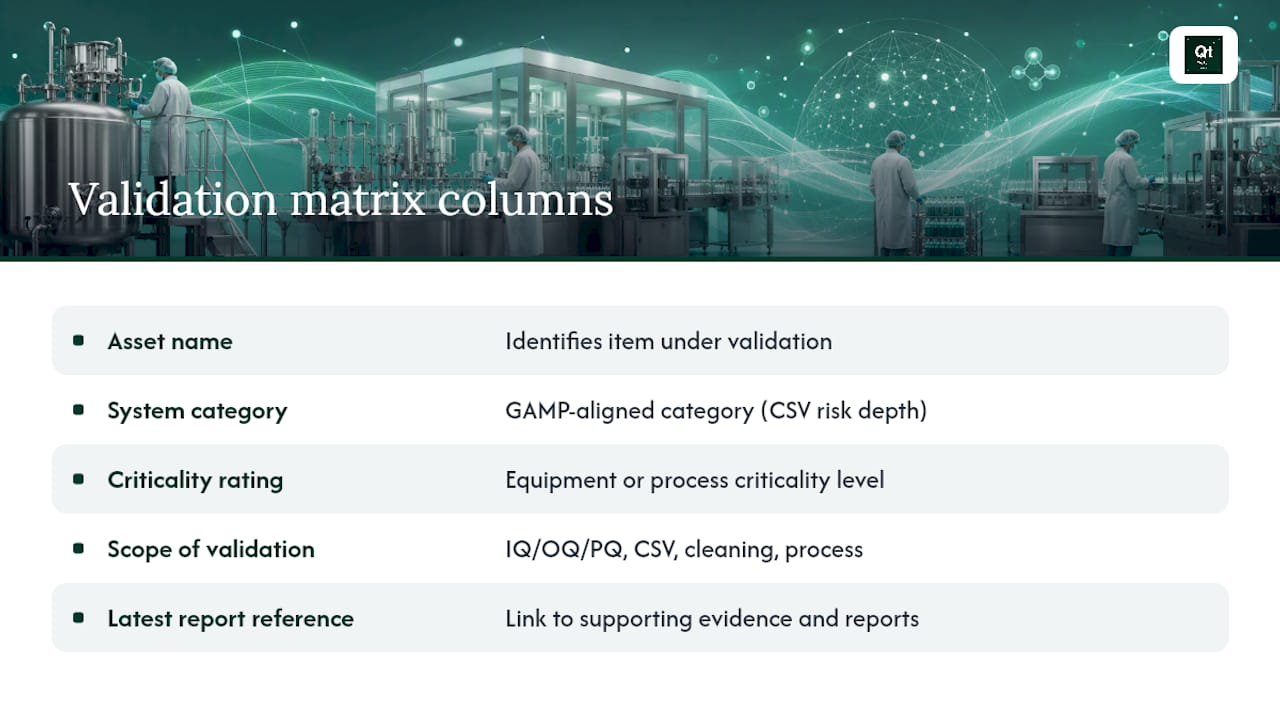
Traceability is where this connection becomes visible to an inspector. A well-built validation matrix typically includes columns for asset name, system category, criticality rating, scope of validation, current status, latest report reference, and next review date. That structure lets anyone, inspector or internal auditor, trace from a single line item straight to the supporting evidence.

Computer system validation and analytical method validation deserve specific treatment inside this structure. CSV activities should appear in the matrix like any other system, with GAMP-aligned category noted, since a spreadsheet tool and a manufacturing execution system carry very different risk profiles despite both being "computerized systems." Vendor factory acceptance testing (FAT) and site acceptance testing (SAT) can be credited toward qualification where the vendor's documentation meets your acceptance criteria, but the VMP should state that credit explicitly rather than leaving it implied.
Utility and cleanroom qualification often gets treated as an afterthought in early-draft VMPs, even though HVAC, water systems, and compressed gas typically carry validation obligations as significant as production equipment. Cleaning validation deserves its own line in the matrix as well, tracking worst-case product and equipment combinations rather than a single blanket entry.
Pro Tip: List computer systems by GAMP category in your matrix, not just by name. A category 1 infrastructure tool and a category 5 custom application require very different validation depth, and lumping them together in one line item hides that difference from anyone reviewing the plan.
How Do You Keep a Validation Master Plan Current?
A VMP earns its credibility through maintenance, not authorship. Schedule regular reviews and update the plan whenever a change affects validated status, with the review cadence and change-impact rules written into the VMP itself so there is no ambiguity about when an update is required.
A practical change control checklist for VMP impact assessment includes:
- Does the change affect a system's validated state or qualification status?
- Does the change alter scope, adding or removing a system from coverage?
- Does the change require a new risk assessment or revised criticality rating?
- Does the requalification schedule need adjustment as a result?
A sensible cadence combines an annual scheduled review with event-driven updates triggered by significant changes, deviations, or new equipment installs. Waiting for the annual cycle to catch a major system change is how VMPs drift out of sync with reality.
When preparing for inspection, have your validation matrix, RACI chart, and requalification schedule ready as a package, since inspectors typically ask for the matrix within the first hour of a validation-focused audit. Present the matrix by walking through a handful of representative systems rather than the entire list, showing how each line connects to its underlying protocol and report.
Pro Tip: Build your requalification schedule and change control log to update automatically wherever possible. A live master list that reflects reality in real time closes the gap between what the VMP claims and what an inspector finds on the floor.
What Should a VMP Template and Checklist Include?
A template that follows Annex 15 conventions and keeps its attachments live will outlast most that try to be exhaustive on day one. Start with the nine-section table of contents outlined earlier, then build a one-page checklist to confirm nothing critical got skipped before the document goes for approval.
A practical sign-off checklist covers:
- Scope statement matches the actual systems inventory on site.
- Validation policy references the current quality manual version.
- Roles and responsibilities name specific positions, not vague departments.
- Validation matrix attachment exists and reflects current system status.
- Change control linkage is stated explicitly, not implied.
- Review date and cadence are documented within the plan itself.
- Required signatures are collected from QA, validation, and senior management.
Scaling the template depends on organization size. A single-site operation can usually centralize the VMP into one document with one matrix. Larger organizations running multiple facilities often distribute VMP responsibilities across sites while maintaining a program-level document that references each site's plan, an approach that keeps accountability local without losing central visibility. Choose a project VMP over a site VMP when the work in question, like a new production line or facility, has a defined start and end date and doesn't belong permanently in the ongoing site plan.
What Actually Breaks Validation Programs?
The gap between a well-written VMP and a defensible one usually comes down to culture, not template quality. Teams that treat the plan as a compliance artifact to file and forget run into trouble the moment an inspector asks a follow-up question the document can't answer.
The sites that hold up best under scrutiny tend to share one habit: they keep the VMP short and lean on a live master list for everything that changes often. When the matrix updates automatically as systems move through qualification, the VMP itself rarely needs revision, which means it stays accurate instead of drifting.
Operational blockers are usually organizational, not technical. Teams that spread validation ownership across departments without a clear RACI often find their matrix goes stale within a quarter, because no single person feels accountable for updating it.
Automated Platforms and Validation Master Plan Maintenance
Automated validation platforms take on the parts of VMP work that erode fastest under manual upkeep: keeping the matrix current, tying change control to validated status, and producing evidence that holds up when an inspector asks a follow-up question.
The manual burden of maintaining a VMP rarely shows up in the initial authoring. It shows up months later, when systems change and nobody updates the matrix to match. Qualitum's Validate·AI platform authors URS, DQ, IQ, OQ, and PQ documentation directly, keeping the validation matrix live rather than treating it as a static export that ages the moment it's saved. Every record gets checked against ALCOA+ principles at both write time and review time, which means the audit trail an inspector asks for is already built, not reconstructed under deadline pressure.
That structure translates into real time savings. Teams using the platform report significant reductions in authoring time, freeing validation leads to focus on risk decisions instead of document formatting. Requalification reminders trigger automatically off the schedule you set in your VMP, and change control links directly to the systems it affects, closing the exact gap that turns routine inspections into findings.

If your VMP maintenance currently depends on someone remembering to update a spreadsheet, book a working session to see how automated authoring and a live traceability matrix change that equation.
Sources
Reference these directly in your VMP's regulatory basis section rather than paraphrasing them secondhand:
- European Commission — EU GMP Annex 15 (Qualification and validation)
- U.S. FDA — Process Validation: General Principles and Practices
- WHO — Guidance: GMP validation (PDF)
- Electronic Code of Federal Regulations — 21 CFR Part 820 (Quality System Regulation)
Cite the specific clause or section number in your reference list rather than the guidance document as a whole, since inspectors sometimes ask you to justify why a particular requirement applies to your scope.
This article is general information, not a substitute for advice from a qualified lawyer. Consult a qualified legal professional about your own circumstances before acting on anything here.
FAQ
What Is the Difference Between a VMP and a Validation Plan?
A VMP typically governs an entire site or program and references narrower validation plans as attachments. A validation plan is usually scoped to a single project or system and sits underneath the VMP.
Does the FDA Require a Validation Master Plan by Name?
No. The FDA's Process Validation guidance expects lifecycle, risk-based validation governance but doesn't require a document called a VMP, unlike EU Annex 15.
How Often Should a VMP Be Reviewed?
Most organizations combine an annual scheduled review with event-driven updates triggered by significant system changes, deviations, or new equipment installs.
What Belongs in a Validation Matrix?
A validation matrix typically lists asset name, system category, criticality, scope of validation, current status, latest report reference, and next review date for every qualified system.
Can Automation Replace Manual VMP Maintenance?
Automated platforms like Qualitum's Validate·AI can keep the validation matrix and supporting documentation live and traceable, reducing the manual burden that causes most VMPs to fall out of date.
Recommended
- Qualitum · The agentic validation platform for life sciences
- Cleaning validation · Validate·AI · Qualitum
- Audit Readiness Checklist for Validation and QA Leaders · Qualitum blog
FAQ
What Is the Difference Between a VMP and a Validation Plan?
A VMP typically governs an entire site or program and references narrower validation plans as attachments. A validation plan is usually scoped to a single project or system and sits underneath the VMP.
Does the FDA Require a Validation Master Plan by Name?
No. The FDA's Process Validation guidance expects lifecycle, risk-based validation governance but doesn't require a document called a VMP, unlike EU Annex 15.
How Often Should a VMP Be Reviewed?
Most organizations combine an annual scheduled review with event-driven updates triggered by significant system changes, deviations, or new equipment installs.
What Belongs in a Validation Matrix?
A validation matrix typically lists asset name, system category, criticality, scope of validation, current status, latest report reference, and next review date for every qualified system.
Can Automation Replace Manual VMP Maintenance?
Automated platforms like Qualitum's Validate·AI can keep the validation matrix and supporting documentation live and traceable, reducing the manual burden that causes most VMPs to fall out of date.