Test automation for CSV means using scripted and unscripted execution to generate traceable, audit-ready validation evidence rather than hand-typed screenshots. The right approach is a risk-based hybrid: automate scripted testing for high-repeatability, not-high-risk features, keep unscripted exploratory testing for discovery and edge cases, and capture every result as an ALCOA+ compliant record at the moment it's created. Done this way, teams see faster CSV cycles and evidence that holds up under inspection.
TL;DR:
>
- Automated CSV testing should focus on low-process-risk features with high reuse potential and clear traceability requirements to maximize efficiency and compliance.
- Building a validated environment requires baselined, version-controlled requirements and linkages from each test to documented risk assessments.
- Automated evidence must meet ALCOA+ standards, providing attributable, legible, contemporaneous, original, and accurate records at every qualification stage.
- Select tools that support requirement traceability, enforce audit trail integrity, and integrate seamlessly with existing quality management systems to ensure validation completeness.
- Over-automation without strategic judgment increases maintenance and reduces effectiveness; prioritize automation for critical, high-risk, and high-reuse features.
Table of Contents
- Which Features Should You Automate First?
- Building the Roadmap From Requirements to Evidence
- How Does This Map to FDA CSA, GAMP 5, and IQ/OQ/PQ?
- What Tools and Integrations Actually Matter?
- How Do Validation Roles Change When You Automate CSV?
- Why the "Automate Everything" Instinct Gets CSV Wrong
- Get CSA-Aligned Evidence Without the Authoring Backlog
- Where to Read More on CSA-Aligned Automation
- Sources
- FAQ
Which Features Should You Automate First?
Not every feature deserves scripted automation, and treating them all the same way wastes engineering hours you don't have. The FDA's final Computer Software Assurance guidance draws the line at process risk: scripted testing works efficiently for features that aren't high process risk, while unscripted or hybrid approaches often fit better elsewhere, including some higher-risk scenarios where exploratory judgment adds more value than a rigid script.
Run every candidate feature through this filter before you write a single automated test case:
- Process risk score. Is a failure here likely to affect patient safety, product quality, or data integrity? If yes, don't default to full scripting. Assess first.
- Reuse frequency. Does this test run on every release, every environment migration, or every regression cycle? High reuse justifies the upfront automation cost.
- Evidence requirements. Does the feature need machine-readable, traceable output for an inspector, or is a simple pass/fail sufficient?
- Maintenance burden. Will the UI or workflow change often enough that scripted tests break every sprint? Volatile interfaces often cost more to automate than to test manually.
Low-repeatability exploratory scenarios and UI-only cosmetic checks rarely justify scripting. They change too often and produce too little evidence value per hour invested.
Pro Tip: Score each requirement on a simple 1 to 3 scale for risk and reuse frequency before your kickoff meeting. Anything scoring low on both dimensions goes straight to a manual or unscripted backlog, no debate needed.
Building the Roadmap From Requirements to Evidence
Automation projects fail most often at the requirements stage, not the scripting stage. Here's the sequence that holds up under audit scrutiny.
- Baseline your requirements. Your approved URS and FRS need to exist in a machine-readable, version-controlled format before any test generation starts. A document that lives only in a Word file with tracked changes turned off is not a baseline.
- Map risk to test strategy. Link every requirement to a documented process-risk assessment, then assign it to scripted, unscripted, or hybrid testing. This decision belongs in the traceability matrix, not in a tester's head. A risk-based validation approach keeps this mapping consistent across systems.
- Generate the tests. Three techniques dominate here: template-driven generation for repeatable patterns, requirements-driven generation that pulls directly from your baselined URS, and AI-assisted generation for volume. Every AI-generated test still needs human review before execution. Industry analysis from PwC is direct on this point: AI accelerates test creation and coverage, but it requires expert oversight to keep results compliant and interpretable.
- Execute with environment parity. IQ and OQ runs need controlled, repeatable environments. PQ testing, whether at the user site or simulated, needs to reflect real operating conditions closely enough that the evidence means something to an inspector.
- Capture evidence as you go, not after. Structured logs, a live traceability matrix, and ALCOA+ checks applied at both write-time and review-time turn a test run into a defensible record instead of a screenshot someone annotated three weeks later.
- Build in change control. Automated impact analysis flags which requirements and tests actually changed when the software updates, so revalidation targets the right scope instead of retesting everything from scratch.
Vendor and industry reporting on automated CSV projects, including analysis from IQVIA, describes validation timelines compress significantly when this sequence is applied pragmatically rather than skipped for speed. The gains come from cutting rework, not from cutting rigor.
How Does This Map to FDA CSA, GAMP 5, and IQ/OQ/PQ?
Your auditor doesn't care that your tests run automatically. They care whether the resulting records satisfy the same regulatory expectations that manual testing always had to meet. Here's where automated artifacts land.
The FDA's CSA guidance explicitly supports proportional documentation: the depth of your evidence should match the risk level of the feature, not a fixed template applied everywhere. That's a deliberate departure from the exhaustive screenshot-per-step habit many CSV teams built under older CSV practice, and it's worth citing directly when a reviewer questions why your evidence looks leaner for a low-risk feature.
Automated artifacts map onto the classic qualification stages this way:
| Qualification Stage | What Automated Evidence Provides |
|---|---|
| IQ | Configuration snapshots, environment baseline logs, installation verification scripts with timestamped pass/fail output |
| OQ | Scripted functional test results tied to specific requirements, with structured logs showing input, expected outcome, and actual outcome |
| PQ | Simulated or live-use test sessions, exploratory testing templates capturing unscripted findings in comparable format, end-to-end workflow evidence |
ALCOA+ governs how each of those records has to look. Every automated test result needs to be attributable to a system or reviewer, legible, contemporaneous with the actual test run, an original record (not a reconstruction), and accurate. The "plus" criteria, complete, consistent, enduring, and available, matter just as much for automated evidence as for manual: a test log that's accurate but gets overwritten on the next run fails the "enduring" test just as badly as a missing signature fails "attributable."
GAMP 5's risk-based principles underpin all of this by design. The framework explicitly scales validation rigor to system risk and complexity, which is why the ISPE's Validation 4.0 analysis frames automation and AI as tools that increase coverage and consistency, while shifting human effort toward governance and the judgment calls scripts can't make.
What Tools and Integrations Actually Matter?
Skip the feature checklist marketing decks push and think in categories instead. Four tool types cover most of the CSV automation stack: requirements-driven script generators, execution engines that run and log tests, evidence-repository platforms that store signed artifacts, and CI/CD connectors that trigger revalidation when code changes.
Whatever category you're evaluating, prioritize these integration points before signing anything:
- Requirement traceability. Can the tool link every test result back to a specific, versioned requirement automatically?
- QMS and ticketing connections. Evidence that lives outside your quality management system creates a second source of truth, which auditors flag every time.
- Audit trail integrity. Look for tamper-evident logging, not just a timestamp field someone could edit.
- Deployment model. Validated private deployment versus shared cloud infrastructure changes your own validation burden for the tool itself.
Run vendor evaluations against four questions: does it support your validation documentation requirements, does it enforce ALCOA+ at the record level, does it offer real integration APIs rather than manual export/import, and does its deployment model match your data governance policy?
Pro Tip: Ask any vendor how their tool itself was validated. If they can't produce their own IQ/OQ evidence, you're about to inherit a validation gap you'll have to close yourself.
How Do Validation Roles Change When You Automate CSV?
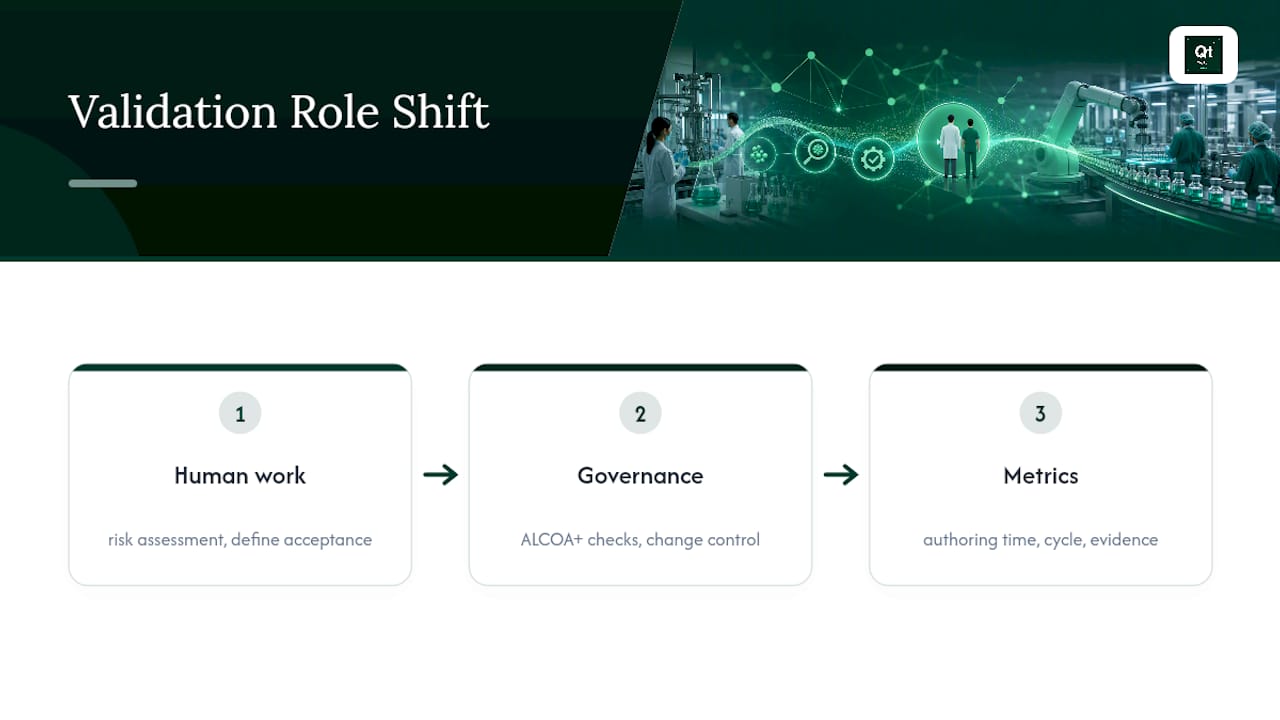
Automation doesn't remove the human from the process. It moves them. Risk assessment, defining acceptance criteria, investigating anomalies, and explaining why an AI-generated test result should be trusted all become higher-value human work once scripting handles the repetitive execution.
Governance has to keep pace. That means ALCOA+ checks applied at write-time and review-time, a documented change-control cadence, and a clear record of every human-in-the-loop decision that overrode or approved an automated result. ISPE's Validation 4.0 framing describes this shift plainly: teams move from being document producers toward becoming quality architects who design the risk logic the automation runs on.
Track authoring time saved, cycle time reduction, and evidence completeness as your operational metrics. They tell you whether the shift is actually working.
Why the "Automate Everything" Instinct Gets CSV Wrong
The temptation once a team gets its first automation win is to scale it to every system, every requirement, every test case. That instinct is backwards, and it's the fastest way to build a maintenance burden that eats the time savings automation was supposed to deliver.
The teams getting real value aren't the ones with the most automated tests. The ISPE's own guidance on Validation 4.0 makes this point directly: a prioritized backlog beats blanket coverage, and formalized exploratory testing templates can produce evidence just as comparable as a script when the feature doesn't warrant one.
The harder discipline is knowing when not to automate. That judgment call, more than any tool selection, is what separates a validation program that survives an audit from one that just looks busy.
— Matt
Get CSA-Aligned Evidence Without the Authoring Backlog
Qualitum is built around the exact hybrid model this article recommends: agentic test generation for repeatable, requirements-driven scenarios, paired with human review at every decision point that matters to an inspector. Every record the platform produces gets checked against ALCOA+ at write-time and again at review-time, closing the audit-trail gaps that manual CSV documentation tends to leave behind.

Teams using this approach report over 70% time savings in authoring validation documentation, with the freed-up hours going toward the risk assessment and anomaly investigation work that actually needs a human. The platform integrates with existing quality management systems rather than replacing them, so your traceability matrix and audit trail stay in one connected system instead of scattered across exported spreadsheets. Security and access-control practices for validated systems, an area covered in detail by compliance partners like Ksign, matter just as much for automated evidence repositories as for the systems they validate.
If you want a clear picture of where your current CSV process has automation gaps before committing to a rebuild, start with a Free Validation Gap Report or book a working session with the Qualitum team to walk through your specific validation backlog.
Where to Read More on CSA-Aligned Automation
- FDA's CSA final guidance for the regulatory baseline on risk-based testing.
- Qualitum's CSV automation roadmap for a deeper implementation walkthrough.
- ISPE's Validation 4.0 analysis for the hybrid testing rationale.
Sources
- Computer Software Assurance for Production and Quality Management System Software | FDA
- How AI will transform computerized system validation | ISPE Pharmaceutical Engineering
- Computer system validation | PwC
FAQ
What Does "Test Automation CSV" Mean in a Regulated Context?
It refers to using scripted and unscripted automated execution to generate traceable, ALCOA+ compliant validation evidence for computer system validation, rather than to comma-separated data files.
Is Scripted or Unscripted Testing Better for CSV?
Neither wins outright. FDA's CSA guidance favors scripted testing for not-high-process-risk, high-repeatability features and unscripted or hybrid testing for exploratory and higher-risk scenarios.
How Does Automated Testing Satisfy ALCOA+ Requirements?
Automated tests satisfy ALCOA+ when each execution produces a structured, signed record capturing who ran it, when, in what environment, and against which baselined requirement, checked at both write-time and review-time.
Does Automating CSV Reduce Validation Cycle Time?
Yes. Industry reporting from IQVIA and platforms like Qualitum, which reports over 70% time savings in authoring, show automation compressing timelines meaningfully when applied to the right subset of tests.
Do Automated Validation Tools Themselves Need Validation?
Yes. Any tool generating or storing validation evidence needs its own qualification, including IQ/OQ evidence, audit trail integrity checks, and a documented deployment model consistent with your data governance policy.
Recommended
- CSV Automation for Validation Teams: A CSA-Aligned Roadmap
- CSA vs CSV for Validation Teams: What QA Needs to Know
- CSV to CSA: The FDA Transition Playbook for QA Teams
- Digital Validation Automation
FAQ
What Does "Test Automation CSV" Mean in a Regulated Context?
It refers to using scripted and unscripted automated execution to generate traceable, ALCOA+ compliant validation evidence for computer system validation, rather than to comma-separated data files.
Is Scripted or Unscripted Testing Better for CSV?
Neither wins outright. FDA's CSA guidance favors scripted testing for not-high-process-risk, high-repeatability features and unscripted or hybrid testing for exploratory and higher-risk scenarios.
How Does Automated Testing Satisfy ALCOA+ Requirements?
Automated tests satisfy ALCOA+ when each execution produces a structured, signed record capturing who ran it, when, in what environment, and against which baselined requirement, checked at both write-time and review-time.
Does Automating CSV Reduce Validation Cycle Time?
Yes. Industry reporting from IQVIA and platforms like Qualitum, which reports over 70% time savings in authoring, show automation compressing timelines meaningfully when applied to the right subset of tests.
Do Automated Validation Tools Themselves Need Validation?
Yes. Any tool generating or storing validation evidence needs its own qualification, including IQ/OQ evidence, audit trail integrity checks, and a documented deployment model consistent with your data governance policy.