Risk-based validation focuses your testing, documentation, and evidence on the systems and process parameters that actually threaten patient safety, product quality, or data integrity, instead of spreading equal effort across everything you validate. The core elements are consistent regardless of industry:
- Lifecycle approach — risk decisions get made and revisited from design through retirement, not once at the start.
- Proportionality — the level of testing and documentation scales with the consequence of failure.
- Criticality focus — effort concentrates on functions tied to patient safety, efficacy, or regulated data.
Traditional validation treats every requirement, screen, and interface as equally deserving of a full test script. Risk-based validation asks a sharper question first: what happens if this fails, and how would we know?
Key Takeaways
Risk-based validation works because it ties documentation depth and testing rigor directly to patient-safety and data-integrity impact, backed by a documented rationale at every stage.
| Point | Details |
|---|---|
| Proportionality is the rule | Formality and documentation depth should scale with risk, per ICH Q9(R1). |
| Map risk to lifecycle stages | Use risk outputs to set CQAs/CPPs in Stage 1 and acceptance criteria in Stage 2 and 3. |
| Document the "why" | Every risk score needs a rationale tied to system function and data impact, or it's an audit finding. |
| Keep risk assessments living | Link reassessment triggers to change control instead of freezing scores after initial sign-off. |
| Automate the documentation burden | Qualitum enforces ALCOA+ at write-time and delivers over 70% time savings in authoring, speeding up CSV cycles. |
Table of Contents
- When Risk-Based Validation Makes Sense
- The Regulatory Baseline You Need to Cite
- Mapping Risk Onto the Validation Lifecycle
- Choosing the Right Risk Assessment Method
- Setting Documentation Levels by Risk Tier
- Governance, Roles, and What Auditors Expect to See
- Where Risk-Based Programs Go Wrong
- A Starting Checklist for Your First Pilot
- How Automation Changes the Adoption Curve
- Get Your Risk-Based Program Running Faster
- Sources
- FAQ
When Risk-Based Validation Makes Sense
Risk-based validation fits nearly every GxP validation scenario: computer system validation (CSV), process validation, cleaning validation, and analytical method validation all benefit from the same discipline. It is particularly valuable when a system has many low-impact configuration options alongside a handful of functions that touch batch release or patient safety.
The payoff shows up in three places:
- Reduced over-testing on features that carry no GxP impact, freeing QA hours for the functions that matter.
- Reallocated effort toward high-risk process parameters, critical quality attributes, and data-integrity controls.
- Stronger inspection narratives, because every testing decision traces back to a documented rationale instead of a blanket policy.
Pro Tip: Favor more formal, structured risk assessment when uncertainty is high or the decision is hard to reverse (a new manufacturing process, a novel automated system). Use lighter, less formal risk tools for routine, well-understood changes with a track record of stable performance.
The Regulatory Baseline You Need to Cite
Any risk-based program has to stand on a documented regulatory foundation, not just internal preference. ICH Q9(R1) organizes quality risk management around four activities:
- Assessment — identifying what might go wrong, how likely it is, and the consequences.
- Control — deciding whether risk is acceptable and how to reduce it.
- Communication — sharing risk information across functions and with regulators.
- Review — revisiting risk periodically or when triggered by change.
FDA's process validation guidance maps risk onto three stages: process design, process qualification, and continued process verification, with risk assessment shaping decisions at each one. Computerized systems add another layer: 21 CFR Part 11 expectations around audit trails, electronic signatures, and access controls mean inspectors will scrutinize whether your risk assessment covered data integrity, not just functional performance.
Risk-based decision-making should determine the level of formality, documentation, and structure a quality risk management activity requires. Low-uncertainty, low-impact decisions warrant lighter documentation than novel or high-consequence ones.
That proportionality principle, drawn from ICH Q9(R1), is the single most useful sentence to keep in front of an inspector who questions why one module got a full protocol and another got a streamlined check.
Mapping Risk Onto the Validation Lifecycle
Risk assessment isn't a one-time gate before testing begins. It should touch every stage of the FDA process validation lifecycle, and the outputs from one stage should feed directly into the next.
In Stage 1 (process design), risk tools identify critical quality attributes (CQAs) and critical process parameters (CPPs) before a single protocol is written. This is where you decide which requirements in your URS deserve deep scrutiny and which are cosmetic.
In Stage 2 (process qualification, including PPQ), risk outputs set your acceptance criteria, sample sizes, and which functions get focused testing versus a lighter check. A high-risk parameter might warrant three qualification batches and tight statistical acceptance limits; a low-risk configuration setting might need only a documented confirmation that it works as intended.
In Stage 3 (continued process verification), risk defines your monitoring plan, the triggers that force reassessment, and the link to change control.
| Lifecycle stage | Risk-driven decision | Typical output |
|---|---|---|
| Stage 1: Process design | Identify CQAs/CPPs via FMEA or risk matrix | Risk register feeding the URS |
| Stage 2: Qualification/PPQ | Set acceptance criteria and sample sizes by risk tier | OQ/PQ protocols with tiered rigor |
| Stage 3: Continued verification | Define monitoring frequency and reassessment triggers | Trend reports, change-control links |
Every one of these outputs should land in a traceability matrix that ties each requirement to its risk rating, its test evidence, and its approval. ICH Q9(R1) explicitly connects risk outputs to the scope of verification and the frequency of follow-up monitoring, so an inspector asking "why this sampling plan?" should find the answer already documented.
Choosing the Right Risk Assessment Method
Not every risk question needs the same tool. Practical guides on validation risk management point to a handful of approaches that cover most GxP scenarios:
- FMEA (Failure Mode and Effects Analysis) — best for systems and processes with multiple failure points; scores severity, likelihood, and detectability separately.
- FTA (Fault Tree Analysis) — useful when you need to trace a specific undesired event back to root causes.
- HACCP — strongest where a process has defined critical control points, common in manufacturing and packaging.
- Simple risk matrices — sufficient for lower-stakes decisions where a 3x3 or 5x5 grid of likelihood versus severity gets the job done.
Scoring gets contentious fast if the criteria aren't defined up front. Severity should reflect patient or product impact, likelihood should reflect how often the failure mode actually occurs, and detectability should reflect whether your current controls would catch it before harm occurs.
A common pitfall is relying on a raw Risk Priority Number (severity times likelihood times detectability) as the sole decision driver. Two very different risk profiles can produce an identical RPN, which hides the fact that one is a severe-but-rare failure and the other is frequent-but-minor. Separating severity from occurrence and detection in your decision rules, or applying weighted scoring, avoids that trap.

| Element | What it measures | Common scale |
|---|---|---|
| Severity | Consequence if the failure occurs | 1 (negligible) to 5 (critical patient impact) |
| Likelihood | Probability the failure mode occurs | 1 (rare) to 5 (frequent) |
| Detectability | Chance current controls catch it first | 1 (certain detection) to 5 (undetectable) |
Every score needs a written rationale tied to system function, intended use, and data impact. A score with no justification is the first thing an auditor will flag.
Setting Documentation Levels by Risk Tier
Proportionality only works if you have clear rules for what "high," "medium," and "low" risk actually mean in terms of paperwork. Vague tiering invites inconsistency, and inconsistency invites audit findings.
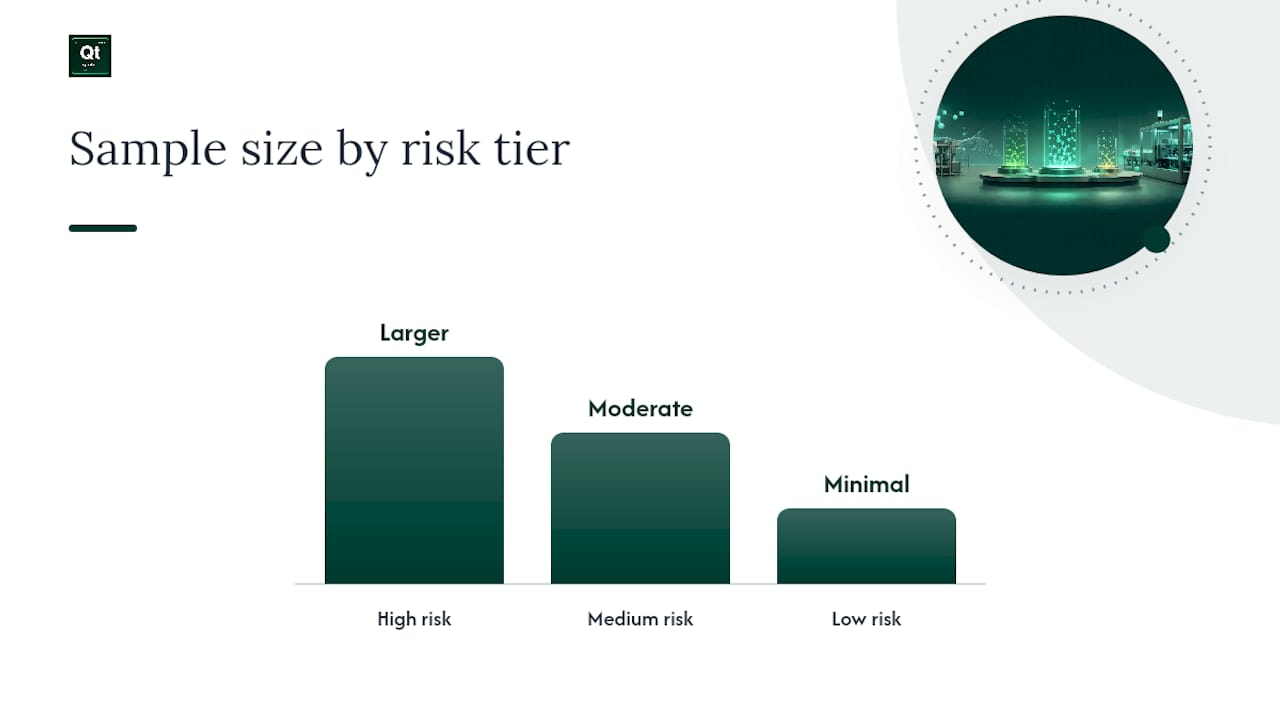
- High risk: full protocol with detailed acceptance criteria, larger sample sizes, and independent QA review before execution.
- Medium risk: structured test scripts with defined pass/fail criteria, but reduced sample sizes and streamlined review.
- Low risk: simplified verification records, often a single confirmation step with a documented rationale for why deeper testing isn't warranted.
| Risk tier | Documentation depth | Typical sample size |
|---|---|---|
| High | Full validation protocol, independent review | Larger, statistically justified |
| Medium | Structured test script, streamlined review | Moderate, risk-justified |
| Low | Simplified verification record | Minimal, rationale documented |
Most teams underestimate how long the initial rollout takes. Expect the first few months to go toward building the risk framework and scoring criteria, with the actual validation execution accelerating once the tiering rules are established. The biggest resource driver isn't the assessments themselves. It's getting cross-functional agreement on what counts as "high risk" in your specific environment.
Governance, Roles, and What Auditors Expect to See
A risk-based program only holds up under inspection if the governance behind it is visible and consistent. Typically, the process owner proposes the initial risk rating, the validation engineer designs the testing approach around it, and the QA lead signs off on both the rationale and the final validation package.
Auditors look for specific artifacts, not just a general sense that risk was "considered":
- A clear problem statement for each risk assessment (what question is being answered).
- Documented risk rationale linking each score to system function and intended use.
- A live traceability matrix connecting requirements, risk ratings, and test evidence.
- ALCOA+ checks confirming data supporting the validation is attributable, legible, contemporaneous, original, and accurate, plus complete, consistent, enduring, and available.
Keep a short audit checklist ready: the current risk register, the traceability matrix, change-control records tied to reassessment triggers, and the sign-off history for each validated system.
Where Risk-Based Programs Go Wrong
The most common audit finding isn't a missing test. It's a risk score with no documented reasoning behind it. An unexplained "low" rating is a weak point every time, regardless of whether the underlying judgment was correct.
- Treating risk assessments as a one-time exercise and never revisiting them after a system change.
- Confusing "risk-based" with "less rigorous," which shows up as under-tested high-impact functions.
- Failing to link risk reassessment triggers to change control, so updates happen without anyone questioning the original risk rating.
Document the "why" behind every score. Tie it explicitly to intended use and data impact, not just a number on a scale.
Pro Tip: Treat your risk assessment as a living document. Build reassessment triggers directly into change control so a system update, integration, or deviation automatically prompts a fresh look at the risk rating, not a filed-and-forgotten form.
A Starting Checklist for Your First Pilot
Pick one process, run the framework, and let the results inform your rollout to other systems.
- Define the problem: what decision does this risk assessment need to support?
- Pick the right tool (FMEA for multi-point failure systems, HACCP for defined control points).
- Run the assessment and document severity, likelihood, and detectability with rationale.
- Set validation scope and documentation depth by risk tier.
- Execute focused testing on high-risk items; simplify verification for low-risk ones.
- Record everything in a traceability matrix.
A cleaning validation program is a good first pilot: contact surfaces and shared equipment paths carry clear patient-safety weight, making the risk tiers easy to justify and the documentation savings on low-risk items immediately visible. Tools built for this, like Qualitum's cleaning validation module, can help structure that first pass.
How Automation Changes the Adoption Curve
Manually maintaining a living risk assessment across dozens of systems, each with its own traceability matrix and change history, is where most risk-based programs stall. Every reassessment trigger, every score justification, and every ALCOA+ check has to be tracked and cross-referenced by hand, which is exactly the kind of work that erodes under deadline pressure.
Automation changes what's realistic to maintain:
- Risk documents stay current because updates propagate automatically instead of requiring a manual redo.
- Traceability matrices update in real time as requirements, risk ratings, and test evidence change.
- ALCOA+ checks run at write-time and review-time, catching data-integrity gaps before they reach an inspector.
Qualitum's own data shows over 70% time savings in authoring validation documentation compared to manual processes, which translates directly into faster CSV cycles. What auditors will still want to see, automated or not, is the same rationale trail: why this score, why this test depth, why this monitoring frequency.
A Pragmatic Next Step
Risk-based validation earns its keep only when it's applied as a lifecycle discipline, not a one-time scoring exercise bolted onto an existing protocol. If you're weighing where to start, don't try to convert your entire validation portfolio at once.
Target a 90-day pilot on one high-impact process, ideally one with a mix of critical and low-risk functions so the proportionality argument is visible to your own team before it ever reaches an inspector.
Get Your Risk-Based Program Running Faster
Qualitum cuts the manual grind out of running a defensible risk-based validation program. Instead of your team hand-building traceability matrices and re-checking ALCOA+ compliance line by line, Qualitum's agentic platform authors validation documentation directly, with every record checked for data integrity at write-time and again at review-time.

A working session with Qualitum typically walks through one real process or system from your environment, showing how Validate·AI structures risk-tiered documentation and feeds a live traceability matrix without the usual authoring backlog. Teams that pilot the platform on a single high-impact process see faster CSV cycles and less time spent reconciling paperwork before an audit. If you're planning that 90-day pilot, book a working session and bring the process you're most anxious about defending.
Sources
Keep these close when building or defending your program:
- Q9(R1) Quality Risk Management | FDA
- ICH Q9 quality risk management — EMA
- ICH Q9(R1) Guideline (2025 Step 4 PDF)
- What Is The Validation Risk Management Process? A Complete Guide | Risk Publishing
This article is general information, not a substitute for advice from a qualified doctor. Consult a qualified healthcare professional about your own circumstances before acting on anything here.
FAQ
What Are the Four Types of Validation?
Most GxP programs distinguish prospective, retrospective, concurrent, and revalidation. Risk-based validation determines how deep each of these needs to go for a given system or process.
What Are the Main Risk Management Methodologies?
FMEA, FTA, HACCP, and risk matrices cover most GxP scenarios, each suited to different failure patterns; qualitative and quantitative scoring approaches sit underneath all of them.
What Is a Risk-Based Approach in Validation?
A risk-based approach directs validation effort, testing depth, and documentation toward the functions and parameters that most affect patient safety, product quality, or data integrity, using structured tools like FMEA to justify each decision.
Why Do Process Validations Often Use Three Batches?
Three consecutive successful batches is a common convention for demonstrating process consistency, but the actual number should be risk-justified based on process variability and criticality, not applied automatically.
How Does Automation Support Risk-Based Validation?
Platforms like Qualitum keep risk assessments and traceability matrices current automatically, enforcing ALCOA+ checks at write-time so documentation stays audit-ready without manual rework.
Recommended
- Validate·AI · Qualitum
- Qualitum · The agentic validation platform for life sciences
- Audit Readiness Checklist for Validation and QA Leaders · Qualitum blog
- How to Test Data Integrity: A Practitioner's Guide · Qualitum blog
FAQ
What Are the Four Types of Validation?
Most GxP programs distinguish prospective, retrospective, concurrent, and revalidation. Risk-based validation determines how deep each of these needs to go for a given system or process.
What Are the Main Risk Management Methodologies?
FMEA, FTA, HACCP, and risk matrices cover most GxP scenarios, each suited to different failure patterns; qualitative and quantitative scoring approaches sit underneath all of them.
What Is a Risk-Based Approach in Validation?
A risk-based approach directs validation effort, testing depth, and documentation toward the functions and parameters that most affect patient safety, product quality, or data integrity, using structured tools like FMEA to justify each decision.
Why Do Process Validations Often Use Three Batches?
Three consecutive successful batches is a common convention for demonstrating process consistency, but the actual number should be risk-justified based on process variability and criticality, not applied automatically.
How Does Automation Support Risk-Based Validation?
Platforms like Qualitum keep risk assessments and traceability matrices current automatically, enforcing ALCOA+ checks at write-time so documentation stays audit-ready without manual rework.