Paperless validation means managing the full validation lifecycle — URS, IQ/OQ/PQ, CSV/CSA, cleaning, and sterilization protocols — using electronic records, e-signatures, audit trails, and automation to produce ALCOA+-compliant, auditable evidence without printed artifacts. The operational payoff is threefold: audit readiness aligned with 21 CFR Part 11 and EU Annex 11 expectations, faster cycle times through reduced authoring and review effort, and data integrity captured at source rather than reconstructed after the fact. This guide prioritizes U.S. regulatory expectations under FDA/21 CFR Part 11 and ISPE good-practice principles throughout.
Three outcomes to keep in mind as you read:
- Audit readiness: electronic records and e-signatures that satisfy Part 11 criteria and hold up under FDA inspection
- Faster cycles: reduced authoring, review, and approval time across the validation lifecycle
- Data integrity by design: immutable evidence captured at the point of execution, not assembled retroactively
Key Takeaways
Paperless validation delivers audit-ready, ALCOA+-compliant evidence across the full validation lifecycle when governance, technology, and cross-functional trust are built together from the start.
| Point | Details |
|---|---|
| Regulatory baseline | Systems must meet 21 CFR Part 11 criteria for electronic records and e-signatures; predicate rules define what records exist. |
| Data integrity by design | ALCOA+ must be enforced at the point of capture, not reconstructed during review or inspection. |
| Paper-on-glass is the primary risk | Cultural resistance and inadequate governance cause teams to recreate paper behaviors inside digital systems. |
| Pilot before scaling | Start with one validation type, measure authoring time and audit-retrieval speed, then set explicit go/no-go criteria. |
| Qualitum's approach | Qualitum enforces ALCOA+ at write-time and review-time, with agentic authoring and a live traceability matrix across the full lifecycle. |
Table of Contents
- What does paperless validation actually cover?
- How do paperless validation systems work?
- What do regulators actually check?
- What are the real benefits, and how do you measure them?
- How do you implement paperless validation without recreating paper?
- Why does paper keep coming back?
- What comes next: AI, Validation 4.0, and sustainability
- The gap between "digital" and "truly paperless"
- Qualitum accelerates your path to audit-ready validation
- Sources
- FAQ
What does paperless validation actually cover?
The term gets used loosely. Vendors apply it to everything from a PDF approval workflow to a fully integrated, data-centric validation platform. Clarifying scope upfront prevents expensive mismatches between what you buy and what an inspector expects to see.
Key terms used throughout this guide:
- Paperless validation / digital validation: the practice of managing the entire validation lifecycle through electronic systems, with no reliance on printed records as the system of record
- Digital validation tools (DVTs): software platforms purpose-built to author, execute, review, approve, and archive validation evidence electronically
- True copy: an electronic reproduction that preserves the content and meaning of the original record, verifiable without printing
- Paper-on-glass: the failure mode where teams digitize the form but replicate paper behaviors — printing electronic reports, adding redundant manual sign-offs, or treating the system as a filing cabinet rather than a source of truth
- ALCOA+: the data-integrity framework requiring records to be Attributable, Legible, Contemporaneous, Original, Accurate, plus Complete, Consistent, Enduring, and Available
The scope of paperless validation extends across the full lifecycle: requirements definition (URS, FS, DQ), qualification protocols (IQ, OQ, PQ), computer system validation (CSV/CSA), cleaning and sterilization validation, risk assessments, and periodic reviews. It is not limited to digitizing a single test form.
Digital validation vs. paper: a direct comparison
| Dimension | Paper-based validation | Digital validation |
|---|---|---|
| Evidence capture | Manual entry, prone to transcription error | Automated or structured electronic capture at source |
| Audit access | Physical binder retrieval, often off-site | Instant search and retrieval, role-based access |
| Version control | Manual numbering, risk of superseded versions in use | System-enforced versioning with change history |
| Review/approval workflow | Sequential routing, physical signatures | Parallel or sequential e-signature workflows with timestamps |
| Traceability | Manual cross-referencing across documents | Live traceability matrix linking requirements to evidence |
| Common failure modes | Lost pages, illegible entries, missing signatures | Paper-on-glass, incomplete audit trails, over-configured reports |
How do paperless validation systems work?
The ISPE Good Practice Guide: Digital Validation frames the shift as moving from document-centric to data-centric processes, where data integrity is achieved by design rather than by inspection after the fact. That framing shapes how the best platforms are architected.
Core features and what they deliver
| Feature | Practical benefit for validation teams |
|---|---|
| Electronic records and e-signatures | Part 11-compliant evidence without paper routing |
| Configurable audit trails | Immutable, timestamped change history accessible to inspectors |
| Live traceability matrix | Instant gap analysis from URS through PQ without manual cross-referencing |
| Protocol templates and authoring tools | Consistent structure, reduced authoring time, reusable content blocks |
| Automated test execution capture | Eliminates transcription errors; captures results at source |
| Role-based approval workflows | Enforces review hierarchy; prevents unauthorized edits |
| Deviation and CAPA linkage | Connects exceptions to corrective actions within the same system |
| Periodic review automation | Triggers reviews on schedule; maintains lifecycle currency |
| API and QMS/LIMS/MES integration | Eliminates duplicate data entry across systems |
Architecture trade-offs matter for regulated environments. On-premises deployment gives maximum control but shifts infrastructure validation burden to your team. Validated private cloud balances control with reduced IT overhead. Multi-tenant SaaS offers the fastest deployment but requires rigorous supplier assurance. Whichever model you choose, the platform itself must be validated — its own IQ/OQ/PQ is not optional.

Gartner Peer Insights reviews of digital validation tools consistently highlight Part 11/Annex 11 compliance support, traceability, and scalability as the features practitioners prioritize most.
What do regulators actually check?
21 CFR Part 11 sets the baseline: electronic records must be trustworthy, reliable, and equivalent to paper records; e-signatures must be unique to the individual, verifiable, and linked to their respective records. The FDA's guidance on Part 11 scope and application clarifies that predicate rules — GMP, GLP, GCP requirements — drive what records must exist; Part 11 governs how those records may be maintained electronically.
During an inspection, expect the following lines of inquiry:
- System access controls: can you demonstrate that only authorized users can create, modify, or approve records?
- Audit trail integrity: are audit trails complete, tamper-evident, and readily retrievable without special tools?
- True copy demonstration: can you show an inspector an electronic record that is verifiably equivalent to the original, without printing it?
- System validation evidence: does the platform itself have IQ/OQ/PQ documentation, change control records, and a current validation status?
- Supplier assurance: does your vendor provide SOC 2 Type II reports or equivalent controls documentation? AICPA SOC frameworks define the standard your vendor should meet.
- Change control: are changes to the system and its configuration tracked, reviewed, and approved?
The ISPE Good Practice Guide reinforces that data integrity must be designed into the system, not bolted on. ALCOA+ is the operational expression of that principle: every record must be attributable, legible, contemporaneous, original, and accurate at the moment of capture. Testing your system's data integrity controls before an inspection — not during one — is the only defensible approach. A practical starting point is a structured data integrity testing process that maps ALCOA+ attributes to specific system controls.
Pro Tip: Build your audit-readiness evidence package before you need it. Maintain a live index of your platform's validation status, supplier assurance documentation, and access control records so you can respond to an inspector's request within hours, not days. An audit readiness checklist built around Part 11 criteria is the fastest way to identify gaps before they become findings.
What are the real benefits, and how do you measure them?
The compliance argument for digital validation is clear. The business case requires numbers, and those numbers come from your own baseline.
Benefits that translate directly to KPIs:
- Reduced authoring time: protocol authoring is typically the largest time sink in a validation project. Tracking hours per protocol type before and after implementation gives you a clean percentage improvement.
- Faster time-to-release: measure calendar days from validation initiation to approved release for a defined product or system type.
- Audit cycle time: how long does it take your team to assemble evidence in response to an inspector's request? Digital systems reduce this from days to hours.
- Deviation rate per validation: fewer manual transcription steps means fewer data-entry errors and fewer resulting deviations.
- Cost per validation project: include labor, storage, courier, and rework costs in the baseline; digital systems reduce all four.
- Paper storage and sustainability: physical archive space, off-site storage fees, and document destruction costs are measurable and often underestimated as a "quiet tax" on paper-based operations.
To build a credible business case, measure your current baseline across at least three validation projects, set conservative pilot targets (not best-case projections), and define a risk-adjusted ROI timeline of 12–24 months.
Supplement manufacturers navigating compliance processes face similar documentation burdens, and the KPI logic applies across regulated manufacturing categories.
How do you implement paperless validation without recreating paper?
The implementation checklist below follows ISPE-aligned governance principles and is sequenced to avoid the most common failure modes.
- Define requirements: document what the system must do, not just what it can do. Map requirements to predicate rules and ALCOA+ attributes.
- Scope risk-based: not every validation type needs the same configuration depth. Prioritize high-risk, high-frequency validation types for the pilot.
- Conduct supplier assurance: review SOC 2 Type II reports, request the vendor's own validation package, and confirm integration capabilities with your LIMS, QMS, and identity management systems.
- Author a system validation plan: the platform itself requires IQ/OQ/PQ. Plan this before deployment, not after.
- Define data migration approach: legacy records need a documented true-copy strategy. Do not migrate everything — migrate what is required by predicate rules and retention schedules.
- Train cross-functionally: include SMEs, auditors, and IT in training, not just validation engineers. ISPE Foundation programs provide structured change management and technical training resources.
- Execute a scoped pilot: one validation type, one site, defined acceptance criteria. Cleanroom qualification or cleaning validation are common pilot candidates because they have well-defined protocols and clear evidence requirements.
- Measure baseline KPIs: capture authoring time, review cycles, and deviation counts during the pilot so you have real data for the scale decision.
- Define decision gates: set explicit go/no-go criteria before moving from pilot to controlled rollout, and from controlled rollout to organization-wide scale.
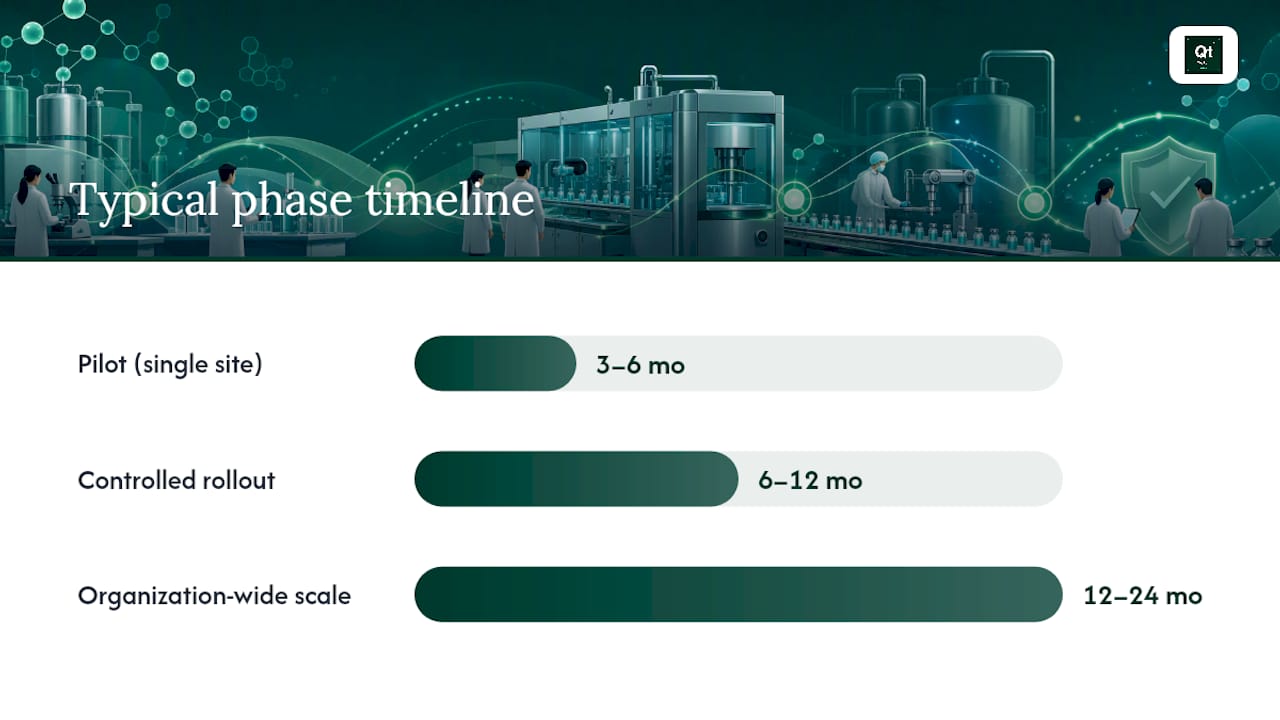
Typical phase timeline:
- Pilot: 3–6 months (single validation type, single site)
- Controlled rollout: 6–12 months (multiple validation types, defined sites)
- Organization-wide scale: 12–24 months (full lifecycle, all sites, QMS integration)
Pro Tip: The ISPE Good Practice Guide explicitly warns against paper-on-glass. The fix is not a technology setting — it is a governance decision. Grant auditors and SMEs direct system access. Define "fit-for-purpose" data capture so teams stop adding redundant review loops. Right-size your reports so they answer a specific question rather than recreating a paper binder.
Why does paper keep coming back?
ISPE's Pharmaceutical Engineering commentary identifies organizational mistrust as the primary reason digital implementations stall short of truly paperless. Teams that do not trust the system — or each other — add manual checkpoints, print electronic records "just in case," and route approvals outside the platform. The result is paper-on-glass: all the cost of a digital system with none of the audit-trail benefit.
Common failure modes and their mitigations:
- Organizational mistrust: run cross-functional governance sessions early; involve QA, IT, regulatory affairs, and operations in requirements definition, not just validation engineers
- Inadequate requirements: vague requirements produce over-configured systems that nobody uses as intended; tie every requirement to a predicate rule or ALCOA+ attribute
- Incomplete audit trails: test audit trail completeness as part of OQ, not as an afterthought; define what "complete" means for each record type before go-live
- Over-configured reports: reports that recreate a paper binder are a red flag; right-size outputs to the question being answered
- Legacy system gaps: APIs and integrations are not optional; a platform that cannot connect to your QMS or LIMS will generate duplicate data entry and shadow records
Red flags during vendor selection:
- The vendor cannot demonstrate audit trail retrieval without exporting to a spreadsheet
- Integration requires custom middleware with no vendor support
- The platform's own validation package is incomplete or unavailable on request
- User access controls are managed outside the system (e.g., shared credentials)
What comes next: AI, Validation 4.0, and sustainability
The near-term trajectory of digital validation is shaped by three converging forces.
Agentic AI and automated authoring are moving from concept to production. Platforms with agentic capabilities can draft protocol sections, aggregate test evidence, and flag ALCOA+ gaps at write-time rather than during review. The governance implication is significant: AI-authored content must carry the same attributability and review chain as human-authored content, which means your validation plan for the platform must address AI-generated records explicitly. ISPE guidance notes that governance must adapt as AI features enter validation tooling.
Validation 4.0 / Pharma 4.0 principles push toward continuous process verification and real-time data flows between MES, LIMS, and validation systems. For data integrity, that means more integration points to validate and more automated data transfers to audit-trail. The upside is that manual data transcription — one of the largest sources of human error in traditional validation — largely disappears.
Sustainability is an increasingly visible factor in validation program design. Eliminating physical print runs, off-site archive storage, and document courier services reduces both operational cost and environmental footprint. These are measurable benefits that belong in your business case alongside compliance and cycle-time arguments.
The gap between "digital" and "truly paperless"
Most organizations that have deployed a digital validation tool have not achieved truly paperless validation. They have digitized the form while preserving the paper process underneath it. The ISPE commentary on this point is direct: technology alone does not change behavior. What changes behavior is governance, cross-functional trust, and a platform designed so that the electronic record is unambiguously the system of record.
The organizations that get this right share a common pattern. They involve SMEs and auditors in the platform from day one, not as end-users of a finished product but as co-designers of the evidence model. They define "fit-for-purpose" data capture before configuration begins. And they treat the platform's audit trail as a first-class deliverable, not a background log.
The practical recommendation: run your first pilot on a single, well-defined validation type with ISPE-aligned acceptance criteria and a pre-defined auditor-access demonstration. If an inspector walked in on day 30 of your pilot, could you show them everything they need without printing a single page? That is the acceptance criterion that matters.
Qualitum accelerates your path to audit-ready validation
Every record is ALCOA+ checked at write-time and again at review-time, so compliance gaps surface before approval rather than during an inspection.

The Qualitum platform covers the full validation lifecycle: URS through PQ, CSV/CSA, cleaning and sterilization validation, deviation and CAPA handling, and periodic review automation. A live traceability matrix connects every requirement to its evidence without manual cross-referencing. Integrations with major QMS, LIMS, and MES platforms eliminate duplicate data entry. Deployment options include validated private cloud and on-premises configurations for organizations with strict data-residency requirements.
The path in is a scoped pilot, not a full-platform commitment. Book a working session to see how Qualitum handles your specific validation types and what your authoring-time baseline looks like against the platform's output.
Sources
Primary regulatory and industry references for policy development and inspection preparation:
- ISPE Good Practice Guide: Digital Validation
- Title 21 CFR Part 11 (Electronic Records; Electronic Signatures) — eCFR
- FDA guidance: Part 11 — Electronic Records; Electronic Signatures — Scope and Application
- Best Digital Validation Tools for Life Sciences Reviews 2026 | Gartner Peer Insights
FAQ
What is paperless validation in regulated life sciences?
Paperless validation manages the full validation lifecycle — protocols, execution records, approvals, and audit trails — through electronic systems that meet 21 CFR Part 11 and ALCOA+ requirements, with no printed artifacts serving as the system of record.
How does digital validation differ from paper-based validation?
Digital validation captures evidence at the point of execution with automated audit trails, role-based e-signatures, and live traceability, eliminating the transcription errors, version-control gaps, and retrieval delays common in paper-based processes.
What is paper-on-glass, and how do you avoid it?
Paper-on-glass occurs when teams digitize forms but preserve paper behaviors — printing electronic records, adding redundant manual sign-offs, or routing approvals outside the platform. ISPE guidance recommends cross-functional governance, SME system access, and right-sized data capture to prevent it.
Does the validation platform itself need to be validated?
Yes. The digital validation system is a computerized system subject to GAMP 5 principles and must have its own IQ/OQ/PQ documentation, change control records, and a current validation status before it can be used to produce GxP records.
How does Qualitum support 21 CFR Part 11 compliance?
Qualitum enforces ALCOA+ at write-time and review-time across every record type, provides tamper-evident audit trails, and supports role-based e-signature workflows aligned with Part 11 criteria. The platform overview details the specific controls and integration options available.
Recommended
- Qualitum · The agentic validation platform for life sciences
- Validate·AI · Qualitum
- How to Test Data Integrity: A Practitioner's Guide · Qualitum blog
- Audit Readiness Checklist for Validation and QA Leaders · Qualitum blog
FAQ
What is paperless validation in regulated life sciences?
Paperless validation manages the full validation lifecycle — protocols, execution records, approvals, and audit trails — through electronic systems that meet 21 CFR Part 11 and ALCOA+ requirements, with no printed artifacts serving as the system of record.
How does digital validation differ from paper-based validation?
Digital validation captures evidence at the point of execution with automated audit trails, role-based e-signatures, and live traceability, eliminating the transcription errors, version-control gaps, and retrieval delays common in paper-based processes.
What is paper-on-glass, and how do you avoid it?
Paper-on-glass occurs when teams digitize forms but preserve paper behaviors — printing electronic records, adding redundant manual sign-offs, or routing approvals outside the platform. ISPE guidance recommends cross-functional governance, SME system access, and right-sized data capture to prevent it.
Does the validation platform itself need to be validated?
Yes. The digital validation system is a computerized system subject to GAMP 5 principles and must have its own IQ/OQ/PQ documentation, change control records, and a current validation status before it can be used to produce GxP records.
How does Qualitum support 21 CFR Part 11 compliance?
Qualitum enforces ALCOA+ at write-time and review-time across every record type, provides tamper-evident audit trails, and supports role-based e-signature workflows aligned with Part 11 criteria. The platform overview details the specific controls and integration options available.