Computer system validation (CSV) is the lifecycle process that proves a computerized system performs as intended and keeps data trustworthy, and it's mandated for medical device manufacturers under 21 CFR Part 820 and Part 11. The FDA's 2026 Computer Software Assurance (CSA) guidance pushes teams toward a risk-based approach instead of exhaustive scripted testing of every function. The immediate action for regulatory and quality teams: identify which functions are truly high-risk, document the reasoning behind your testing depth, and keep the evidence traceable enough to survive an inspector's questions.
TL;DR:
>
- Most validation efforts should focus on high-risk functions, with lighter testing on low-risk features, justified by documented risk assessments.
- Traceability matrices must link requirements, design, and testing to ensure comprehensive coverage and audit readiness, especially for high-impact systems.
- Ongoing compliance depends on structured change control, periodic reviews, and automatic capture of critical data attributes, incorporating cybersecurity controls.
- Automation tools can streamline documentation and traceability, but the core challenge remains validating requirements and risk classification before testing.
- Building a robust Validation Master Plan with clear scope, risk methodology, and prioritized checklists is essential for consistent, defendable CSV activities.
Table of Contents
- What Counts as a Computerized System Under Medical Device CSV?
- Which Regulations Govern Medical Device CSV Compliance?
- What Does the CSV Lifecycle Look Like From Planning to Retirement?
- CSA vs Traditional CSV: How Do You Apply a Risk-Based Approach Without Losing Audit Defensibility?
- What Are the Most Common CSV Audit Findings, and How Do You Fix Them?
- How Do You Build a Validation Master Plan and CSV Checklist?
- How Do You Keep a Validated System Compliant Over Time?
- Where Does Automation Actually Change CSV Workflows?
- What Training Do CSV Personnel Actually Need?
- How Should CSV Fit Into Your Broader Quality Management System?
- What Do Successful Medical Device CSV Implementations Look Like?
- How Are Cloud Computing and AI Changing CSV Practices?
- Who Owns What in the CSV Process?
- What Tools Do Teams Use to Manage CSV Activities?
- The Real Gap in Most CSV Programs
- How Qualitum Can Help You Move Faster on CSV
- Sources
- FAQ
What Counts as a Computerized System Under Medical Device CSV?
CSV scope covers any software or automated system that touches product quality, manufacturing operations, or your quality management system. If a system's failure could compromise device safety, efficacy, or record integrity, it belongs in your validation inventory. That's a broader net than most new validation leads expect.
Think about the systems your plant or quality group actually runs day to day:
- Manufacturing execution systems (MES) that sequence production steps and enforce work instructions
- Electronic batch record (EBR) systems that replace paper lot records
- Laboratory information management systems (LIMS) handling test results and specifications
- Automated inspection and vision systems on the production line
- Production control and equipment interface software
- Quality system software, including document control, CAPA, and complaint handling platforms
- Software as a Medical Device (SaMD) components, specifically where they integrate with your QMS data flows
One clarification worth pinning to the wall: "CSV" in a regulatory context has nothing to do with the comma-separated value file format. That confusion sounds trivial until a junior engineer files a data export spec under the wrong document type, and now your traceability matrix references the wrong artifact. Standardize the acronym's meaning in your document templates and training materials so nobody conflates a spreadsheet export with a validation deliverable.
The scoping decision itself deserves documentation, not assumption. A comprehensive review of CSV practice in regulated industries notes that unclear system boundaries, especially around interfaces between validated and non-validated tools, are a recurring source of gaps auditors catch. Draw the line explicitly in your Validation Master Plan and revisit it whenever a system gets a new integration.
Which Regulations Govern Medical Device CSV Compliance?
Three regulatory anchors define what auditors expect from your validation program, and each one maps to a specific kind of evidence.
21 CFR Part 820, the Quality System Regulation, is the foundational requirement. Two clauses matter most for CSV work: 820.30(g) requires design validation, which extends to software used in device design and production, and 820.70(i) requires that automated processes be validated according to an established protocol. Inspectors read these clauses as a mandate for documented proof, not a suggestion.
21 CFR Part 11 governs electronic records and electronic signatures. If your validated system creates, modifies, or stores records that support a regulatory submission or a quality decision, Part 11 controls around audit trails, system access, and record retention apply. This is where data integrity and CSV intersect most directly: a system can be functionally validated and still fail Part 11 if the audit trail is incomplete or user access isn't role-restricted.
FDA's CSA guidance (2026) doesn't replace Part 820 or Part 11. It changes how you demonstrate compliance with them. CSA asks teams to apply critical thinking to determine testing depth based on risk, rather than running the same scripted test protocol on every feature regardless of its impact.
Beyond U.S. rules, most device manufacturers also map to:
- EU Annex 11 for computerized systems used under EU GMP and technical documentation requirements
- ISO 13485 for tying software validation into your broader quality management system
- GAMP 5 (ISPE's guide), the practical framework most teams use to classify system risk and scale validation effort accordingly
For readers building out ISO alignment, our practical guide to ISO 13485 software validation covers how to map these clauses to actual QMS documentation.
What Does the CSV Lifecycle Look Like From Planning to Retirement?
Every credible CSV program follows some version of the V-model: requirements on one side, corresponding test verification on the other, with traceability connecting every rung. The essential guide to CSV in regulated industries lays out these phases clearly, and they hold whether you're validating a LIMS or a cloud-based EBR.
1. Validation Master Plan and scoping. Before touching a single test script, define which systems are in scope, who owns each one, and what risk approach governs the project. This document sets the ground rules everything else follows.
2. User Requirements Specification (URS). Written requirements describing what the system must do, in testable language. Vague URS entries ("system must be reliable") produce vague test cases and weak traceability. This is the single highest-leverage document in the entire lifecycle, and it's the one teams rush most.
3. Functional specifications and design mapping. Translate URS items into how the system will actually deliver them, then build a traceability matrix linking each requirement to a design element and a test case.
4. Qualification stages (DQ, IQ, OQ, PQ). Each qualification answers a distinct question:
| Stage | What it verifies | Minimum evidence |
|---|---|---|
| DQ (Design Qualification) | The system design meets user requirements | Design review records, URS-to-design traceability |
| IQ (Installation Qualification) | The system is installed correctly in its intended environment | Installation checklists, configuration records, version confirmation |
| OQ (Operational Qualification) | The system operates according to specifications across its range | Test scripts with pass/fail results, boundary and negative testing |
| PQ (Performance Qualification) | The system performs reliably under real production conditions | Production-scale test runs, monitoring data over a defined period |
5. Testing execution and deviation handling. Every failed test needs a documented deviation, root cause, and resolution before you can call the system validated. Deviations that get "fixed" without a paper trail are exactly what inspectors flag first.
6. CAPA integration. Validation failures that reveal systemic issues, not just isolated bugs, should feed your Corrective and Preventive Action process, connecting CSV to your broader quality system rather than treating it as a siloed IT exercise.
7. Decommissioning and revalidation triggers. Systems don't stay validated forever. A version upgrade, a new interface, a change in intended use, or a hosting migration can all trigger revalidation. Retiring a system also needs documented evidence of data migration or archival, so historical records remain retrievable.
The PMC review also ties this whole structure back to GAMP 5, which is where risk classification determines how much rigor each phase actually needs, a distinction the next section covers in detail.
CSA vs Traditional CSV: How Do You Apply a Risk-Based Approach Without Losing Audit Defensibility?
CSA doesn't lower your compliance bar. It redirects your effort toward the functions where failure actually threatens patient safety or data integrity, and it expects you to document why you tested some features lightly and others exhaustively.
The FDA's guidance describes this as a shift from scripted, exhaustive testing toward risk-based assurance activities built on critical thinking rather than rote documentation. In practice, that means:
- Running a GxP impact analysis on each system feature before deciding test depth, not after
- Classifying features by risk severity (patient safety, product quality, data integrity) using a framework like GAMP 5's risk categories
- Applying lighter-touch verification, such as ad hoc or exploratory testing, to low-risk, non-configured functions
- Reserving scripted, fully documented protocols for high-risk features tied to device safety or record integrity
- Recording the rationale behind every risk classification decision, not just the test result
Adopting CSA is as much a cultural shift as a procedural one. Teams accustomed to running the same exhaustive protocol on every screen now have to justify, in writing, why a lower-risk function got less scrutiny while a safety-critical one got more. That justification is exactly what an FDA CSA transition should produce as a durable artifact, not an afterthought.
Pro Tip: Document your risk classification method itself, not just its outcomes. Auditors increasingly ask how you decided a feature was low-risk, not just what you decided. Write down the criteria before you apply them.
When presenting this to auditors, your traceability matrix should show the risk rating next to each requirement, along with a short rationale field. That single addition turns a standard traceability document into evidence of critical thinking, which is precisely what CSA guidance rewards.
What Are the Most Common CSV Audit Findings, and How Do You Fix Them?
FDA warning letters and inspection reports show a fairly consistent pattern of CSV-related citations. Knowing the pattern in advance is half the remediation work.
- Missing or vague URS. Requirements written after the system was already built, or requirements too generic to test against, top the list. Fix: rewrite requirements in testable language and re-trace them to existing test evidence before the next audit cycle.
- Incomplete traceability matrices. Gaps between requirements and test cases, or test cases with no requirement behind them. Fix: run a line-by-line reconciliation and close every orphaned entry.
- Insufficient test coverage on high-risk functions. Especially common where CSA was applied without a documented risk rationale. Fix: retrospective risk assessment, then targeted supplemental testing where coverage was actually thin.
- Weak change control. Systems modified without formal impact assessment or revalidation decision. Fix: reconstruct the change history, assess each change's validation impact retroactively, and close the gap with a CAPA.
- Audit trail gaps under Part 11. Missing timestamps, editable logs, or insufficient user attribution. Fix: patch the technical control immediately, then document the interim risk exposure and corrective timeline.
The containment sequence that works under time pressure: stop the bleeding first (lock down the control gap), assess the historical exposure honestly, then formalize the fix through CAPA with a defined verification step. Inspectors expect to see, at minimum, a current traceability matrix, signed test records for high-risk functions, and a change control log with impact assessments attached. Anything less invites a follow-up finding.
How Do You Build a Validation Master Plan and CSV Checklist?
A Validation Master Plan (VMP) is the governing document that tells auditors, and your own team, how validation decisions get made across every system in scope. Skip building one and every project reinvents its own rules, which is its own audit risk.
Essential sections of the VMP
- Scope and objectives: which systems, which sites, which regulatory frameworks apply
- System inventory: every validated system, its owner, its risk classification, and its revalidation history
- Risk-based approach: the methodology for classifying systems and scaling validation rigor, referencing GAMP 5 categories
- Acceptance criteria: what "validated" means for each qualification stage
- Resourcing and roles: who authors, who reviews, who approves
A working Validation Master Plan template should let you fill each of these sections without inventing structure from scratch.
A prioritized checklist
Must-do before any system goes live:
| Task | Why it's non-negotiable |
|---|---|
| Testable URS drafted and approved | Everything downstream traces back to it |
| Risk classification documented | Determines test depth and satisfies CSA expectations |
| IQ/OQ/PQ protocols executed with signed records | Core evidence of a validated state |
| Traceability matrix complete and reconciled | The single artifact auditors check first |
| Vendor qualification on file for purchased systems | Confirms supplier controls meet your quality standards |
Recommended but not audit-critical on day one:
- Automated test execution logs for repeatability
- Periodic review schedule drafted in advance
- Training records cross-referenced to system access levels
Your URS entries need, at minimum, a unique identifier, a testable requirement statement, and a risk tag. Test cases need the same identifier, expected result, actual result, and pass/fail status. Traceability matrix rows should link URS ID to design element to test case ID, nothing looser. For vendor-supplied systems, supplier qualification should confirm the vendor's own development lifecycle, their change notification process, and whether they'll support your audit requests directly. A GAMP 5 implementation guide is worth keeping on hand while building out these categories for the first time.
How Do You Keep a Validated System Compliant Over Time?
Validation isn't a one-time event. A system validated in January and left unmonitored through December is a liability by year's end, because software, usage, and threats all drift.
Change control decides revalidation. Not every change needs full requalification, but every change needs a documented decision about whether it does. A configuration tweak that doesn't touch a validated function might need only a documented impact assessment. A version upgrade touching core calculations almost always triggers at least partial OQ.
Periodic review keeps the validated state honest. Set a cadence, annually for most GxP systems, and review actual usage patterns, deviation history, and any accumulated minor changes that individually seemed trivial but collectively shifted system behavior.
Practices worth building into your governance:
- Schedule periodic reviews on a fixed calendar, not "as time allows"
- Track deviation frequency and severity as a leading indicator of drift
- Reconcile the change log against the validated configuration baseline quarterly
- Confirm user access lists still match current role assignments
ALCOA+ has to live at write-time, not just audit-time. Data that's attributable, legible, contemporaneous, original, and accurate, plus complete, consistent, enduring, and available, holds up far better when those checks are enforced the moment a record is created, rather than reconstructed retroactively during an audit. Operationalizing this means capturing metadata automatically, enforcing role-based approvals before a record locks, and storing logs in a tamper-evident format from the start.
Cybersecurity basics belong in your validation evidence. Role-based access control, patch management records, and intrusion monitoring for validated systems should show up in your qualification documentation, not just your IT security policy. An auditor asking "how do you know this system's data hasn't been altered" wants to see the technical control referenced in your validation file, not a separate document nobody cross-links.
Where Does Automation Actually Change CSV Workflows?
Agentic validation platforms are starting to change what "authoring a validation package" means in practice. Instead of a validation engineer manually drafting URS documents, test scripts, and traceability matrices in parallel spreadsheets, an agent-based system can generate first drafts of each artifact, cross-linked from the start, cutting authoring time substantially compared to manual document assembly.
Agentic validation platforms can apply automation to the specific artifacts that consume the most validation team time: traceability matrices that update automatically as requirements change, audit trails generated as a byproduct of the authoring process rather than reconstructed later, and ALCOA+ checks applied at both write-time and review-time on every record.
The real bottleneck in most CSV programs isn't testing. It's the manual documentation burden that surrounds testing, the traceability updates, the audit trail reconciliation, the version control across a dozen linked documents. Automating that layer, without removing human review of the actual risk decisions, is where the time savings actually come from.
Fit patterns worth knowing before piloting: repeatable test execution across similar systems (MES rollouts across multiple sites, for instance) sees the biggest gains, because the agent learns the pattern once. Integration with existing QMS platforms matters more than raw feature count. And a pilot-first approach, validating one system or one site before expanding, gives your team a defensible track record before scaling automation into higher-risk systems.
What Training Do CSV Personnel Actually Need?
Validation competency isn't a single training module. It's a layered set of skills that differ by role, and treating it as one generic course is a common gap auditors notice during personnel file reviews.
Validation authors need working knowledge of the applicable regulations (Part 820, Part 11), your company's SOPs for document authoring, and enough system-specific knowledge to write testable requirements rather than vague ones. Testers executing OQ and PQ protocols need training on the specific system under test plus a clear understanding of deviation documentation standards, since a poorly recorded deviation can undo an otherwise solid test run.
Reviewers and approvers carry a different burden: they need enough regulatory fluency to recognize when a risk classification rationale is thin, not just enough familiarity to sign where indicated. That distinction matters more under CSA, where the rationale behind a testing decision is itself an inspectable artifact.
Competency should be demonstrated, not just documented. Practical checks, having a new validation author draft a URS section and having it critiqued against real traceability standards, catch gaps that a training completion certificate alone won't. Training records also need to cross-reference system access: someone approved to execute OQ on a LIMS should have training on file specific to that system, not a generic "computer validation fundamentals" certificate from three systems ago.
Refresher training matters most after a regulatory guidance shift. The 2026 CSA guidance is exactly this kind of moment: teams trained under the older scripted-testing mindset need explicit retraining on risk-based rationale documentation before they're qualified to apply CSA to new projects.
How Should CSV Fit Into Your Broader Quality Management System?
CSV shouldn't operate as a parallel process running alongside your QMS. It should be one integrated thread within it, feeding the same document control, CAPA, and change management systems that govern every other quality activity.
The clearest integration point is change control. A software change and a process change should route through the same change control procedure, with CSV-specific impact assessment as one step within it, not a separate parallel approval track that quality management never sees.
CAPA integration matters just as much. When a validation deviation reveals a systemic issue, rather than an isolated test failure, it needs to enter your CAPA system the same way a manufacturing nonconformance would. Treating validation findings as a special category outside normal quality escalation is how systemic issues stay invisible to management review.
ISO 13485 gives the cleanest external framework for this integration, since it explicitly ties software validation into document control, risk management, and design control requirements that most device QMS platforms already structure around. Teams building this connection from scratch benefit from a structured mapping between ISO 13485 clauses and validation deliverables rather than treating the standard as a separate checklist.
Practically, this means your traceability matrices, deviation records, and validation certificates should live in, or connect directly to, the same QMS repository as your other controlled documents. Integration also means your management review process should include validation status metrics, systems overdue for periodic review, open CSV-related CAPAs, alongside the metrics you already track for complaints and nonconformances.
What Do Successful Medical Device CSV Implementations Look Like?
The pattern across effective CSV programs isn't sophistication. It's discipline applied consistently across a defined system inventory, with risk classification driving effort rather than a one-size-fits-all protocol.
A device manufacturer transitioning a legacy MES validation from scripted, exhaustive test scripts to a CSA-aligned risk-based approach typically starts with a GxP impact analysis on each MES function, separating safety-critical batch release logic from lower-risk reporting features. The safety-critical functions keep full scripted OQ; the reporting features move to lighter, documented ad hoc verification. The documented rationale for that split, not the split itself, is what makes the approach defensible.
Another common success pattern involves LIMS validation where traceability was the historical weak point. Teams that rebuild their traceability matrix around unique, stable requirement identifiers, rather than descriptive text that changes with every document revision, report far fewer audit findings tied to "cannot locate supporting test evidence," because the linkage survives document updates that would otherwise break a loosely worded matrix.
What ties these examples together isn't a specific tool or template. It's the sequence: classify risk first, write testable requirements second, then scale documentation depth to match the classification, with every decision recorded as it happens rather than reconstructed for an audit months later.
How Are Cloud Computing and AI Changing CSV Practices?
Cloud-hosted validated systems raise a specific question traditional CSV frameworks didn't originally anticipate: who owns qualification of infrastructure you don't physically control? The practical answer most teams land on is a shared responsibility model, where the cloud provider's own SOC 2 or ISO certifications cover infrastructure-level controls, while your validation package covers the application configuration, data flows, and user access layer sitting on top of it.
This shifts vendor qualification from a one-time supplier audit to an ongoing relationship. Cloud platforms update continuously, sometimes without advance notice matching your change control cadence, so your validation approach needs a defined process for assessing vendor-pushed updates against your validated configuration baseline, not just your own internally initiated changes.
AI and machine learning components introduce a different complication: many AI models produce outputs that shift as they're retrained or as underlying data changes, which challenges the traditional assumption that a validated system behaves identically every time. Teams validating AI-assisted functions, including validation automation itself, need documented evidence of consistent behavior within defined bounds, plus a change control trigger for retraining events, not just software version updates.
For validation authoring specifically, agent-based systems that draft documentation and cross-link traceability automatically are becoming part of the CSV toolkit rather than just the systems being validated. That dual role, AI as both a validated subject and a validation tool, is relatively new territory, and documenting the distinction clearly in your VMP avoids confusion during an audit about which role a given AI component is playing.
Who Owns What in the CSV Process?
CSV fails most often not from missing technical skill but from unclear ownership, where everyone assumes someone else is tracking the traceability matrix until an audit reveals nobody was.
Quality Assurance typically owns the Validation Master Plan and holds final approval authority on validated state decisions. QA doesn't necessarily write every test script, but QA signs off on whether the evidence supports a validated claim.
Validation engineers or a dedicated CSV team author the URS, functional specs, and test protocols, and execute IQ/OQ/PQ testing. This role needs both technical system knowledge and regulatory fluency, which is why cross-training between IT and quality functions matters more here than almost anywhere else in a device organization.
IT or engineering typically owns system administration, installation, and technical configuration, feeding IQ evidence and supporting change implementation once QA approves a change.
Regulatory affairs reviews validation packages that support submissions and ensures the CSV approach aligns with current guidance, including the 2026 CSA shift, across the organization's regulatory strategy.
System owners or business process owners, often from manufacturing, lab operations, or a specific functional department, hold accountability for day-to-day system use and for flagging when actual usage has drifted from what was validated.
Cross-functional review boards, meeting periodically to review the system inventory, open validation projects, and periodic review status, keep these roles from operating in silos. Without that forum, it's common for IT to implement a change, assume QA was informed, and discover months later that no impact assessment was ever documented.
What Tools Do Teams Use to Manage CSV Activities?
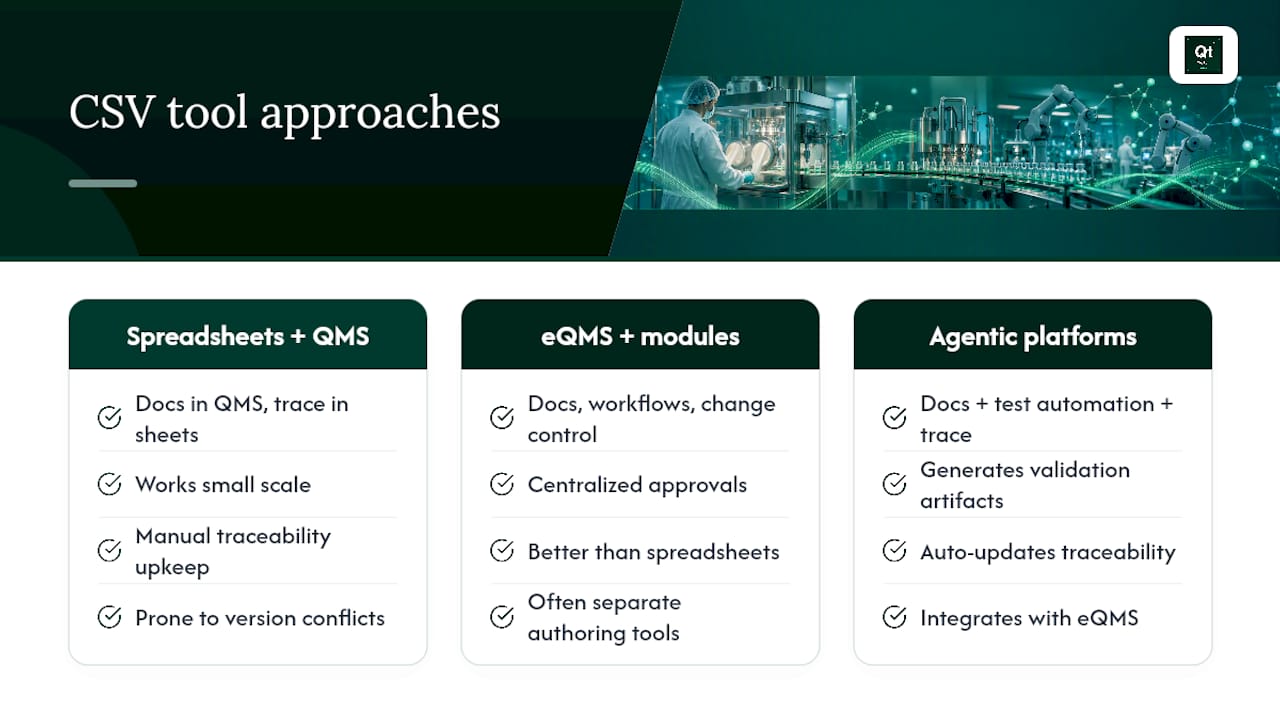
Most CSV programs run on some combination of three tool categories: document management systems for controlled documents (URS, protocols, reports), test management tools for executing and tracking test cases, and increasingly, dedicated validation automation platforms that combine both functions with built-in traceability.
Traditional approaches lean heavily on QMS platforms extended with validation modules, paired with spreadsheet-based traceability matrices maintained manually. This works at small scale but becomes fragile fast: a spreadsheet traceability matrix with hundreds of rows, maintained by hand across multiple contributors, is exactly where version conflicts and orphaned entries creep in.
Electronic quality management systems (eQMS) with validation-specific modules handle document routing, approval workflows, and change control integration more reliably than spreadsheets, and most device manufacturers already run one for broader quality management. The gap most teams hit is connecting that eQMS to the actual authoring work, requirements drafting, test case generation, traceability updates, which still often happens outside the system in separate documents.
Agentic validation platforms can close that gap by generating validation artifacts directly with built-in traceability and connecting to existing eQMS platforms through integrations rather than replacing them. The practical advantage isn't just speed. It's that traceability updates automatically as requirements evolve, instead of requiring a manual reconciliation pass before every audit.
Whatever combination your organization runs, the evaluation question is the same: does the tool make traceability easier to maintain over the system's full lifecycle, or does it just make the initial authoring faster while leaving ongoing maintenance manual? Both matter, but maintenance is where most programs actually lose ground.
The Real Gap in Most CSV Programs
The conventional advice on CSV treats documentation volume as a proxy for compliance quality: more test scripts, more signed pages, more binders on the shelf. That instinct is backwards, and the FDA's own CSA guidance says so directly. A thin, well-reasoned risk rationale for a low-impact feature is stronger evidence than fifty pages of scripted test results nobody can explain the purpose of six months later.
What gets underestimated is how much audit defensibility rides on the URS, not the test execution. Teams pour resources into elaborate OQ protocols while writing requirements in language too vague to trace against anything. Fix the requirements first. Everything downstream, traceability, risk classification, CSA-aligned test depth, only works if the thing you're testing against was written to be testable in the first place.
If there's one place to spend disproportionate effort in 2026, it's building the documented rationale behind your risk classifications before an inspector asks for it, not after. That's the artifact CSA actually rewards, and it's the one most legacy CSV programs don't have on file yet.
— Matt
How Qualitum Can Help You Move Faster on CSV
Qualitum gives validation teams a faster path through the exact bottleneck this guide keeps circling back to: the manual documentation burden that eats up authoring time on URS, test cases, and traceability matrices.

If you want a concrete look at where your current validation program stands against a risk-based CSA approach, start with the free validation gap report. It's built specifically to flag the traceability and documentation gaps auditors catch first. Technical teams evaluating deeper automation can also look at Validate·AI for authoring specifics or the full platform overview for how integration with your existing QMS actually works. Either way, the next step is a conversation, not a commitment, so reach out to Qualitum's technical team and see where a pilot fits your system inventory.
Sources
- Computer Software Assurance for Production and Quality Management System Software | FDA
- The essential guide to computer system validation in the pharmaceutical industry (PMC)
- Electronic Code of Federal Regulations — 21 CFR Part 820
FAQ
What Is CSV in a Medical Device Context?
CSV, computer system validation, is the documented lifecycle process proving that a computerized system used in device manufacturing or quality management performs as intended and preserves data integrity, required under 21 CFR Part 820 and Part 11.
What Is the Difference Between CSA and CSV?
CSV traditionally implies exhaustive, scripted testing of every system function, while CSA (Computer Software Assurance) is the FDA's risk-based approach that scales testing depth to a feature's actual risk to patient safety and data integrity, documented through critical-thinking rationale rather than uniform scripts.
What Is GxP and How Does It Relate to CSV?
GxP refers to the family of "good practice" regulations (GMP, GLP, GCP) governing regulated industries, and CSV is the mechanism by which manufacturers demonstrate that computerized systems supporting GxP processes are fit for their intended use.
Why Is CSV Required for Medical Device Companies?
CSV is required because unvalidated software controlling manufacturing, quality decisions, or electronic records can compromise product safety and data trustworthiness, risks that 21 CFR Part 820 and Part 11 specifically address through mandatory validation.
Can Automation Tools Legitimately Reduce CSV Authoring Time?
Agentic validation platforms like Qualitum can meaningfully cut authoring time by generating cross-linked URS, test cases, and traceability matrices with ALCOA+ checks built into the authoring process itself, rather than replacing the risk judgment and review that regulated teams must still perform.
Recommended
- CSV to CSA: The FDA Transition Playbook for QA Teams
- CSA vs CSV for Validation Teams: What QA Needs to Know
- Part 11 Compliance: Inspection-Ready Checklist for QA Teams
- Change Impact Assessment for CSV/CSA: A Validation Lead's Guide
FAQ
What Is CSV in a Medical Device Context?
CSV, computer system validation, is the documented lifecycle process proving that a computerized system used in device manufacturing or quality management performs as intended and preserves data integrity, required under 21 CFR Part 820 and Part 11.
What Is the Difference Between CSA and CSV?
CSV traditionally implies exhaustive, scripted testing of every system function, while CSA (Computer Software Assurance) is the FDA's risk-based approach that scales testing depth to a feature's actual risk to patient safety and data integrity, documented through critical-thinking rationale rather than uniform scripts.
What Is GxP and How Does It Relate to CSV?
GxP refers to the family of "good practice" regulations (GMP, GLP, GCP) governing regulated industries, and CSV is the mechanism by which manufacturers demonstrate that computerized systems supporting GxP processes are fit for their intended use.
Why Is CSV Required for Medical Device Companies?
CSV is required because unvalidated software controlling manufacturing, quality decisions, or electronic records can compromise product safety and data trustworthiness, risks that 21 CFR Part 820 and Part 11 specifically address through mandatory validation.
Can Automation Tools Legitimately Reduce CSV Authoring Time?
Agentic validation platforms like Qualitum can meaningfully cut authoring time by generating cross-linked URS, test cases, and traceability matrices with ALCOA+ checks built into the authoring process itself, rather than replacing the risk judgment and review that regulated teams must still perform.