A live traceability matrix is a continuously updated, linked record that connects each requirement to its implementing artifacts and verification evidence. Unlike a static RTM built once and frozen at a milestone, it stays synchronized as requirements, designs, and test results change, keeping regulated projects inspection-ready under frameworks like ISO/IEC/IEEE 29148, FDA design control expectations, and ALCOA+ data integrity principles.
TL;DR:
>
- Maintaining a live traceability matrix requires real-time updates linked to requirements, design, testing, and risk controls, ensuring ongoing audit readiness.
- Automating links and change events between requirement management tools and testing platforms helps prevent orphaned records and reduces manual effort.
- Regular integrity checks and clear ownership with SLAs are essential to avoid matrix decay from staleness, broken links, or unclear responsibility.
- Building a lean schema with core columns, then incrementally adding advanced fields like regulatory references, supports practical, sustainable upkeep.
- Using a high-risk subsystem for initial piloting can demonstrate immediate operational benefits, such as faster impact analysis and reduced last-minute remediation.
Table of Contents
- What Goes Into a Live Traceability Matrix
- Live Traceability Reduces Audit Risk, Not Just Paperwork
- How to Build a Live RTM Step by Step
- Keeping the Matrix Live: Automation and Governance Patterns
- A Sample RTM Row Structure You Can Adapt
- Where Live RTMs Break Down
- How Qualitum Operationalizes Live Traceability
- Where to Pilot Your First Live RTM
- See How Qualitum Keeps Your Matrix Audit-Ready
- Sources
- FAQ
What Goes Into a Live Traceability Matrix
A traceability matrix earns the word "live" through its schema, not its file format. A spreadsheet can technically update in real time, but most fail because the columns were never built to survive change. The fields below reflect what regulated teams actually need to defend a design under audit.
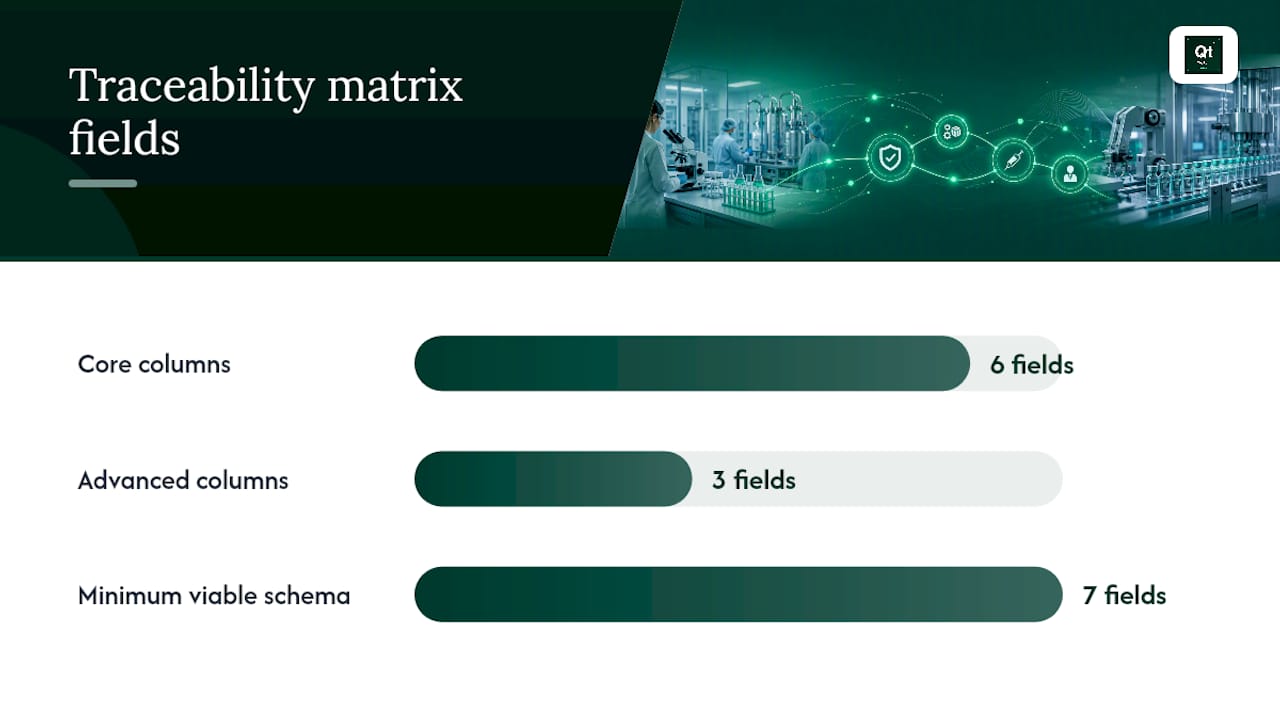
Core columns answer the basic question every reviewer asks: does this requirement have proof? A workable traceability matrix typically includes a unique Requirement ID, a plain-language description, the requirement's source (a user need, a regulatory clause, a risk control), its priority, one or more linked Test Case IDs, and a Current Status field that reflects where verification actually stands today, not where it stood at the last design review.
Regulated programs need more than that baseline. Medical device and pharma teams commonly add:
- Risk Control ID linking the requirement to its entry in the risk management file
- Regulatory/Standard Reference pointing to the specific clause (21 CFR Part 820, IEC 62304, ISO 14971) the requirement satisfies
- ALCOA+ Flag marking whether the record has passed data integrity checks at write time and review time
- Change History capturing who modified the row, when, and why, satisfying audit trail expectations without a separate log
Relationship types matter as much as the columns themselves. A requirement can be "verified by" a test case, "implemented by" a design element, or "derived from" a higher-level user need. Forward traceability follows a requirement down to its test evidence; backward traceability follows a test result up to the requirement it validates. Bidirectional traceability, where every link resolves cleanly in both directions, is what auditors actually check, because a broken backward path is exactly how orphaned test cases and unverified requirements slip through.
| Column | Purpose | Required or advanced |
|---|---|---|
| Requirement ID | Unique identifier for traceability queries | Core |
| Description | Plain-language statement of the requirement | Core |
| Source | Origin document or stakeholder need | Core |
| Priority | Risk-based sequencing for test coverage | Core |
| Test Case ID(s) | Verification evidence link | Core |
| Current Status | Real-time verification state | Core |
| Risk Control ID | Ties requirement to risk file entry | Advanced |
| Regulatory Reference | Specific standard or clause satisfied | Advanced |
| ALCOA+ Flag | Data integrity check status | Advanced |
Teams new to this should resist the urge to build every field on day one. A minimum viable schema, the six core columns plus a single regulatory reference field, is something a small team can actually keep current. You can always add risk control links once the basic habit of updating status holds.
Live Traceability Reduces Audit Risk, Not Just Paperwork
Regulatory scrutiny on quality systems has intensified. The FDA's 2024 amendments to the Quality System Regulation align device requirements more closely with ISO 13485, and that alignment raises the bar on what inspectors expect to see when they ask for verification evidence. A matrix that was accurate six months ago and hasn't been touched since doesn't meet that bar.
For medical device programs, the RTM is one of the clearest paths to a defensible Design History File. FDA guidance ties design control expectations directly to the ability to show, row by row, that a requirement was implemented and verified. Standards like IEC 62304 for software life cycle processes reinforce the same expectation for embedded and software-driven devices: every requirement needs a traceable path to a verification result, and that path needs to hold up under scrutiny months or years after the work was done.
The operational payoffs show up well before an inspector arrives:
- Faster impact analysis. When a requirement changes, a live RTM tells you instantly which test cases, design elements, and risk controls need review, instead of a multi-day manual search across documents.
- Risk-based test prioritization. Linking priority and risk control fields lets QA teams focus verification effort where it matters instead of testing everything equally.
- Fewer last-minute remediation cycles. Teams that maintain traceability as an ongoing habit avoid the frantic reconstruction effort that typically precedes an audit.
Pro Tip: Run a monthly "orphan query" against your matrix, filtering for any requirement with no linked test case or any test case with no linked requirement. Catching a broken link in week four is a five-minute fix. Catching it during an inspection is a finding.
Practitioner guidance increasingly frames the living RTM as the operational backbone of risk-based testing, particularly for teams working in agile or iterative cycles where requirements and test scope shift weekly rather than at fixed milestones. A matrix that only gets rebuilt at each major release simply can't keep pace with that cadence, and the gap between "what we documented" and "what we actually built" grows every sprint it goes unchecked.
How to Build a Live RTM Step by Step
Building a matrix that stays current starts with decisions about ownership and scope, not with column headers. Here's the sequence that works for most regulated teams.
- Decide your source of truth. Pick the authoritative system for requirements (a requirements management tool, an ALM platform, or a controlled document repository) and commit to it. Splitting authority across multiple "true" copies is the single fastest way to guarantee drift.
- Scope the pilot narrowly. Choose one subsystem, one product line, or one requirement category rather than attempting an enterprise-wide rollout on day one. A contained pilot surfaces schema problems before they multiply.
- Design a lean schema and relationship model. Start with the core six fields, define what "verifies," "implemented by," and "derived from" mean for your team, and document this as your traceability information model, essentially the rulebook for how records connect.
- Automate the links. Wire your requirements tool, design repository, and test management system together through APIs, integrations, or event hooks so that a new test case automatically registers against its requirement instead of waiting for someone to update a spreadsheet by hand.
- Capture change events as they happen. Configure your toolchain to log status changes, new links, and modified requirements in real time rather than batching updates weekly.
- Assign owners and set SLAs. Every row needs a named owner responsible for keeping its links current, and every flagged break (an orphaned test, a stale status) needs a defined resolution window, commonly 48 to 72 hours for active projects.
- Set up automated coverage checks. Build a recurring report, whether a dashboard or a scheduled query, that surfaces coverage percentage, orphaned records, and status discrepancies without requiring anyone to manually audit the matrix.
Pro Tip: Assign SLA ownership by role, not by name. "The QA lead resolves flagged links within 72 hours" survives staff turnover. "Sarah resolves flagged links" does not.
Cross-industry traceability work backs up this event-driven approach. Digital traceability research in food supply chains shows that systems built around event capture and interoperable identifiers outperform static, periodically rebuilt records for both speed and accuracy, a pattern that translates directly to regulated product development, where the "recall" equivalent is a failed audit finding or a field action triggered by an unverified change.
Keeping the Matrix Live: Automation and Governance Patterns
The maintenance model determines whether your RTM survives past the pilot. Most matrices die a slow death from three causes: no automation, no ownership, and no routine check for integrity, addressed one at a time below.
Event-driven maintenance is the mechanism that keeps a matrix from decaying between reviews. Webhooks and change-event listeners can watch your requirements tool and test management system, then automatically flag any downstream artifact affected by a modification, so a changed acceptance criterion doesn't sit disconnected from its test case for weeks before anyone notices.
Integrations do the heavy lifting that manual updates never will:
- ALM and PLM systems feed requirement and design changes into the matrix without a human re-typing anything
- Configuration management tools capture version changes that affect which test results still apply
- CI pipelines and test management platforms push pass/fail status directly into the Current Status field the moment a test run completes
- Change control systems log the who, what, and when that satisfies audit trail and ALCOA+ traceability requirements automatically
Automated integrity checks catch what human review misses. Scheduled queries for orphan detection (a requirement with zero linked tests), missing coverage (a risk control with no verification path), and discrepant statuses (a test marked "passed" against a requirement still flagged "in progress") should run on a fixed cadence, not only before an audit. Practitioner guidance from requirements management vendors makes the same point: the real value of an RTM comes from treating it as part of daily workflow rather than a document reconstructed under deadline pressure.
Governance closes the loop. Someone needs explicit responsibility for reviewing flagged breaks on a set cadence, whether weekly or biweekly depending on program velocity, and that review needs to produce an audit-ready checkpoint: a timestamped record showing the matrix was checked, what was found, and what was resolved. Skip this step and the automation just generates alerts nobody acts on.
Pro Tip: Build your integrity check to flag discrepancies, not just count them. A dashboard that says "12 orphaned links" is less useful than one that lists each orphan with its last-modified date and assigned owner.
A Sample RTM Row Structure You Can Adapt
Seeing a populated matrix makes the schema concrete. The rows below show how a requirement flows from source through design, test, status, and regulatory reference in a medical device context.
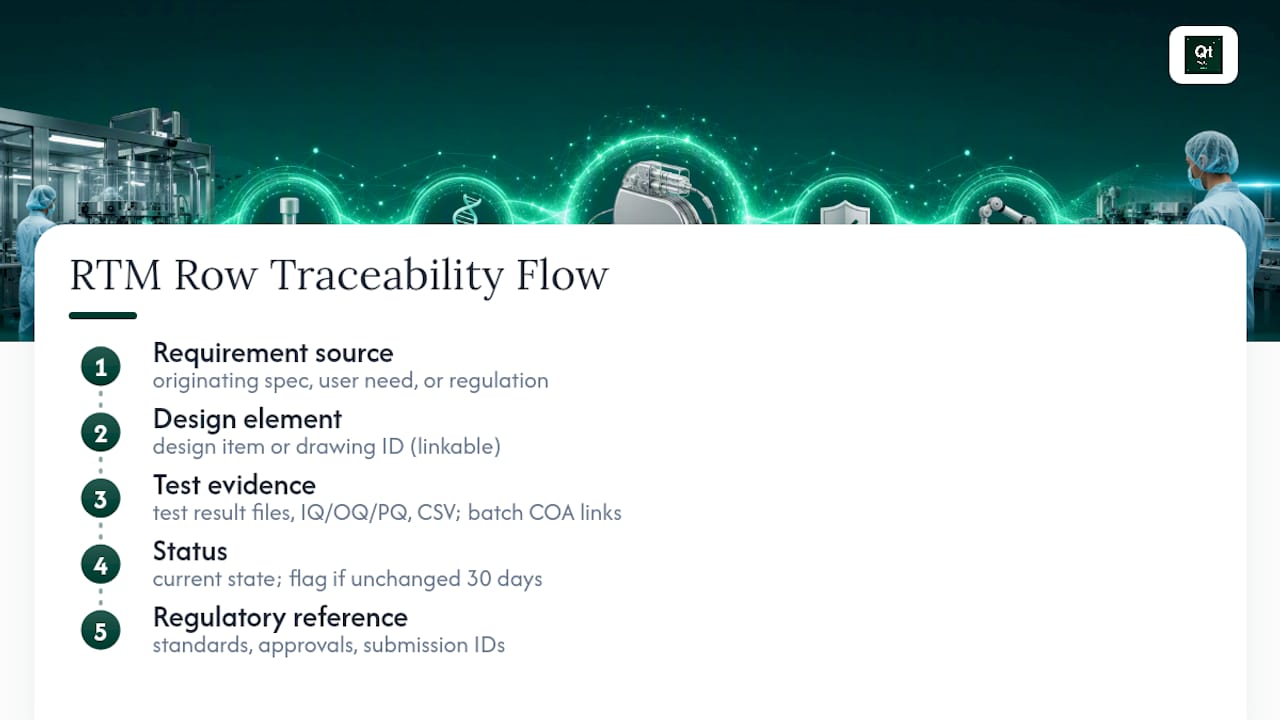
This structure scales directly for pharma and medical device work by extending each row with a Risk Control ID column that links back to the risk management file, plus a Validation Protocol Reference field pointing to the specific IQ/OQ/PQ or CSV document that generated the test evidence. Laboratory teams working with outside partners should also plan for how sample or batch documentation, including certificates of analysis, get referenced in the matrix when a requirement depends on lab-verified inputs.
Importing this into a spreadsheet is straightforward: use one row per requirement, protect the ID column from edits, and add a simple conditional format that flags any row where Status hasn't changed in 30 days. Teams using ALM tools like Jira, Polarion, or Jama can typically map these same columns directly onto custom fields and use the platform's native linking to enforce bidirectional traceability instead of relying on manual cross-references.
Where Live RTMs Break Down
Most RTM failures trace back to one of four root causes, and each has a straightforward fix.
- Staleness from one-time builds. A matrix built once for a milestone review decays immediately afterward. Fix it with automation and a defined review cadence, not another manual rebuild.
- Over-engineered schemas. Twenty-column matrices look thorough and get abandoned within a quarter. Start with the minimum viable schema and add fields only when a real audit gap demands it.
- Broken or orphaned links. Requirements without tests, or tests without requirements, accumulate silently. Automated integrity checks and a triage workflow catch these before an auditor does.
- Unclear ownership. A matrix with no named owner has no one accountable for keeping it current. Map every row category to a role, not a person, with an explicit maintenance SLA attached.
How Qualitum Operationalizes Live Traceability
Qualitum's agentic validation platform builds live traceability into the authoring process itself rather than treating it as a separate maintenance chore. Every record passes ALCOA+ checks at write time and again at review time, so links between requirements, protocols, and evidence stay defensible as they're created, not reconstructed later. Teams using Validate·AI report over 70% time savings in authoring, with inspection-ready audit trails generated as a byproduct of the work rather than a bolt-on step. For regulated teams weighing whether their current matrix would survive scrutiny, a validation gap check shows where the exposure actually sits.
Where to Pilot Your First Live RTM
Pilot on a high-risk subsystem with measurable stakes, one where a missed verification would actually matter. Track two numbers: coverage percentage and time-to-verify after a requirement change. Stakeholder buy-in comes fast once you can run an audit query live in a meeting and get an answer in seconds instead of days. Once that pilot holds for a full release cycle, expand governance and automation to adjacent product lines rather than jumping straight to enterprise rollout.
— Matt
See How Qualitum Keeps Your Matrix Audit-Ready
Building a live RTM by hand, with webhooks, integrity checks, and manual SLA tracking, takes real engineering investment most quality teams don't have spare capacity for. Qualitum is built specifically for regulated life sciences teams that need traceability enforced automatically, not maintained through discipline alone. Its agent-authored validation records carry links between requirements, test evidence, and regulatory references from the moment they're created, with ALCOA+ checks running at write time and review time so nothing drifts silently between audits.

If you want to see where your current traceability approach has gaps before an inspector finds them, start with the free validation gap report. For a broader look at how the platform handles validation lifecycle work end to end, the platform overview walks through the full system.
Sources
- Traceability: Attracting attention in manufacturing | SATO America
- Medical devices; quality system regulation amendments | Federal Register
FAQ
What Is an RTM With an Example?
A requirements traceability matrix links each requirement to its design, test evidence, and status, such as linking "Device shall alert on sensor fault" to a design reference, a test case, and a verified result, as shown in the sample table above.
Is RTM Used in Agile?
Yes, agile teams use RTMs, though the matrix needs to update every sprint rather than only at major milestones, which is why event-driven automation matters more in agile programs than in fixed-milestone ones.
How Do You Build a Traceability Matrix?
Pick an authoritative source of truth, design a lean schema around core fields like Requirement ID and Status, automate links between your requirements and test tools, and assign owners with defined maintenance SLAs.
How Do You Prepare an RTM for Testing?
Link every requirement to at least one test case before test execution begins, prioritize by risk level, and confirm bidirectional traceability so no test case exists without a linked requirement and vice versa.
Does a Live RTM Really Reduce Audit Prep Time?
Teams that maintain traceability continuously, rather than rebuilding it before each audit, avoid the multi-week remediation cycles common with static matrices, since coverage gaps and broken links get caught and fixed as they occur rather than discovered all at once.
Recommended
- What Is a Validation Traceability Matrix and Why Auditors Demand One
- Audit Trail Review: Inspection-Ready Guide for QA Teams
- Audit Readiness Checklist for Validation and QA Leaders
FAQ
What Is an RTM With an Example?
A requirements traceability matrix links each requirement to its design, test evidence, and status, such as linking "Device shall alert on sensor fault" to a design reference, a test case, and a verified result, as shown in the sample table above.
Is RTM Used in Agile?
Yes, agile teams use RTMs, though the matrix needs to update every sprint rather than only at major milestones, which is why event-driven automation matters more in agile programs than in fixed-milestone ones.
How Do You Build a Traceability Matrix?
Pick an authoritative source of truth, design a lean schema around core fields like Requirement ID and Status, automate links between your requirements and test tools, and assign owners with defined maintenance SLAs.
How Do You Prepare an RTM for Testing?
Link every requirement to at least one test case before test execution begins, prioritize by risk level, and confirm bidirectional traceability so no test case exists without a linked requirement and vice versa.
Does a Live RTM Really Reduce Audit Prep Time?
Teams that maintain traceability continuously, rather than rebuilding it before each audit, avoid the multi-week remediation cycles common with static matrices, since coverage gaps and broken links get caught and fixed as they occur rather than discovered all at once.