A validated pharmaceutical LIMS must prove ALCOA+-aligned data integrity and 21 CFR Part 11 controls for every regulated workflow it touches, using a documented, risk-based approach that traces requirements to tests and evidence. Validation isn't optional whenever a LIMS supports GxP records: quality reviewers and auditors expect proof that the system's intended use, risk classification, test coverage, and results all connect in a single defensible thread.
TL;DR:
>
- Validation efforts should focus on high-risk functions like audit trails, electronic signatures, and access controls, with lighter testing for low-risk features.
- The validation plan must start with an intended-use statement and include a risk assessment to determine test scope, not a feature list from the vendor.
- Test scripts should trace directly to regulatory requirements, document expected results beforehand, and treat deviations as data points instead of failures.
- Maintaining an up-to-date traceability matrix during testing is critical for audit readiness and prevents gaps in requirement-to-test coverage.
- Automated validation platforms can reduce authoring time by over 70% and ensure ALCOA+ compliance at every documentation stage.
Table of Contents
- What Regulators Expect From LIMS Compliance in Pharmaceuticals
- How Do You Scope a LIMS Validation Plan?
- What Does IQ, OQ, and PQ Look Like for a LIMS?
- Validating Instrument Interfaces and Data Migration
- Keeping Your Validation Package Audit-Ready
- Change Control, Periodic Review, and Revalidation Triggers
- Common LIMS Validation Challenges and Quick Fixes
- What Automation Changes About LIMS Validation Evidence
- Building Validation Deliverables That Hold Up Under Inspection
- Why Risk-Based Thinking Beats Documentation Volume
- How Qualitum Fits Into Your Validation Program
- Sources
- FAQ
What Regulators Expect From LIMS Compliance in Pharmaceuticals
Inspectors don't ask whether you validated your LIMS. They ask you to prove it, on paper, with evidence that survives cross-examination. Under 21 CFR Part 11, that proof needs to cover six operational control areas: system validation, audit trails, electronic signatures, access controls, record retention, and system security. Miss one, and the gap shows up as a data integrity finding, not a paperwork nitpick.
Every record your LIMS generates also has to hold up against ALCOA+: attributable, legible, contemporaneous, original, accurate, plus complete, consistent, enduring, and available. A result that can't be traced back to who entered it, when, and under what conditions fails the standard even if the number itself is correct.
The FDA's Computer Software Assurance framework changes how you get there. Instead of scripting exhaustive test cases for every function, CSA directs testing effort toward functions that could affect patient safety or product quality, and allows lighter-touch verification elsewhere.
Common inspection findings that proper validation prevents:
- Audit trails disabled or not reviewed on a defined schedule
- Shared logins that erase attributability
- Electronic signatures not bound to the specific record they approve
- No documented linkage between a requirement and the test that verified it
By the numbers: Lab Manager's review of Part 11 enforcement patterns identifies audit-trail review as one of the most frequently cited gaps in pharmaceutical inspections, precisely because labs treat it as a pre-submission cleanup task rather than a routine control.
How Do You Scope a LIMS Validation Plan?
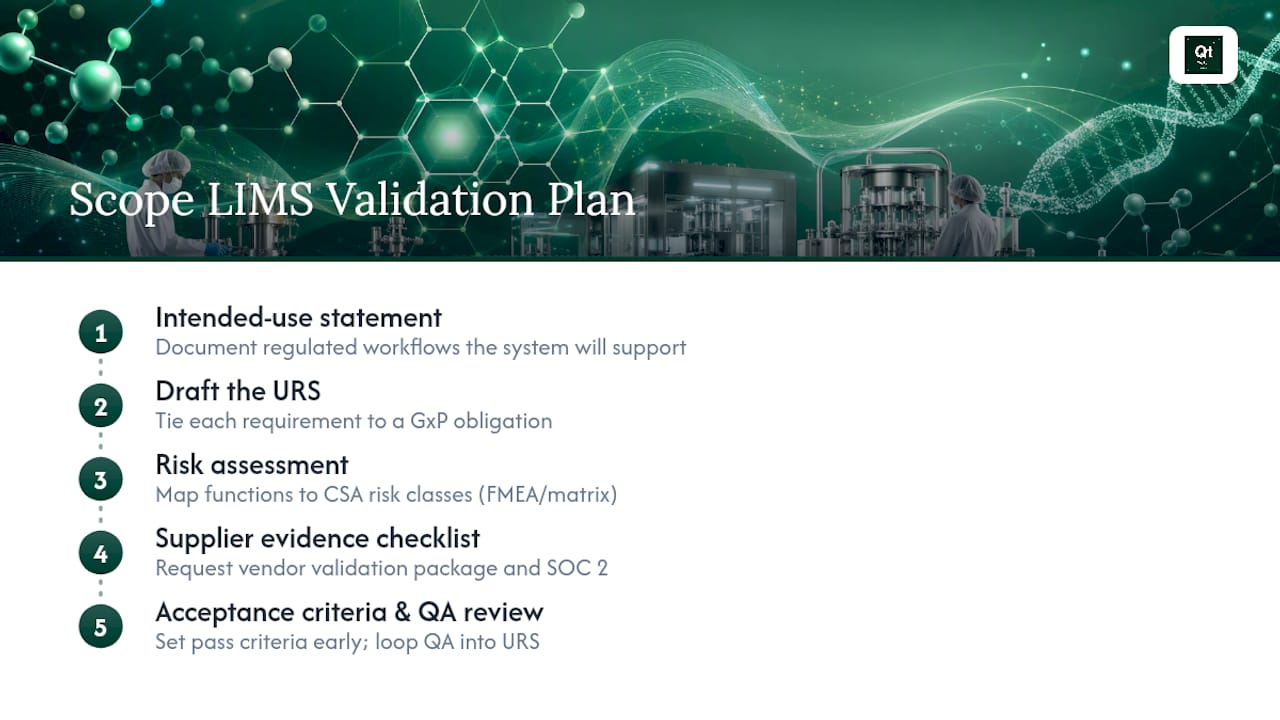
Every defensible LIMS validation plan starts with a intended-use statement, not a feature list. Write down exactly which regulated workflows the system will support (sample tracking, stability testing, batch release, whatever applies) before a single test script gets drafted. That statement becomes the anchor for your user requirements specification (URS) and functional requirements specification (FRS), and it's what an auditor will ask to see first.
1. Draft the URS around regulatory outcomes, not vendor features. Each requirement should tie back to a GxP obligation, whether that's electronic signature enforcement, audit-trail completeness, or specimen chain-of-custody. A URS written from a vendor's marketing sheet instead of your own regulatory needs is the single most common cause of rework once testing starts.
2. Run a risk assessment before you assign test depth. FMEA or a simple risk matrix works fine here; the goal is mapping each function to a CSA risk class based on its potential impact on patient safety, product quality, or data integrity. High-risk functions (result approval, audit-trail configuration) get scripted, documented testing. Low-risk functions (report formatting, dashboard color schemes) can rely on unscripted verification.
3. Build a supplier evidence checklist before assuming you need to test everything yourself. For SaaS LIMS, request the vendor's validation package, SOC 2 report, and security documentation; validated supplier evidence can reduce your in-house testing burden when it genuinely covers your intended use. For on-premise deployments, you'll carry more of that verification internally, particularly around infrastructure and access controls.
Pro Tip: Loop QA into the URS review before it's finalized, not after IQ starts. Requirements gaps caught early cost an afternoon; the same gaps caught during OQ cost a retest cycle and a deviation report.
Acceptance criteria should be set at this planning stage too; deciding what "pass" means during test execution, rather than in advance, invites exactly the kind of after-the-fact rationalization inspectors are trained to spot.
What Does IQ, OQ, and PQ Look Like for a LIMS?
Installation Qualification confirms the system is built and configured the way the specification says it should be. That means verifying server or cloud environment settings, software versions, and security configurations against your documented baseline, not just checking that the install completed without an error message.
Operational Qualification tests whether individual functions behave correctly under defined conditions. Under a CSA-aligned approach per GAMP 5, OQ scripts concentrate on the high-risk functions identified during your risk assessment: result calculations, workflow approvals, audit-trail capture, access-control enforcement. Lower-risk functions can move through ad hoc or exploratory testing with a documented record of what was checked, which is faster and still defensible when the risk rationale is written down.
Performance Qualification, or user acceptance testing, confirms the system performs correctly in the hands of real users doing real work. Test data should mirror actual sample types, batch sizes, and edge cases (a specimen with a failed result, a signature applied out of sequence) rather than clean, idealized scenarios that never surface a defect.
Building the test package:
- Design test scripts that trace directly to a URS or FRS line item
- Capture expected results before execution, never after
- Log deviations with a clear description, root-cause note, and disposition (retest, waiver, or requirement change)
- Route every executed script through a documented QA review before it counts as evidence
Pro Tip: Treat a deviation as a data point, not a failure to hide. A validation package with a few well-documented deviations and clean resolutions reads as more credible to an auditor than one that claims a flawless first pass on every script.
Approval gates matter as much as the tests themselves: nothing should move from OQ to PQ, or from PQ to go-live, without a named QA reviewer signing that the evidence meets the pre-defined acceptance criteria.
Validating Instrument Interfaces and Data Migration
Instrument connections are where ALCOA+ quietly breaks down if nobody checks the mapping logic, making the use of primary antibodies, ELISA kits & research reagents with reliable traceability essential for accurate results. A parsing script that misreads a well position or drops a UDF mapping doesn't throw an error. It just attaches the wrong result to the wrong sample, silently.
Validate the specific mapping parameters your instrument interfaces rely on: container identifiers, well or slot positions, and any custom field maps used to route results. Illumina's parseCSV documentation offers a useful concrete example of how granular this mapping logic gets, and why generic "it connected successfully" testing isn't validation.
Data migration checks that belong in every cutover plan:
- Reconcile a statistically justified sample of migrated records against the source system, field by field
- Confirm timestamps migrate with original creation and modification metadata intact, not stamped with the migration date
- Verify user attribution survives the move, so historical records still show who entered or approved them
- Confirm the audit trail itself migrated, or that a documented bridge preserves the old system's history
Immutability checks matter here too: once migrated, a record shouldn't be editable in a way that erases its original provenance.
Keeping Your Validation Package Audit-Ready
A complete validation package typically includes the validation plan, URS/FRS, risk assessment, a traceability matrix linking requirements to tests to results, executed IQ/OQ/PQ protocols, deviation records, and a validation summary report. Missing any one of these turns a routine inspection question into a scramble.
The traceability matrix deserves special attention. It's the single document that lets an auditor follow the thread from "this requirement mattered because of X regulation" through "this test verified it" to "here's the evidence." Build it as you go, not retroactively.
For audit-trail review, set a defined schedule rather than reviewing only before submissions. Findings from those reviews should feed directly into your CAPA system when they surface anomalies, and that linkage itself needs to be documented and inspectable.
Lab Manager's analysis of Part 11 enforcement notes that routine, documented audit-trail oversight is what separates a compliant program from one that only performs the check right before an inspection.
Retention practices matter over the long haul: store validation records in formats and systems that remain readable for the full retention period, and periodically confirm you can actually retrieve and open them, not just that they exist somewhere.
Change Control, Periodic Review, and Revalidation Triggers
Validating a LIMS once and never touching the file again is how compliant systems quietly drift out of their validated state. A disciplined change-control and periodic-review cadence is what keeps the original validation evidence meaningful years later.
- Run an impact assessment on every proposed change, no matter how small it looks. A configuration tweak to a calculation field can silently invalidate a result set if nobody checks whether it affects a previously validated function.
- Route changes through a formal approval gate that includes QA sign-off before implementation, with the assessment documented alongside the change record.
- Schedule periodic reviews, commonly annually for GxP systems, tracking KPIs like open deviations, audit-trail exception rates, and unresolved CAPA items tied to the LIMS.
- Define clear revalidation triggers in advance: major version releases, new instrument or system integrations, a change in intended use, or a shift in the regulatory requirements the system supports.
Waiting until a problem surfaces to decide whether a change needed revalidation is a losing strategy in front of an inspector.
Common LIMS Validation Challenges and Quick Fixes
Most LIMS validation findings trace back to a handful of repeat offenders, and each one has a straightforward fix once you know to look for it.
- Untested edge cases in UAT — mitigate by scripting scenarios with failed results, out-of-sequence signatures, and boundary values, not just clean-path data.
- Audit trails configured but never reviewed — mitigate with a documented review calendar and a named owner.
- Vendor evidence accepted without verifying it covers your intended use — mitigate with a supplier evidence checklist mapped to your own risk classes.
- Traceability matrix built after testing instead of during planning — mitigate by making it a living document from the URS stage onward.
| Pitfall | Inspection risk | Fast mitigation |
|---|---|---|
| No routine audit-trail review | Part 11 data integrity finding | Set a recurring review schedule with CAPA linkage |
| Shared user logins | Attributability failure | Enforce unique credentials, verify in access-control tests |
| Requirements not traced to tests | Incomplete evidence chain | Maintain a live traceability matrix from day one |
| Supplier evidence unverified | Gaps in cloud/SaaS assurance | Require SOC reports and map to intended use |
What Automation Changes About LIMS Validation Evidence
Manual authoring is where most validation cycles lose weeks. Every protocol, trace matrix entry, and deviation write-up has to be drafted, formatted, and cross-checked by hand, and that burden scales with every regulated workflow you add.
Qualitum's agent-based approach checks every record against ALCOA+ criteria at write-time and at review-time, rather than leaving that check to a manual QA pass at the end. That structural difference is what supports the platform's documented reduction in authoring time, which the company reports at over 70%.
- Traceability matrices update automatically as requirements, tests, and results are authored
- Audit-trail evidence is captured in a format built for inspection, not reconstructed after the fact
- Human signatures remain the authoritative approval step, with automation handling the drafting burden underneath
The result isn't less rigor. It's the same rigor, produced faster, with less room for a transcription error to become an inspection finding.
Building Validation Deliverables That Hold Up Under Inspection
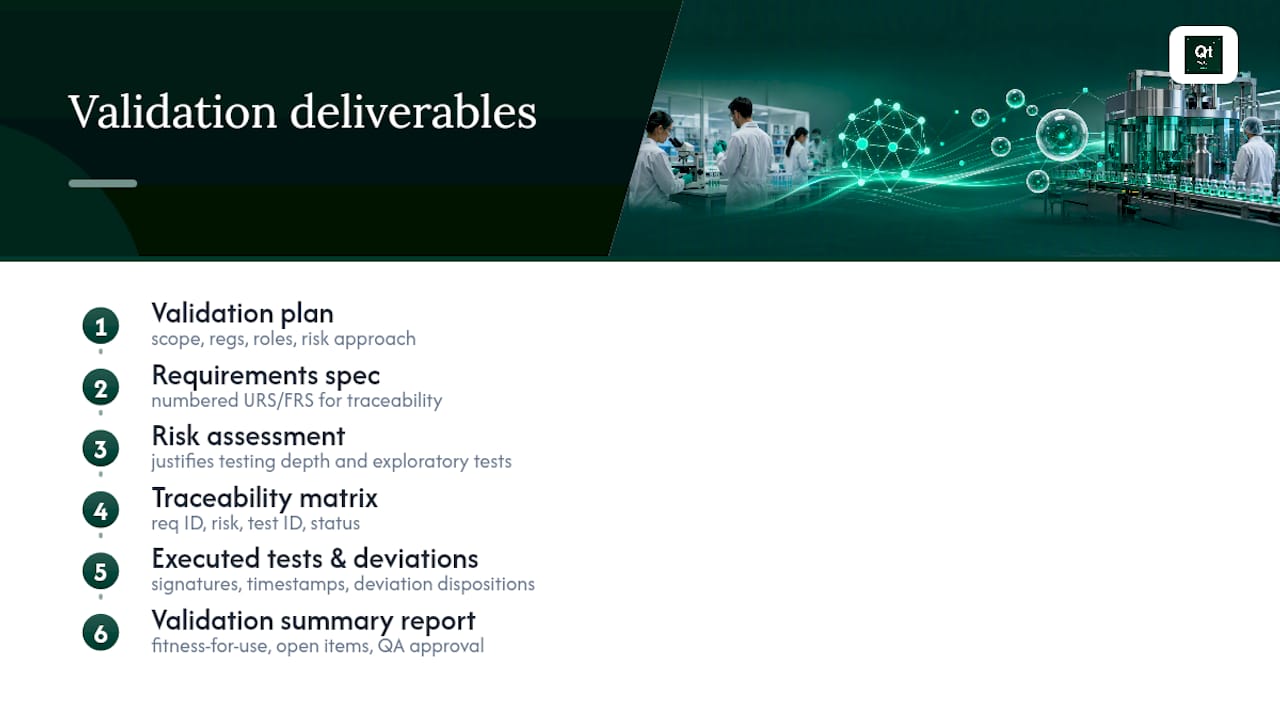
A pharmaceutical LIMS validation package needs to read as one coherent argument, not a folder of disconnected documents. Structure your deliverables so each one answers a specific question an inspector will ask.
The validation plan answers "what were you trying to prove and how." It states scope, applicable regulations, roles and responsibilities, and the risk-based approach you're following, whether that's a GAMP 5 category framework or a CSA-aligned risk tiering.
The requirements specification (URS/FRS) answers "what did the system need to do." Number every requirement so it can be referenced in the traceability matrix without ambiguity.
The risk assessment report answers "why did some functions get more testing than others." This document is what justifies unscripted or exploratory testing for low-risk functions when an auditor questions why a script wasn't written for every feature.
The traceability matrix answers "how do you know you tested everything that mattered." Format it as a table with requirement ID, risk class, associated test script ID, and result status, and keep it current throughout execution rather than reconstructing it at the end.
The executed test protocols and deviation log answer "show me the proof." Every script needs a reviewer signature, a timestamp, and a disposition for any deviation encountered.
The validation summary report closes the package. It states whether the system is fit for intended use, references any open items with remediation timelines, and carries the QA approval that authorizes go-live. ISO/IEC 17025 reinforces this same expectation for laboratory information-management systems more broadly, requiring validation before use proportional to the system's intended application.
Why Risk-Based Thinking Beats Documentation Volume
The conventional advice on LIMS validation still leans on a documentation-heavy mindset: script every function, generate paper for everything, and treat volume as a proxy for rigor. That instinct is outdated. CSA's whole premise is that scripted testing should concentrate where patient safety or product quality is actually at stake, and unscripted, well-reasoned verification is legitimate everywhere else.
What the research actually supports is this: validation quality comes from the strength of the traceability between requirement, risk, test, and result, not from the page count of the final binder. A thin package with airtight traceability beats a thick one with gaps an auditor can find in ten minutes.
Where most teams go wrong isn't execution. It's scoping. Skipping the intended-use statement, or writing a URS from a sales deck instead of your own regulatory obligations, guarantees rework later. Prioritize the risk assessment and the traceability matrix before you write a single test script. Everything downstream, including how much you can safely automate, depends on getting that foundation right.
— Matt
How Qualitum Fits Into Your Validation Program
If your team is still hand-authoring URS documents, trace matrices, and test scripts in separate files that need manual reconciliation, you're spending review time on formatting instead of on risk. Qualitum's platform closes that gap by having every record checked against ALCOA+ at the moment it's written and again at review, so the evidence arrives audit-ready instead of needing a cleanup pass before submission.

The Validate·AI and Operate·AI platform builds your traceability matrix as requirements, tests, and results are authored, with human QA sign-off remaining the final word at every gate. For teams evaluating fit before committing budget, Qualitum's Pilot engagement is a practical way to test the approach against a real validation scope, and the free validation gap report gives you a fast read on where your current program has exposure. If you'd rather talk through your specific LIMS scope first, book a working session with the Qualitum team.
Sources
- Pharma LIMS: Meeting GxP and 21 CFR Part 11 data integrity requirements | Lab Manager
- GAMP 5 Guide (ISPE)
- parseCSV integration details | Clarity LIMS
FAQ
What Is the Purpose of LIMS Validation?
LIMS validation proves that a laboratory information management system produces accurate, attributable, and complete data for its intended regulated use. It documents the evidence chain from requirement to test to result that regulators expect to see during an inspection, following Part 11 data integrity principles.
What Does LIMS Stand for in Pharma?
LIMS stands for Laboratory Information Management System, the software pharmaceutical labs use to track samples, results, and workflows tied to GxP-regulated testing. In a pharma context, that system must meet the same data integrity and audit-trail standards as any other computerized system handling regulated records.
What Is GAMP 5 Validation?
GAMP 5 is a widely used framework, published by ISPE, for validating computerized systems in a risk-proportional way. It guides teams on when full IQ/OQ/PQ is warranted versus when tailored, lighter-touch verification is appropriate based on a system's risk classification.
Why Do Validations Often Reference Three Batches?
The "three batches" convention comes from process validation guidance for manufacturing, not LIMS validation specifically, and definitions of what counts as sufficient evidence vary by system and regulation. For LIMS itself, the relevant standard is risk-based test coverage tied to intended use, not a fixed batch count.
Does Qualitum Handle LIMS Validation Automation?
Qualitum's Validate·AI and Operate·AI platform automates the authoring of validation deliverables including URS, traceability matrices, and test protocols, with every record ALCOA+ checked at write-time and review-time. Pricing details for Qualitum's Source·AI and Tender·AI product lines are available directly on its pricing page.
Recommended
- Data Integrity Compliance for Pharma: A Practical Playbook
- ALCOA+ Examples Every Pharma Team Should Know
- Cut Authoring 70% With CSA Aligned CSV Test Automation for Validation
- QMS Linked ALCOA+ Validation Metrics for Heads of Validation
FAQ
What Is the Purpose of LIMS Validation?
LIMS validation proves that a laboratory information management system produces accurate, attributable, and complete data for its intended regulated use. It documents the evidence chain from requirement to test to result that regulators expect to see during an inspection, following Part 11 data integrity principles.
What Does LIMS Stand for in Pharma?
LIMS stands for Laboratory Information Management System, the software pharmaceutical labs use to track samples, results, and workflows tied to GxP-regulated testing. In a pharma context, that system must meet the same data integrity and audit-trail standards as any other computerized system handling regulated records.
What Is GAMP 5 Validation?
GAMP 5 is a widely used framework, published by ISPE, for validating computerized systems in a risk-proportional way. It guides teams on when full IQ/OQ/PQ is warranted versus when tailored, lighter-touch verification is appropriate based on a system's risk classification.
Why Do Validations Often Reference Three Batches?
The "three batches" convention comes from process validation guidance for manufacturing, not LIMS validation specifically, and definitions of what counts as sufficient evidence vary by system and regulation. For LIMS itself, the relevant standard is risk-based test coverage tied to intended use, not a fixed batch count.
Does Qualitum Handle LIMS Validation Automation?
Qualitum's Validate·AI and Operate·AI platform automates the authoring of validation deliverables including URS, traceability matrices, and test protocols, with every record ALCOA+ checked at write-time and review-time. Pricing details for Qualitum's Source·AI and Tender·AI product lines are available directly on its pricing page.