Functional specification validation is the process of confirming that every documented requirement is complete, unambiguous, correct, and testable before development begins. It matters because auditors don't accept intentions as evidence. They accept records. The rule that governs everything else in this process is simple: if a requirement cannot be tied to at least one acceptance test, it cannot be validated, and if it cannot be validated, it does not belong in a controlled specification.
TL;DR:
>
- Requirements must be linked to at least one acceptance test to ensure validation is testable and defensible during audits.
- Validation techniques should be scaled to requirement criticality, with formal methods reserved for safety-critical systems.
- Clear, measurable acceptance criteria should be written first to avoid untestable vague requirements like "user-friendly" or "processing quickly."
- An auditable traceability matrix should record validation methods, test cases, and evidence for each requirement, simplifying compliance and revalidation.
- Using automated tools to generate and link requirements and tests can reduce authoring time by over 70% and improve evidence consistency.
Table of Contents
- What a Functional Specification Covers and What Needs Validation
- Primary Validation Techniques and When to Use Each
- Making Requirements Testable: From Vague Wording to Acceptance Criteria
- Traceability, the Validation Matrix, and Acceptance Testing in Practice
- A Step-by-Step Checklist to Validate a Functional Specification
- Where Specification Validation Actually Breaks Down
- Why Testability, Not Documentation Volume, Decides Audit Outcomes
- Cut Authoring Time Without Cutting Evidence Quality
- Sources
- FAQ
What a Functional Specification Covers and What Needs Validation
A functional specification document (FSD or FRS) describes what a system must do, not how engineers build it. That distinction separates it from a business requirements document (BRD), which captures the "why," and a technical design spec, which handles the "how." The FSD sits in between, translating business intent into a form developers and testers can act on, which is exactly why ISO/IEC/IEEE's definition treats it as a mandatory bridge document rather than an optional artifact.
Validation has to touch every category of requirement, not just the obvious ones. In a regulated system, that means checking:
- System-level and subsystem-level functional requirements
- Safety-related and risk-mitigating requirements
- Interface and integration behavior between modules or connected systems
- Performance thresholds and response criteria
- Exception, error, and boundary handling
For each category, TechTarget's overview of functional specification documents notes the spec should describe intended capabilities and interactions clearly enough that developers and testers can work from it without guessing. Validation checks the spec against four criteria: completeness, clarity, correctness, and consistency across the whole document.
Primary Validation Techniques and When to Use Each
No single technique catches every defect. The NASA Software Engineering Handbook's requirements validation guidance recommends planned combinations of methods, scaled to how critical each requirement is. Here's how to think about the toolkit:
- Structured inspections and formal reviews. Assign specific roles, moderator, author, reviewer, so gaps in wording or logic get caught systematically rather than by chance.
- Walkthroughs with stakeholders. These surface unstated assumptions. A requirement that reads fine on paper often unravels the moment a business owner walks through the intended workflow out loud.
- Test-based validation. Draft acceptance tests directly from the requirement text as early as possible. The Requirements Engineer's guidance on testing-based validation points out this step alone tends to expose ambiguity that reviews miss, because writing a test forces someone to define exact inputs and outputs.
- Prototyping and demonstrations. For anything user-facing, a clickable mockup or working demo validates intent faster than a paragraph of prose ever will.
- Formal methods and model checking. Reserve these for safety-critical properties. Validation-driven development research frames this as attaching a validation obligation to each requirement, an explicit link between the requirement and the concrete action, simulation, model check, or test, that proves it.
Match the technique to the stakes. A cosmetic UI requirement might only need a walkthrough. A dose-calculation function in a medical device needs formal methods layered on top of test-based validation, not instead of it.
Making Requirements Testable: From Vague Wording to Acceptance Criteria
A requirement is only as good as the test you can write against it. Testability rules require four elements: the input conditions, any preconditions that must hold, the expected output, and how the system handles boundary or exception cases.
Consider the difference:
- Vague: "The system shall process orders quickly."
- Verifiable: "The system shall confirm order submission within 2 seconds for order payloads up to 50 line items, and return an error code within 1 second if the payload exceeds that limit."
The second version gives a tester something to measure. From there, you derive positive test conditions, negative scenarios (what happens at 51 line items), and boundary values (exactly 50, exactly 2 seconds). The Requirements Engineer's analysis of test-based validation makes the case that deriving these tests early, rather than after coding starts, is what actually catches hidden assumptions before they become defects.
Pro Tip: Write the acceptance test title before you finalize the requirement wording. If you can't name a test for it, the requirement isn't ready.
Every requirement should map to at least one acceptance test with a defined piece of expected evidence, not just a pass/fail checkbox.
Traceability, the Validation Matrix, and Acceptance Testing in Practice
A requirements traceability matrix (RTM) is where validation stops being a one-time exercise and becomes an auditable system. NASA's guidance on requirements validation recommends recording the validation method used and linking it to the RTM so the evidence survives past the review meeting. A detailed breakdown of how a validation traceability matrix satisfies auditors walks through why reviewers specifically look for this link, not just a list of requirements.
A workable RTM needs these fields at minimum:
- Requirement ID and its origin (BRD reference or user need)
- Validation method applied (inspection, test, formal method)
- Linked acceptance test case(s)
- Pass/fail result
- Evidence location (protocol reference, screenshot, log file)
Coverage means one acceptance test per requirement at minimum, with additional scenario coverage for anything branching into multiple paths. When a requirement or component changes later, the RTM tells you exactly which tests need rerunning. Validation-driven development research calls this the difference between horizontal refinement, which usually leaves validation obligations intact, and vertical refinement, which almost always requires rechecking them.
A Step-by-Step Checklist to Validate a Functional Specification
Run through these steps in order, and don't skip the sign-off step just because deadlines are tight:
- Confirm every requirement traces back to the BRD or documented user need, and confirm scope boundaries are explicit.
- Schedule structured reviews with assigned roles and a checklist covering completeness, clarity, correctness, and consistency.
- Derive acceptance tests for every requirement and have a second reviewer check them, not just the author.
- Prototype or demonstrate any requirement involving user interaction or safety-critical behavior.
- Record every result in the RTM and the validation plan, then get formal stakeholder sign-off.
- Archive the evidence and document what would trigger revalidation later.
Pro Tip: Build the revalidation triggers into the plan on day one. Teams that skip this step end up re-deriving scope from memory during an audit, which is a far worse position than doing it now.
Where Specification Validation Actually Breaks Down
The same failure modes show up across pharma, biotech, and medical device teams. Requirements get written in language that sounds precise but can't be tested ("the system shall be user-friendly"). Acceptance tests get written after development starts instead of before, which defeats the point. Traceability lives in three different spreadsheets that stop matching each other by the second sprint. And evidence, screenshots, sign-off emails, protocol PDFs, ends up scattered across shared drives with no single source of truth.
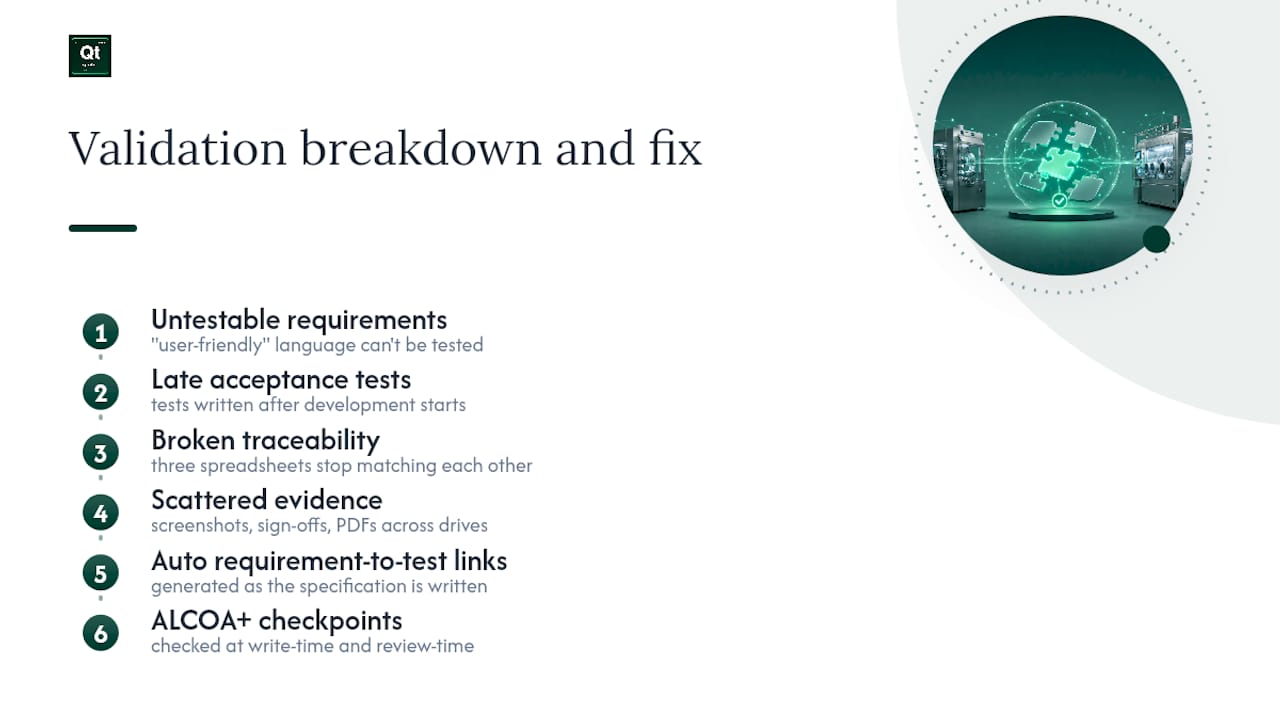
Automation closes these gaps by generating requirement-to-test links as the specification is written rather than reconstructing them later, with every record checked against ALCOA+ data integrity principles at write-time and again at review-time. That checkpoint structure is what shortens CSV cycles without cutting corners on evidence quality.
Why Testability, Not Documentation Volume, Decides Audit Outcomes
Most teams treat specification validation as a documentation exercise: write more detail, add more review signatures, hope the auditor is satisfied. That instinct is backwards. Auditors don't reward thick documents. They reward traceable ones, where a reviewer can pick any requirement at random and find its test, its result, and its evidence within thirty seconds.
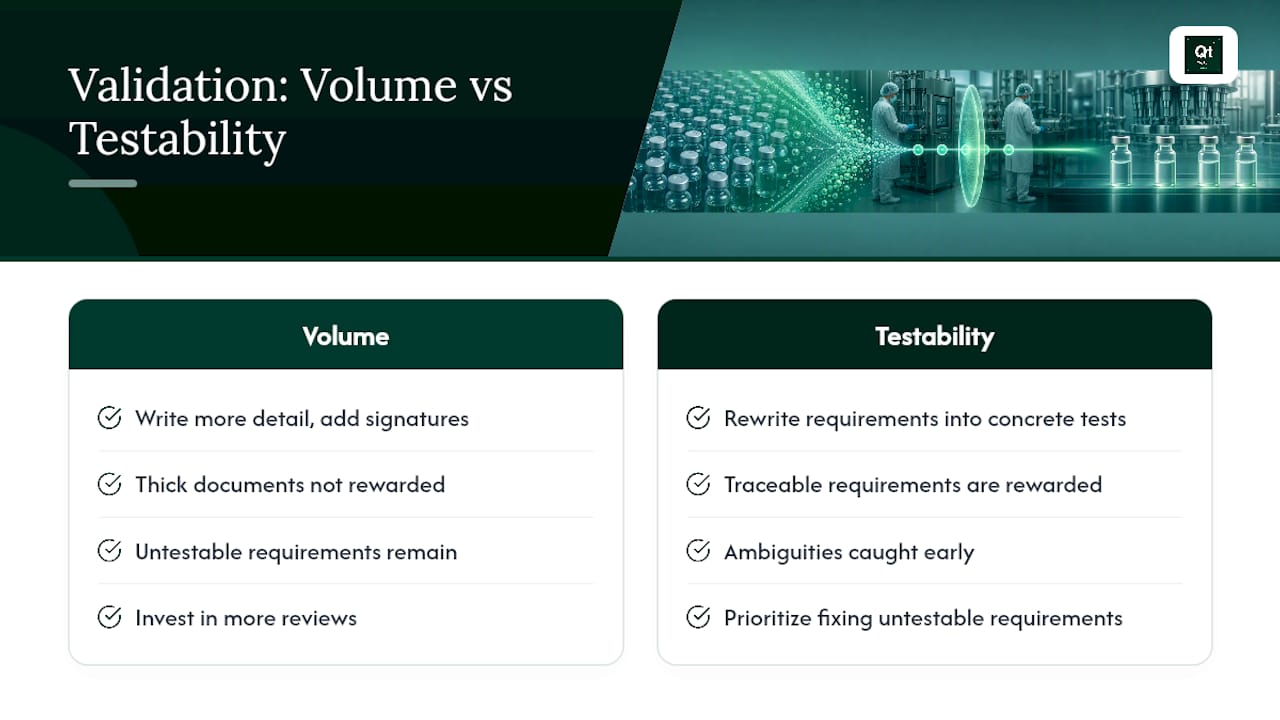
The conventional advice, "get more stakeholder sign off," treats validation as a social process. It's actually a testability problem first. A requirement that can't produce a concrete test is a liability no matter how many people initialed it. Teams that prioritize test-based validation early, before the review meetings, catch the ambiguities reviews are prone to rubber stamp past.
If there's one place to spend limited validation time, it's rewriting untestable requirements into verifiable ones and making sure the RTM reflects reality, not the plan from six months ago. Everything else, formal methods, prototyping, extensive walkthroughs, works better once that foundation is solid, and accomplishes far less when it isn't.
— Matt
Cut Authoring Time Without Cutting Evidence Quality
Manual specification validation eats weeks that most validation teams don't have, and every spreadsheet-based RTM eventually drifts from the actual test results. Qualitum's Validate·AI platform links requirements to acceptance tests as the specification is authored, not after, with every record checked against ALCOA+ principles at write-time and review-time. That structure is part of why teams using the platform report over 70% time savings in authoring compared to manual documentation cycles.

If your current process depends on someone manually reconciling a traceability spreadsheet before every audit, that's a fixable problem. Some solutions work alongside existing quality management systems rather than replacing them, so traceability can be consolidated in one place instead of multiple locations. Book a working session to see how requirement-to-test linkage works in practice, or request a Free Validation Gap Report to see where your current specification would hold up under audit and where it wouldn't.
Sources
For deeper technical grounding, review NASA's requirements validation guidance, TechTarget's functional specification overview, and the validation-driven development paper on formal validation obligations. Internally, Qualitum's guides on ISO 13485 software validation and the validation master plan cover planning and documentation structure in more depth.
- SWE-055 - Requirements Validation - NASA Software Engineering Handbook Ver B
- Testing Based Requirement Validation: Catching Defects Early for Success | The Requirements Engineer
- Validation-driven development (VDD) — arXiv
FAQ
How Do You Prepare an FSD Document?
Start from the BRD, translate business goals into specific functional requirements, and write each one so it can produce at least one acceptance test before the document leaves draft status.
What Is the Difference Between a BRD, FRD, and FSD?
A BRD captures business goals and the "why," while an FRD or FSD specifies what the system must do to meet those goals; both feed into technical specs that define how it gets built.
What Does an SRS Example Look Like?
A software requirements specification (SRS) example typically lists numbered functional requirements with defined inputs, preconditions, and expected outputs, paired with non-functional requirements like performance or security thresholds.
Can You Give an Example of a Functional Specification?
A functional specification for a login feature might state that the system shall authenticate a user within 2 seconds given a valid username and password, and return a specific error code after three failed attempts, each condition testable on its own.
What Is the Single Most Important Check in Functional Specification Validation?
Verifiability. If a requirement cannot map to at least one clearly defined acceptance test, it fails validation regardless of how complete or well written it otherwise appears.
Recommended
- CSA vs CSV for Validation Teams: What QA Needs to Know
- Making DevOps CSV Compliance Audit-Ready in Regulated Pipelines
- CSV Automation for Validation Teams: A CSA-Aligned Roadmap
- Change Impact Assessment for CSV/CSA: A Validation Lead's Guide
FAQ
How Do You Prepare an FSD Document?
Start from the BRD, translate business goals into specific functional requirements, and write each one so it can produce at least one acceptance test before the document leaves draft status.
What Is the Difference Between a BRD, FRD, and FSD?
A BRD captures business goals and the "why," while an FRD or FSD specifies what the system must do to meet those goals; both feed into technical specs that define how it gets built.
What Does an SRS Example Look Like?
A software requirements specification (SRS) example typically lists numbered functional requirements with defined inputs, preconditions, and expected outputs, paired with non-functional requirements like performance or security thresholds.
Can You Give an Example of a Functional Specification?
A functional specification for a login feature might state that the system shall authenticate a user within 2 seconds given a valid username and password, and return a specific error code after three failed attempts, each condition testable on its own.
What Is the Single Most Important Check in Functional Specification Validation?
Verifiability. If a requirement cannot map to at least one clearly defined acceptance test, it fails validation regardless of how complete or well written it otherwise appears.