Embed continuous validation directly into your CI/CD pipeline so every build, test, and deployment run produces defensible evidence aligned to 21 CFR Part 11, EU Annex 11, and GxP. That is the entire answer to DevOps CSV compliance in one sentence. Everything else in this guide explains how to make it defensible in front of an auditor.
The mechanics matter more than the philosophy here. Automating compliance checks inside a CI/CD pipeline turns computerized system validation (CSV) from a periodic, manual checkpoint exercise into continuous compliance, and shops that make the switch have cut validation documentation cycle times by more than 70%. That is not a marginal efficiency gain. It is the difference between a validation team that spends its quarter chasing signatures and one that spends the quarter improving the product.
Get there in four moves:
- Run a short System Risk Assessment (SRA) to scope how much validation rigor each change actually needs, rather than defaulting every release to full IQ/OQ/PQ.
- Implement immutable artifacts and traceable commits so every build has a checksum, a Git SHA, and a link back to the requirement it satisfies.
- Add pipeline gates that capture ALCOA+ evidence automatically at write-time and review-time, not as a end-of-sprint scramble.
- Pilot automated evidence tooling on one pipeline before rolling it out fleet-wide. Platforms like Qualitum are built specifically for this handoff between DevOps velocity and GxP defensibility.
Here is what an audit-ready pipeline needs, at minimum:
- A traceability matrix that updates itself from pipeline test outcomes, not a spreadsheet someone edits on Fridays.
- Role-based access control (RBAC) enforced at the repository and pipeline level, matching your segregation-of-duties policy.
- Manual approval gates with recorded rationale, for the changes where human judgment genuinely belongs in the loop.
- Signed, checksummed build artifacts that cannot be altered after the fact without breaking the chain of custody.
Table of Contents
- Why DevOps CSV Compliance Requires Rethinking Validation
- How Do You Map CSV Requirements Into DevOps Controls?
- What Do CSV Deliverables Look Like Inside a DevOps Pipeline?
- Which Pipeline Patterns Actually Produce Defensible Evidence?
- How Do You Capture Auditable Test Evidence in a CI/CD Pipeline?
- Azure DevOps Recipes You Can Implement Today
- How Should You Scope Validation Risk in Agile Releases?
- What Should an Audit-Ready Traceability Package Include?
- What Deficiencies Do Auditors Find Most Often?
- How Automated Validation Platforms Close the Evidence Gap
- How Do You Validate Open Source and Third-Party Components in a DevOps Pipeline?
- What Change Management Looks Like in a DevOps CSV Framework
- Data Privacy and Security Under CSV Principles in DevOps Pipelines
- Training and Qualification for DevOps Teams Doing CSV Work
- Handling Deviations and CAPA in a Continuous Validation Framework
- How Qualitum Can Accelerate Your DevOps CSV Pilot
- Key Takeaways: What to Implement This Quarter
- Sources
- FAQ
Why DevOps CSV Compliance Requires Rethinking Validation
Periodic validation assumes a system is stable between reviews. DevOps assumes the opposite: the system changes constantly, sometimes multiple times a day. That mismatch is the whole reason "just run CSV the old way, faster" never works. Regulators have not lowered the bar on audit trails or data integrity. They have simply started encountering pipelines where the evidence either does not exist yet or exists in a dozen disconnected tools.
Continuous validation replaces the "big bang" review with evidence generated at every pipeline stage, so by the time a release ships, the audit trail already exists. It is a different failure mode than periodic validation, not an absence of failure modes. A quarterly validation cycle fails loudly when the review finds a gap. A continuous pipeline fails quietly, through documentation drift, unless someone designs the pipeline to catch that drift automatically.
The upside is real. Shorter validation cycles mean shorter time-to-release. Evidence generated automatically is reproducible in a way that hand-typed test logs never are. When something goes wrong, you can trace the failure to a specific commit within minutes instead of reconstructing a timeline from memory and email threads. The tradeoff is that velocity without discipline produces documentation drift fast: a team ships ten releases before anyone notices the traceability matrix stopped updating after release six.
Three regulatory frameworks have to stay visible on every architecture decision you make:
- 21 CFR Part 11 governs electronic records and electronic signatures for FDA-regulated systems, and it does not care whether your signature came from a paper form or a pipeline approval gate.
- EU Annex 11 sets the EU's expectations for computerized systems, with particular emphasis on data integrity and system validation documentation.
- GxP data-integrity principles, commonly summarized as ALCOA+ (attributable, legible, contemporaneous, original, accurate, plus complete, consistent, enduring, and available), apply regardless of whether the record lives in a lab notebook or a CI/CD log.
Pro Tip: Automation should make compliance a byproduct of shipping software, not a separate project that runs alongside it. If your team is building compliance dashboards that live outside the pipeline, you have built a second system to maintain instead of eliminating documentation debt.
How Do You Map CSV Requirements Into DevOps Controls?
Every regulatory requirement has a DevOps-native equivalent. The work is translating "the regulation says X" into "the pipeline enforces X automatically," and most teams skip this step, which is why their audits go badly.
21 CFR Part 11's electronic signature requirements map cleanly onto pipeline approval gates, provided the approver identity, timestamp, and rationale are captured and cannot be edited after the fact. EU Annex 11's system validation expectations map onto version-controlled infrastructure as code, where every environment configuration change is itself a reviewable, auditable commit. GxP's ALCOA+ principles map onto immutable artifact storage and structured logging that captures who ran a test, when, and under what conditions, an approach FDA-focused DevOps blueprints treat as foundational rather than optional.
| Regulatory requirement | DevOps artifact | Evidence captured |
|---|---|---|
| Electronic signatures (21 CFR Part 11) | Pipeline approval gate | Approver identity, timestamp, reason for approval |
| System validation (EU Annex 11) | Infrastructure as code repository | Version history, reviewer, deployment record |
| Data integrity / ALCOA+ (GxP) | Immutable artifact store | Checksum, build ID, commit SHA, retention log |
| Audit trail continuity | Centralized pipeline log with RBAC | Who accessed what, when, and what changed |
| Change control | Linked work item and pull request | Requirement ID, risk classification, test results |
Build your regulatory mapping matrix around three columns, minimum: requirement, artifact, and evidence location. A fourth column for reviewer sign-off makes the matrix inspection-ready without extra tooling. This is not a document you write once. It is a living structure that pipeline events populate as they happen, which is the only way it stays accurate past your first release cycle.
What Do CSV Deliverables Look Like Inside a DevOps Pipeline?
Every traditional CSV deliverable still exists in a DevOps model. It just lives somewhere different than the validation binder your team may be used to.
The System Risk Assessment (SRA) becomes a triage artifact attached to a work item, scoping how much validation effort a given change warrants before a single line of code merges. The User Requirements Specification (URS) and Functional Requirements Specification (FRS) live as structured work items in your requirements-management tool, linked directly to the test cases that verify them. Design Qualification (DQ) becomes architecture decision records reviewed and approved in version control. Installation Qualification (IQ) and Operational Qualification (OQ) become infrastructure-as-code provisioning and automated smoke tests run against every deployed environment. Performance Qualification (PQ) becomes production-representative test suites that run against staging environments built to mirror live conditions.
The traceability chain that ties all of it together looks like this: a commit references a work item ID, a pipeline run executes the tests tied to that work item, the pipeline publishes an artifact with a checksum, and that artifact links to the release record. Pull that chain for any given feature and you have a complete, chronological evidence trail without opening a single separate document.
| CSV deliverable | DevOps equivalent | Where it lives |
|---|---|---|
| SRA | Risk classification tag on work item | Requirements-management tool |
| URS / FRS | Structured work items with acceptance criteria | Requirements-management tool, linked to repo |
| DQ | Architecture decision record | Version control, peer-reviewed |
| IQ | Infrastructure-as-code provisioning log | Pipeline execution log |
| OQ | Automated functional test suite results | CI test reports, archived per build |
| PQ | Production-representative test results | Staging pipeline artifacts |
Retention matters as much as generation. An evidence bundle that exists only in a build agent's temporary storage is worthless the moment that agent gets recycled. Route everything into a system with defined retention periods that match your organization's record-retention policy, not the default log rotation your DevOps team set up for debugging convenience.
Which Pipeline Patterns Actually Produce Defensible Evidence?
Not every CI/CD pattern is compliance friendly by default. The patterns that hold up under audit share a common trait: they make evidence a side effect of the pipeline running, rather than a task someone has to remember to do afterward.
Gated promotions require a build to pass defined criteria before advancing to the next environment, and each gate leaves a timestamped record. Immutable artifact repositories guarantee that what got tested is exactly what got deployed, with no silent recompilation in between. Signed builds add cryptographic proof of origin, which matters when an auditor asks how you know a production artifact was not tampered with after testing. Reproducible infrastructure as code means an auditor can recreate your validated environment from the same code that built it the first time. GitOps flows, where the desired state of infrastructure lives in version control and gets reconciled automatically, turn "what changed and who approved it" into a query instead of an investigation.
Per-change validation deserves particular attention, because the actual bottleneck in high-velocity regulated environments is rarely deployment speed. It is validation confidence. Teams that batch changes and validate the batch at the end lose the ability to isolate which change caused a failure. Teams that validate each change against real dependencies as it happens can deploy independently and still produce a clean audit trail, because each change carries its own evidence rather than sharing evidence with nine other unrelated changes.
A minimal pipeline recipe that satisfies most of this:
- Every merge triggers a build that generates a checksummed, versioned artifact.
- Automated tests run against that specific artifact and log environment, parameters, and result.
- A manual approval gate captures the approver's identity and stated reason before promotion to a validated environment.
- The promoted artifact and its test evidence get archived together, keyed to the same build ID.
Pro Tip: Enforce artifact checksum verification at every promotion step, not just at the final release. If a checksum mismatch is only caught in production, you have already lost the ability to prove the tested artifact is the deployed artifact.
How Do You Capture Auditable Test Evidence in a CI/CD Pipeline?
Different tests satisfy different validation questions, and mapping them correctly is what keeps your OQ and PQ evidence from getting muddled together. Unit and integration tests, run early and often, primarily support Operational Qualification: they prove the system functions as designed under controlled conditions. System-level and regression tests, especially those run in production-representative environments, support Performance Qualification: they prove the system performs as intended under real-world conditions.

The distinction between simulated and production-like testing environments is not cosmetic. A test suite run against a lightweight mock database tells you the code works. A test suite run against a staging environment configured identically to production, with representative data volumes, tells you the system works. Auditors ask which one generated your PQ evidence, and "we assumed unit tests would cover it" is not an acceptable answer.
Every test result needs metadata captured automatically to meet ALCOA+: who or what triggered the run, the exact timestamp, the environment configuration, the parameters used, and the pass/fail outcome with any deviation noted. Bolting this on after the fact through manual logging defeats the purpose. It has to be a structural feature of the pipeline, generated the same way every time.
| Test type | Validation purpose | Evidence stored | Traceability link |
|---|---|---|---|
| Unit tests | Component-level OQ support | Test report per build | Linked to commit SHA |
| Integration tests | System-level OQ support | Test report with environment config | Linked to work item ID |
| System / regression tests | PQ support | Full test suite output, archived | Linked to release record |
| Continuous verification (post-deploy) | Ongoing performance monitoring | Anomaly logs, rollback triggers | Linked to deployment event |
Continuous verification tools that monitor deployed systems against baselines extend this evidence chain past the deployment moment, flagging deviations and triggering rollback decisions automatically. That is worth building into your PQ strategy for systems that run continuously rather than shipping once and sitting static.
Azure DevOps Recipes You Can Implement Today
If your organization already runs on Azure DevOps, most of the compliance architecture above maps onto features that already exist. You do not need a separate compliance toolchain bolted alongside your engineering one.
The ManualValidation@1 task is the most direct fit for a CSV approval gate. It pauses a YAML pipeline and requires a designated approver to review and confirm before the pipeline continues, and it is configurable with approvers, custom instructions, and timeout behavior. A basic configuration looks like this:
- task: ManualValidation@1
  timeoutInMinutes: 1440
  inputs:
    notifyUsers: 'qa-lead@company.com'
    instructions: 'Confirm OQ test results reviewed and approved before promotion to validated environment.'
    onTimeout: 'reject'
That single task, correctly configured, produces a timestamped, attributable record of exactly who approved a promotion and why. It works only within YAML pipelines, so if your team still runs classic pipelines for legacy reasons, this is a strong argument for migrating.
Artifact publishing deserves the same rigor. Publish build artifacts to an immutable feed, generate checksums at publish time, and never allow a promoted artifact to be rebuilt or overwritten under the same version tag. If your build pipeline can silently regenerate "the same" artifact with different contents, your chain of custody is broken before an auditor even asks the first question.
Work item linkage closes the loop. Tie your SRA and URS work items directly to the pipeline runs and builds that satisfy them, so pulling a work item in Azure Boards shows every commit, test run, and artifact tied to that requirement. Azure DevOps teams already use this pattern with RSAT for regression testing and Power Automate for approval routing, cutting out the manual paper-based sign-off entirely.
Pro Tip: Run local pipeline validation, schema checks and the Preview API, before pushing YAML changes to a shared branch. It catches syntax and logic errors early, though it cannot fully replicate runtime behavior, so treat it as a first filter rather than a substitute for your validated test environment.
How Should You Scope Validation Risk in Agile Releases?
Not every change deserves full IQ/OQ/PQ treatment, and pretending otherwise is how teams burn out their validation function trying to keep pace with sprint cadence. A lightweight SRA run at the start of each change classifies it by risk tier and scopes evidence accordingly.
- Classify the change. Is it major (affects a GxP-critical function), minor (affects supporting functionality with indirect GxP impact), or cosmetic (no functional or data-integrity impact)?
- Match evidence depth to risk tier. Major changes need full OQ/PQ evidence and a documented approval gate. Minor changes may need automated regression evidence and a lighter review. Cosmetic changes may need only a peer code review and an automated test pass.
- Document the classification decision itself. An auditor will ask why a change was scoped as minor, and "someone decided" is not an answer. The classification criteria need to be written down and applied consistently.
- Route accordingly through the pipeline. Configure your pipeline so risk classification determines which gates trigger, rather than manually deciding gate-by-gate.
A simple criteria matrix helps triage decisions happen fast and consistently:
- Change touches patient safety, product quality, or data integrity directly? Treat as major, full validation evidence required.
- Change touches system performance or supporting infrastructure without direct GxP impact? Treat as minor, automated evidence plus lightweight review.
- Change is cosmetic, UI text, non-functional refactoring? Treat as low-risk, automated test evidence sufficient.
For legacy systems transitioning into a continuous validation model, a bridging justification document explains why previously validated functionality does not need to be re-validated from scratch, referencing the original validation evidence and describing what has and has not changed since. This keeps your transition defensible instead of looking like you simply stopped validating things you used to validate.
What Should an Audit-Ready Traceability Package Include?
An auditor asking for evidence should never trigger a scramble. The goal is a package that can be assembled from live pipeline data in under an hour, not reconstructed from memory across three departments.
The checklist that matters most:
- Signed, timestamped approval records for every gated promotion.
- Checksums for every artifact currently in production, matched to their build logs.
- Environment specification documents showing exactly what infrastructure was validated.
- Test evidence, organized by requirement, showing OQ and PQ coverage.
- A current traceability matrix, ideally generated automatically rather than maintained by hand.
- Access logs showing who touched the pipeline, repository, and artifact store, and when.
A traceability matrix template that satisfies most inspection formats needs four columns at minimum:
| Requirement ID | Artifact | Evidence location | Reviewer |
|---|---|---|---|
| URS | Build with checksum verified | CI artifact repository | J. Alvarez, QA |
| URS | Regression suite results | Test report archive | M. Chen, RA |
| SRA | Risk classification record | Requirements tool | K. Osei, Validation lead |
Package the evidence bundle in the order an inspector typically reviews it: requirement, then the design decision that satisfied it, then the test evidence, then the approval record, then the deployed artifact checksum. Reviewing in that sequence yourself before the visit catches gaps while you still have time to close them. Qualitum's audit readiness checklist walks through this sequencing in more depth if you want a reference to adapt.
What Deficiencies Do Auditors Find Most Often?
The same handful of gaps show up across most DevOps CSV audits, and nearly all of them are structural rather than random.
Documentation drift tops the list: a traceability matrix that was accurate at go-live and has quietly diverged from reality ever since, because nobody built the pipeline to keep it updated automatically. Missing traceability links come next, evidence that exists but is not connected to the requirement it supposedly satisfies, which is functionally the same as evidence that does not exist. Mutable artifacts, builds that can be silently regenerated under the same version tag, undermine chain of custody even when the underlying testing was sound. Insufficient segregation of duties shows up when the same person can write code, approve its promotion, and sign off on the validation record, with no independent review. And weak evidence for third-party components appears whenever a team can explain their own code thoroughly but goes vague the moment a vendor library or open-source package comes up.
Mitigations for each are direct: enforce artifact immutability at the repository level rather than relying on process discipline. Attach commit IDs to every validation record automatically, so the link cannot be forgotten. Add electronic signature gates that require a distinct approver identity from the author. Capture a software bill of materials (SBOM) and checksums for every third-party dependency as part of the build process, not as a one-time exercise.
When an auditor asks for missing evidence on the spot, a fast triage procedure prevents panic: check the artifact repository first for the checksum and build log, check the requirements tool second for the linked work item, check the pipeline execution history third for the test run and approver record. Most "missing" evidence turns out to be evidence that exists but was never linked, which is a findable problem rather than an unfixable one.
Pro Tip: Run a mock evidence pull once a quarter, picking a random release and reconstructing its full validation chain from scratch. If your team cannot do it in under an hour, that gap will show up in a real audit eventually.
How Automated Validation Platforms Close the Evidence Gap
Manual documentation is where most CSV programs lose the DevOps speed advantage they were supposed to gain. Every gate above, traceability, approval records, checksum verification, is achievable with native CI/CD tooling and disciplined process. It is also achievable faster, and with fewer human errors, through a platform purpose-built to generate that evidence as a byproduct of the validation lifecycle itself.
Qualitum was built around that exact handoff. Its platform uses a multi-agent system to author validation deliverables, URS, FRS, DQ, IQ, OQ, PQ, and CSV/CSA documentation, directly, rather than asking a validation engineer to write each artifact from a template. Every record it generates gets checked against ALCOA+ principles at both write-time and review-time, which is a meaningfully different guarantee than checking compliance once at the end of a document's life.
Capabilities that matter specifically for DevOps CSV work:
- Automated evidence capture tied directly to pipeline events, not reconstructed after the fact.
- A live traceability matrix that updates as pipeline runs complete, rather than one someone edits manually each sprint.
- Immutable artifact linkage that preserves chain of custody automatically.
- Electronic-signature workflows compatible with 21 CFR Part 11 expectations.
- Deviation and CAPA tracking built into the same evidence chain as validation records.
- Integrations with existing quality management systems, so validation evidence does not live in a separate silo from the rest of your quality function.
Organizations using Qualitum for authoring have seen significant time savings in validation authoring cycles, freeing validation and QA staff to focus on judgment calls, risk assessment, and audit strategy instead of formatting documents. A sensible pilot scope for a first engagement: one pipeline, one representative release, measured against three outcomes, evidence completeness, traceability link accuracy, and hours saved in authoring. That scope is small enough to run in weeks, not quarters, and large enough to show whether the approach holds up under your specific quality management system and regulatory profile.
How Do You Validate Open Source and Third-Party Components in a DevOps Pipeline?
Third-party and open-source components are where most CSV evidence chains quietly break down, because teams validate the code they wrote and wave through everything they imported. That gap is exactly what auditors probe first, since it is the easiest weakness to find.
Start with a software bill of materials (SBOM) generated automatically as part of every build, listing every dependency, its version, and its license. Pin dependency versions explicitly rather than allowing floating version ranges. A pipeline that pulls "latest" on every build cannot produce reproducible validation evidence, because the artifact tested on Tuesday may not match the artifact deployed on Thursday.
Vet new dependencies before they enter the codebase, checking for known vulnerabilities, license compatibility, and maintenance activity, rather than discovering problems during an audit. Once a dependency is approved, checksum it and treat any version change as a change requiring the same risk classification process you apply to internally written code. A minor version bump in a logging library is a different risk tier than a major version upgrade to a database driver, and your SRA process should reflect that difference rather than treating all dependency updates identically.
What Change Management Looks Like in a DevOps CSV Framework
Traditional change control assumes changes are infrequent enough to review individually with a formal change request form. DevOps assumes changes happen dozens of times a day. Reconciling those two realities is the core challenge of change management under continuous validation.
The fix is tiering change control to match the risk classification work covered earlier. High-risk changes still get a formal change request, cross-functional review, and documented approval before merge. Low-risk changes get an automated, policy-enforced review, still documented, still attributable, but not requiring a human committee to convene. The change record itself lives as a linked artifact, tied to the commit, the work item, and the pipeline run that implemented it, so "what changed and why" is answerable from the same evidence chain used for everything else.
Emergency changes need a defined fast path with retrospective review, because regulated systems occasionally need a same-day fix, and a change process that cannot accommodate that reality gets bypassed informally, which is worse than having no formal process at all. Document the fast path in advance, including who can authorize it and what retrospective evidence gets captured, so an emergency fix does not become an untraceable one.
Data Privacy and Security Under CSV Principles in DevOps Pipelines
Data integrity and data privacy overlap more than most validation teams initially plan for. A pipeline that generates perfectly attributable, contemporaneous audit records is still a compliance liability if those records contain patient data or other sensitive information accessible to anyone with repository access.
Encrypt validation evidence at rest and in transit, particularly when pipeline logs or test data include production-representative datasets that carry real sensitive information. Apply the same RBAC discipline to your evidence store that you apply to your production systems, since an audit trail with weak access controls undermines the very data integrity it exists to demonstrate. Mask or synthesize sensitive data in lower environments where full production data is not actually required for the test to be meaningful.
Retention and disposal policies need to account for both regulatory retention requirements and privacy regulations that may require data deletion after a defined period, two obligations that occasionally pull in opposite directions and need a documented resolution rather than an ad hoc one.
Training and Qualification for DevOps Teams Doing CSV Work
A pipeline is only as compliant as the team configuring it, and that is the part most CSV transitions underinvest in. Engineers who understand YAML and Git history do not automatically understand why an approval gate needs a documented rationale or what ALCOA+ actually requires of a log entry.
Baseline training should cover the specific regulatory frameworks your organization operates under, 21 CFR Part 11, EU Annex 11, GxP data integrity principles, translated into what they mean for pipeline configuration decisions specifically, not abstract regulatory theory. Role-specific qualification matters too: someone configuring approval gates needs different training than someone reviewing traceability matrices before an audit, and lumping both into one generic compliance training module tends to satisfy neither.
Document the training itself as part of your qualification records, since "the team is trained" is a claim an auditor will ask you to prove the same way they ask you to prove anything else. Refresher training tied to pipeline changes, not just an annual calendar date, keeps the team current as your validation architecture evolves.
Handling Deviations and CAPA in a Continuous Validation Framework
Deviations do not stop happening because your validation is continuous. They just show up differently, often as a failed pipeline gate or an unexpected test result rather than a batch record discrepancy discovered days later.
The advantage of catching a deviation inside a pipeline is speed: the root cause investigation starts with a specific commit, a specific test run, and a specific timestamp, rather than a multi-week reconstruction effort. Route deviation records through the same traceability chain as everything else, linked to the build, the requirement, and the test that flagged it, so the CAPA record inherits the evidence automatically instead of requiring someone to gather it manually.
Corrective and Preventive Actions (CAPA) benefit from the same automation discipline. A corrective action that fixes the immediate deviation should generate a new work item, a new test case that would have caught the issue earlier, and a link back to the original deviation record. A preventive action that changes the pipeline itself, adding a new gate, tightening a threshold, should be treated as a change requiring its own risk classification, since a pipeline modification is itself a validated system change. Platforms with dedicated investigation workflows, including modules built specifically for root-cause tracking, can shorten this cycle considerably by keeping the deviation, the investigation, and the corrective action linked in one evidence chain rather than three separate documents.
Field Perspective: What Actually Breaks First
Most teams that fail at this transition do not fail because they lack tooling. They fail because they hit validation starvation: they keep validating in large batches out of habit, then wonder why their DevOps pipeline runs ten times a day but their compliance evidence still trickles out once a sprint. The tooling was never the constraint. The batching habit was.
The teams that get this right almost always start smaller than their instincts tell them to. One pipeline. One release train. A narrow, boring pilot that nobody outside the validation team notices for the first month, because it is not trying to prove the whole DevOps transformation works on day one. It is trying to prove that a single risk-classified change can generate its own complete evidence chain without a human manually assembling it afterward.
My honest read on the documentation drift problem: it is not a discipline failure, it is an architecture failure. Teams do not drift because people got lazy. They drift because someone built a traceability matrix as a static document instead of a live query against pipeline data, and static documents rot the moment the system underneath them keeps changing. The fix is never "remind people to update the spreadsheet." The fix is removing the spreadsheet from the workflow entirely.
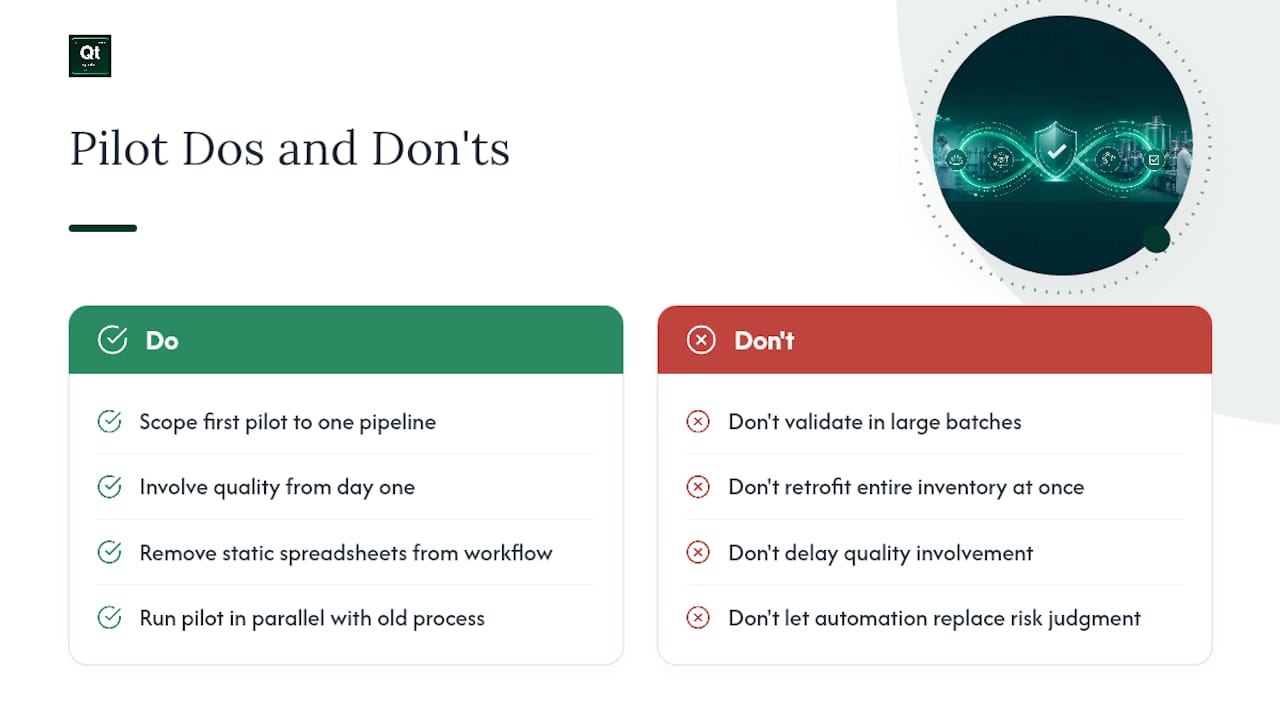
The dos and don'ts that separate the pilots that scale from the ones that quietly get abandoned: do scope your first pilot to a single, well-understood pipeline with a low blast radius. Don't attempt to retrofit your entire validated system inventory into continuous validation in one initiative, that guarantees a mess nobody can defend to an auditor. Do involve your quality function from day one of pipeline design, not after the architecture is already locked. Don't treat automated evidence capture as a replacement for risk judgment, it replaces the paperwork, not the thinking.
One pilot I'd point to as a model, without naming names because the pattern matters more than the specific company: a mid-size device manufacturer took exactly one release train, applied risk-tiered validation with a documented SRA, wired up automated evidence capture on that pipeline alone, and ran it in parallel with their existing process for two release cycles before cutting over. It worked because they measured against their old process the whole time instead of assuming the new one was better and moving on. That comparison is what gave them a defensible story when their next audit came around.
How Qualitum Can Accelerate Your DevOps CSV Pilot
If you have read this far, you already know the gap: the controls exist, but building and maintaining them by hand inside a fast-moving pipeline eats the exact time savings DevOps was supposed to deliver. Qualitum closes that gap by having a multi-agent system author your validation deliverables directly and check every record against ALCOA+ at write-time and review-time, so the evidence is defensible the moment it is generated, not cleaned up before an audit.

A practical starting point is a scoped pilot: one pipeline, one representative release, run in parallel with your current process. The goal is measurable evidence capture, an automatically updating traceability matrix, and a real read on authoring time saved, not a full platform rollout on day one. Validate·AI integrates with the artifact repositories and CI systems you already run, connects into your existing quality management system rather than replacing it, and deploys in a validated, private environment so data integrity and access control stay under your organization's control throughout the pilot.
If you are ready to see what that looks like against your own pipeline, book a working session with Qualitum's team and bring a real release to test it against.
Key Takeaways: What to Implement This Quarter
DevOps CSV compliance works when pipeline evidence generation and regulatory traceability are the same system, not two systems reconciled manually after the fact.
| Point | Details |
|---|---|
| Run a lightweight SRA first | Classify every change by risk tier before deciding how much validation evidence it requires. |
| Enforce artifact immutability | Checksum every build and block silent regeneration under the same version tag. |
| Add pipeline evidence gates | Configure approval steps like ManualValidation@1 to capture attributable, timestamped sign-offs. |
| Track SBOM for third-party code | Pin dependency versions and checksum open-source components the same way you treat internal code. |
| Pilot automated evidence tooling | Run a scoped test with a platform like Qualitum on one pipeline before a full rollout. |
Sources
Keep these close when updating your validation master plan or assembling an audit binder:
- Continuous compliance for cloud-native CI/CD pipelines
- Manual validation v1 - Azure Pipelines
- Solving the validation problem
This article is general information, not a substitute for advice from a qualified lawyer. Consult a qualified legal professional about your own circumstances before acting on anything here.
FAQ
Is Azure DevOps Being Discontinued?
No. Microsoft continues to actively develop and support Azure DevOps, including the YAML pipeline features like ManualValidation@1 that CSV teams rely on for approval gates.
What Are the Five Pillars of DevOps?
Common frameworks describe DevOps around culture, automation, lean practices, measurement, and sharing (often abbreviated CALMS), though the specific pillar list varies by source and organization.
What Are CSV Deliverables?
Core CSV deliverables include the System Risk Assessment (SRA), User Requirements Specification (URS), Functional Requirements Specification (FRS), and the qualification protocols DQ, IQ, OQ, and PQ, each of which maps to a specific artifact inside a DevOps pipeline.
What Are the Five Components of Azure DevOps?
Azure DevOps organizes around five services: Azure Boards for work tracking, Azure Repos for source control, Azure Pipelines for CI/CD including tasks like ManualValidation@1, Azure Test Plans for testing, and Azure Artifacts for package management.
How Do You Ensure CSV Compliance in a DevOps Environment?
Ensure compliance by mapping every regulatory requirement to a specific pipeline control, immutable artifacts, approval gates, RBAC, automated evidence capture, and validating that mapping with a pilot before scaling it, an approach platforms like Qualitum are built to accelerate.
Recommended
- How to Test Data Integrity: A Practitioner's Guide · Qualitum blog
- Operate·AI · Qualitum
- Audit Readiness Checklist for Validation and QA Leaders · Qualitum blog
- Cleaning validation · Validate·AI · Qualitum
FAQ
Is Azure DevOps Being Discontinued?
No. Microsoft continues to actively develop and support Azure DevOps, including the YAML pipeline features like ManualValidation@1 that CSV teams rely on for approval gates.
What Are the Five Pillars of DevOps?
Common frameworks describe DevOps around culture, automation, lean practices, measurement, and sharing (often abbreviated CALMS), though the specific pillar list varies by source and organization.
What Are CSV Deliverables?
Core CSV deliverables include the System Risk Assessment (SRA), User Requirements Specification (URS), Functional Requirements Specification (FRS), and the qualification protocols DQ, IQ, OQ, and PQ, each of which maps to a specific artifact inside a DevOps pipeline.
What Are the Five Components of Azure DevOps?
Azure DevOps organizes around five services: Azure Boards for work tracking, Azure Repos for source control, Azure Pipelines for CI/CD including tasks like ManualValidation@1, Azure Test Plans for testing, and Azure Artifacts for package management.
How Do You Ensure CSV Compliance in a DevOps Environment?
Ensure compliance by mapping every regulatory requirement to a specific pipeline control, immutable artifacts, approval gates, RBAC, automated evidence capture, and validating that mapping with a pilot before scaling it, an approach platforms like Qualitum are built to accelerate.