A deviation is any documented departure from an approved procedure, specification, or validated state, and a CAPA is the systemic response that prevents it from happening again. The moment a deviation surfaces, contain the immediate risk, assess product and patient impact, and log the event. Everything else, classification, root cause, effectiveness checks, and training, follows from that first move.
TL;DR:
>
- Only systemic deviations with recurring root causes, such as training gaps or equipment flaws, typically require formal CAPA interventions.
- Root cause investigations must capture evidence immediately and use appropriate tools like 5-Why or fishbone diagrams based on complexity.
- Clear ownership and documented timelines are essential, with standard durations of 30 days for minor, 45 for major, and 60 for critical CAPAs.
- Effectiveness checks must be specific, measurable, and set in advance, using trend data to confirm the implemented actions prevent recurrence.
- Automated systems that ensure traceability and ALCOA+ compliance significantly reduce investigation time and documentation gaps.
Table of Contents
- What separates a deviation, a nonconformance, and CAPA
- How do you classify and prioritize deviations by risk?
- What does a proper root cause investigation look like?
- What are the CAPA process steps from initiation to closure?
- How do you verify that a CAPA actually worked?
- What mistakes keep showing up in CAPA programs?
- Where does automation fit in deviation and CAPA management?
- Why treating deviations as information changes everything
- How Qualitum Closes the Evidence Gap in CAPA Workflows
- Sources
- FAQ
What separates a deviation, a nonconformance, and CAPA
A deviation is a departure from an approved process, method, or specification, whether that's a temperature excursion during a hold step or a missed in-process check. A nonconformance is narrower: it describes a product or material that fails to meet a defined requirement, often discovered at inspection or release testing. CAPA, corrective and preventive action, is the structured response that addresses root cause once an investigation is complete.
Not every deviation needs a CAPA. FDA guidance on quality systems expects systematic investigation and scientific justification, but a one-off operator slip with no product impact and no recurrence pattern may close with a documented investigation alone. A CAPA becomes necessary when the root cause is systemic: a training gap affecting multiple operators, an equipment design flaw, or a procedure that doesn't reflect how the process actually runs. ICH Q10 frames CAPA as a core element of the pharmaceutical quality system, tied directly to knowledge management and continuous improvement, not a one-time fix.
How do you classify and prioritize deviations by risk?
Most quality systems sort deviations into three tiers: minor, major, and critical. Minor deviations have no product or patient impact and typically close within the deviation record itself. Major deviations affect quality attributes or process control but don't reach the patient. Critical deviations carry potential patient safety, efficacy, or regulatory impact, and they trigger the deepest investigation and the shortest response clock.
ICH Q9 gives the underlying logic: investigation depth should scale with risk to the patient, not with how visible the deviation is to auditors. A short checklist keeps classification consistent across shifts and sites:
- Does the deviation affect a critical quality attribute or critical process parameter?
- Could the affected batch already be in distribution?
- Has a similar deviation occurred in the past 12 months?
- Does the deviation involve a validated system operating outside its qualified state?
Any "yes" pushes the classification up a tier, not down.
What does a proper root cause investigation look like?

The first hour after detection matters more than most teams treat it. Before anyone opens a root cause tool, capture the physical evidence: equipment logs, batch records, environmental monitoring data, and operator statements taken while memory is fresh. Quarantine affected material. Photograph anything that will change or get cleaned before the investigation team arrives.
From there, a defensible investigation typically follows this sequence:
- Define the problem statement precisely. Vague statements ("mixing was off") produce vague root causes. State what deviated, from what, by how much, and when.
- Select the right tool for the complexity. A 5-Why analysis works for linear, single-cause events. An Ishikawa (fishbone) diagram suits problems with multiple contributing factors, such as a recurring contamination event. FMEA fits proactively, when you're scoring failure modes before they become deviations.
- Test the root cause against the evidence. A root cause should explain every occurrence and every non-occurrence. If it doesn't, keep digging.
- Document the reasoning trail, not just the conclusion, so an inspector can follow the logic two years later.
The most common pitfall is stopping at "human error." Industry benchmarking on CAPA management links superficial root-cause labels directly to higher recurrence rates. Human error is almost always a symptom of something upstream: unclear instructions, poor ergonomics, alarm fatigue, or a procedure that assumes conditions that don't exist on the floor.
Pro Tip: If your root cause statement would let you write an identical investigation report for a different operator next month, you haven't found the root cause yet.
What are the CAPA process steps from initiation to closure?
The CAPA workflow runs in five stages: initiation, planning, implementation, effectiveness verification, and closure. Each stage needs a named owner and a clear handoff, because ambiguous ownership is where most CAPA timelines quietly die.
- Initiation: QA opens the CAPA record, links it to the source deviation, and assigns an owner, usually the process or equipment owner closest to the root cause.
- Planning: The owner defines specific actions, target dates, and required resources, then QA reviews the plan for adequacy before approval.
- Implementation: Actions execute, with evidence, revised SOPs, training records, engineering change orders, captured as they happen, not reconstructed later.
- Effectiveness verification: A defined monitoring period confirms the action worked, using pre-set acceptance criteria.
- Closure: QA reviews the full evidence package and formally closes the record.
Modern electronic CAPA systems often model this as a literal status lifecycle. Microsoft's Dynamics 365 CAPA case documentation describes staged cases with assigned activities that move through defined statuses, which mirrors what most mature paper-based systems were already trying to enforce manually.
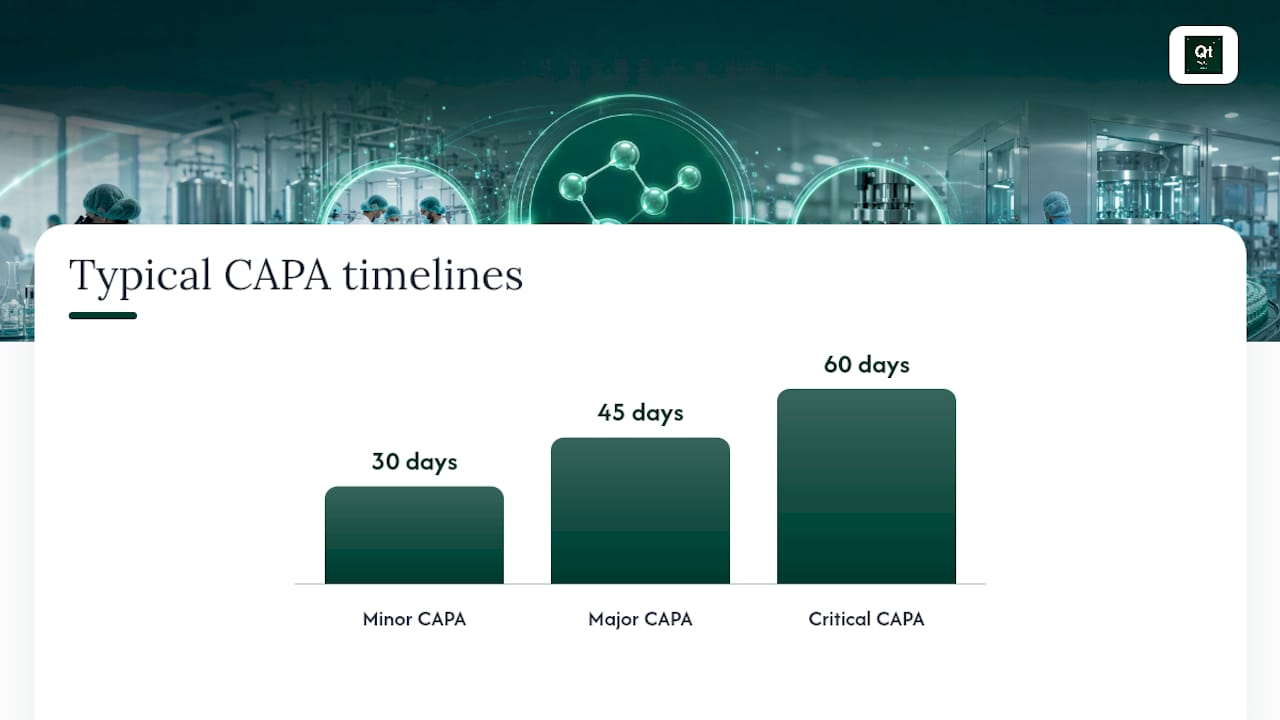
Timelines vary by classification, but 30 days for minor CAPAs, 45 for major, and 60 for critical is a common industry baseline. Exceptions happen, a supplier investigation waiting on external lab data, for example, but every extension needs a documented justification, not a silent overdue flag.
How do you verify that a CAPA actually worked?
A CAPA is only as good as its acceptance criteria. Before you write "retrain operators" or "revise SOP," ask whether the action is specific, measurable, assignable to a named owner, and bound to a date. "Improve awareness" is not a CAPA action; "reduce excursions on Line 3 to zero over a 90-day monitoring window" is.
Effectiveness checks need to be designed prospectively, before implementation, not written retroactively once the numbers already look fine. That means setting the monitoring window, the acceptance threshold, and the data source in the CAPA plan itself.
- Define the monitoring period length before implementation, not after.
- Set a numeric or binary acceptance criterion, not a qualitative impression.
- Pull deviation trend data across the monitoring window, not just a single snapshot.
- Compare against a pre-CAPA baseline to isolate the effect of the action.
Deviation trending matters here too. If similar deviations keep surfacing at other sites or on other lines after a CAPA closes, that's a signal the fix addressed a symptom, not the system. Trend analysis is also how CAPA connects back to ICH Q10's knowledge management expectation: closed CAPAs feed the next risk assessment, they don't just sit in an archive.
What mistakes keep showing up in CAPA programs?
Three failures repeat across nearly every inspection finding related to CAPA. First, vague corrective actions that can't be objectively verified. Second, effectiveness checks skipped or rubber-stamped without real monitoring data. Third, CAPAs that never connect to change control, so the fix exists on paper but the validated process never actually changes.
Training closes most of these gaps, but only if it targets the right competencies:
- Structured investigation technique (5-Why, Ishikawa, FMEA), not just "how to fill out the form."
- Computer system validation and electronic signature awareness for anyone documenting CAPA in an electronic system.
- Documentation standards that hold up under ALCOA+ scrutiny: attributable, legible, contemporaneous, original, accurate, and complete.
Training programs built specifically around deviation and CAPA management treat these as core, testable competencies rather than onboarding checkboxes. Pair that training with a standard RCA template and clear escalation triggers so a CAPA overdue by even a few days surfaces in leadership reporting automatically, not at the next scheduled review.
Pro Tip: Ask a new investigator to walk you through a closed CAPA's logic without looking at the conclusion first. If they can't reconstruct the reasoning, the documentation failed, even if the CAPA itself was sound.
Where does automation fit in deviation and CAPA management?

Manual CAPA documentation is where most audit findings originate, not because teams lack rigor, but because reconstructing evidence after the fact invites gaps. Validated automation changes that by capturing evidence, signatures, and status changes as they happen, with traceability built in rather than bolted on afterward.
Qualitum's Investigate·AI supports root cause analysis by linking evidence directly to the deviation record and carrying that linkage through to the CAPA plan, so the reasoning trail an inspector wants to see already exists.
- Every record is checked against ALCOA+ at write time and again at review time, closing the audit trail gaps that manual logs tend to create.
- Investigation evidence, RCA reasoning, and CAPA actions stay linked in one traceable chain instead of scattered across forms and spreadsheets.
- Integration with existing quality management systems means CAPA data doesn't live in a separate silo from the rest of the QMS.
None of this replaces sound investigation judgment. It removes the reconstruction work that turns a good investigation into a documentation liability.
Why treating deviations as information changes everything
Programs that punish reporting get less data, not fewer problems. A just culture, one that separates system failure from individual blame, is what actually surfaces the recurring patterns worth fixing. Leadership that reviews deviation trends monthly, not just at annual management review, catches systemic drift before it becomes a critical finding. Competency doesn't end at initial training either; investigators get better with deliberate practice, the same way any diagnostic skill does.
— Matt
How Qualitum Closes the Evidence Gap in CAPA Workflows
Qualitum gives QA teams inspector-ready evidence without the manual reconstruction that eats weeks during every investigation. Instead of rebuilding an audit trail from scattered logs and email threads after the fact, every record, from initial deviation capture through CAPA effectiveness check, is ALCOA+ checked at write-time and again at review, so the traceability an inspector asks for already exists.

That matters most in the two places CAPA programs lose the most time: root cause linkage and effectiveness verification. Validate·AI enforces the same audit-trail discipline across validation lifecycle documentation, so CAPA evidence and validation evidence live in one traceable system rather than two disconnected ones. Teams typically see over 70% time savings in authoring cycles, time that goes back into investigation quality instead of paperwork.
If your last inspection turned up a documentation gap or a CAPA closed on thin evidence, book a working session to see how Qualitum's platform handles it end to end.
Sources
FAQ
What is the difference between a deviation and a CAPA?
A deviation is the departure from an approved process, method, or specification that gets documented and investigated. A CAPA is the corrective and preventive action taken afterward to address the root cause and prevent recurrence.
What is a deviation in quality control?
In quality control, a deviation is any unplanned departure from an approved procedure, specification, or validated condition, ranging from a temperature excursion to a missed process step, that requires documentation and investigation before the batch or process can proceed.
What are common CAPA mistakes?
The most frequent failures are vague corrective actions that can't be objectively verified, skipped or superficial effectiveness checks, and CAPAs that never connect to change control, so the fix never reaches the validated process itself.
Is CAPA part of Six Sigma?
CAPA and Six Sigma share root cause tools like the fishbone diagram and 5-Why, but CAPA is a regulatory quality system requirement under frameworks like ICH Q10, while Six Sigma is a broader process-improvement methodology; many QA teams borrow Six Sigma's analytical tools inside a CAPA investigation.
How long should a CAPA take to close?
Timelines scale with risk classification: a common industry baseline is roughly 30 days for minor CAPAs, 45 for major, and 60 for critical, with any extension requiring a documented justification rather than a silent overdue status.
Recommended
- Audit Readiness Checklist for Validation and QA Leaders
- Cleanroom & utility qualification
- Cleaning validation
- Qualitum - Digital Validation Automation · Product Guide
FAQ
What is the difference between a deviation and a CAPA?
A deviation is the departure from an approved process, method, or specification that gets documented and investigated. A CAPA is the corrective and preventive action taken afterward to address the root cause and prevent recurrence.
What is a deviation in quality control?
In quality control, a deviation is any unplanned departure from an approved procedure, specification, or validated condition, ranging from a temperature excursion to a missed process step, that requires documentation and investigation before the batch or process can proceed.
What are common CAPA mistakes?
The most frequent failures are vague corrective actions that can't be objectively verified, skipped or superficial effectiveness checks, and CAPAs that never connect to change control, so the fix never reaches the validated process itself.
Is CAPA part of Six Sigma?
CAPA and Six Sigma share root cause tools like the fishbone diagram and 5-Why, but CAPA is a regulatory quality system requirement under frameworks like ICH Q10, while Six Sigma is a broader process-improvement methodology; many QA teams borrow Six Sigma's analytical tools inside a CAPA investigation.
How long should a CAPA take to close?
Timelines scale with risk classification: a common industry baseline is roughly 30 days for minor CAPAs, 45 for major, and 60 for critical, with any extension requiring a documented justification rather than a silent overdue status.