Any proposed change that could alter a validated state, affect ALCOA+ data integrity, or modify GxP-relevant functionality requires a formal change impact assessment. Purely administrative edits — correcting a typo in a non-GxP document, for example — generally do not. The expected outcome is a documented impact classification (Low, Medium, or High) that maps directly to proportionate assurance: no retest, targeted verification, or full revalidation.
Your immediate next step: open a Change Request (CR) with a clear justification, a preliminary risk rank, and an assigned owner. That single action focuses every subsequent SME conversation and gives QA a defensible starting point.

Organizations that shift to risk-based Computer Software Assurance (CSA) approaches typically report 40–60% reductions in validation documentation burden without reducing actual system control. That figure is the practical case for proportionate revalidation.
Pro Tip: Draft the CR before any technical work begins. A CR submitted after implementation is a deviation waiting to happen.
Table of Contents
- What does the change impact assessment lifecycle look like?
- How do you classify a change and decide the verification scope?
- How do you build a risk-based assessment aligned to CSA and GAMP 5?
- What should you test, and when is full revalidation actually required?
- Which documents must you update after a change?
- Who must sign off, and what confirms a CR is ready to close?
- Practical examples and edge cases worth knowing
- How Qualitum reduces effort and enforces evidence for change impact assessments
- Key Takeaways
- The case for narrower scope, documented well
- Qualitum cuts change assessment time without cutting corners
- Useful sources
- FAQ
What does the change impact assessment lifecycle look like?
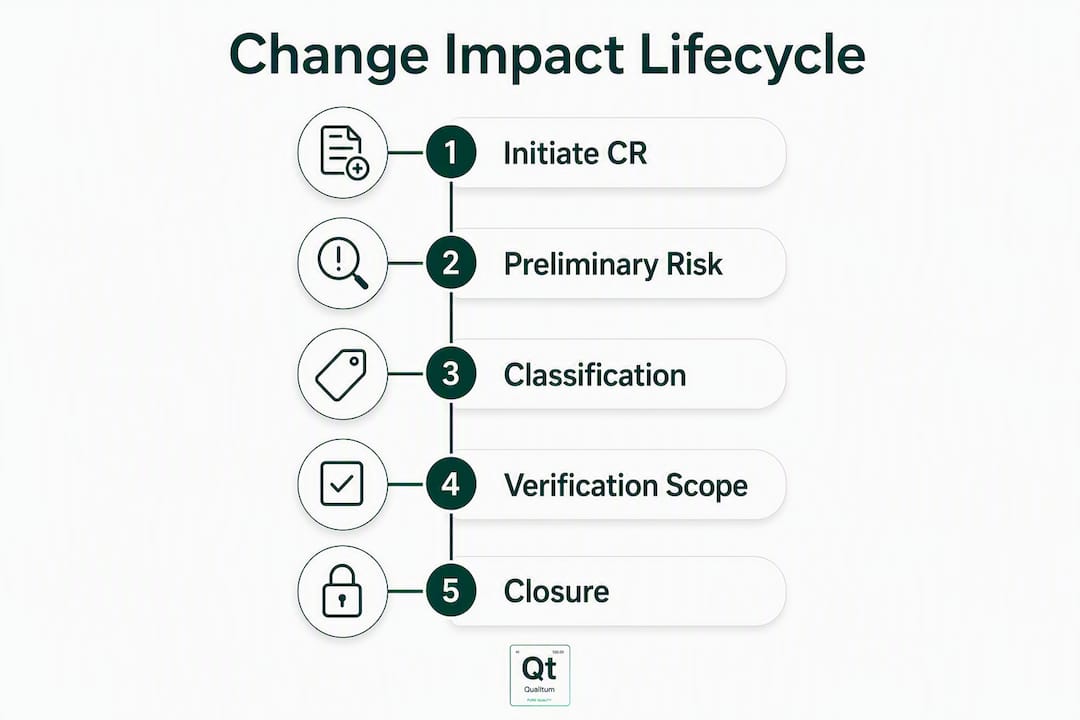
A well-run impact analysis process follows six stages, each with a clear owner and exit criterion.
- CR submission. Document who is requesting the change, what is changing, why, and the proposed implementation date. Assign a system owner and a validation lead at this stage.
- Preliminary triage and risk ranking. The system owner and relevant SMEs review the CR and assign an initial risk tier (Low, Medium, High) based on GxP relevance, data integrity exposure, and regulatory reporting implications.
- Formal risk-based impact assessment. SMEs evaluate effects on data integrity (ALCOA+), critical functionality, user workflows, and compliance obligations under 21 CFR Part 11, Annex 11, or ISO 13485. This is where the verification scope is defined and documented.
- QA and system owner approval. No implementation proceeds without a signed approval gate. Regulatory Affairs joins for changes with submission implications.
- Implementation, verification, and evidence capture. Execute targeted tests, capture objective results (screenshots, logs, executed protocols), and handle any defects through a formal deviation if required.
- Traceability update and CR closure. Update the traceability matrix, revise affected validation artifacts, complete QA review, and formally close the CR with documented evidence.
Timeline expectations: Low-classification changes typically close in one to two weeks. Medium changes with targeted regression testing run two to four weeks. High-classification changes requiring partial or full revalidation can extend to six to twelve weeks depending on system complexity and resource availability.
Pro Tip: Set a triage SLA — for example, 48 hours from CR submission to preliminary risk rank — so the lifecycle does not stall at step two.
How do you classify a change and decide the verification scope?
Classification turns on five decision axes: effect on GxP functionality, impact on ALCOA+ data integrity, changes to user workflows, regulatory reporting implications, and availability of supplier or vendor lifecycle evidence.
| Classification | Criteria | Required Assurance | Minimum Evidence |
|---|---|---|---|
| Minor (no config change) | No GxP function affected; no data handling change | No revalidation | Updated CR form; vendor release notes |
| Minor with configuration | Config change; no impact on critical data paths or outputs | Targeted smoke tests | CR form; test results; traceability matrix note |
| Major | GxP functionality, audit trail, or data outputs affected | Targeted regression testing; URS/FRS update | Updated protocols; executed tests; traceability matrix revision |
| Critical | System outputs used in regulatory submissions; critical quality attributes affected | Partial or full IQ/OQ/PQ | Full protocol suite; deviation handling if applicable; updated VMP |
Examples in practice: Editing a user role label with no permission change is Minor. A vendor patch that updates the UI but leaves all GxP data paths unchanged is Minor with configuration at most. A configurable workflow change that alters batch record routing is Major. A firmware upgrade that changes how timestamps are generated is Critical.
Pro Tip: Capture the classification rationale in one paragraph on the CR form itself. Auditors look for the "why," not just the outcome.
How do you build a risk-based assessment aligned to CSA and GAMP 5?
Start with intended use. Map the system's critical functions against predicate rules — 21 CFR Part 11, Annex 11, or ISO 13485 — to identify which functions are GxP-relevant before scoring anything.
ISPE GAMP 5 (Second Edition) recommends a simple severity × likelihood matrix to assign risk tiers, with outcomes linked to product quality and patient safety rather than to system complexity alone. A calculation algorithm change that affects a critical quality attribute scores high severity regardless of how unlikely the failure seems. Loss of audit trail integrity scores high on both axes.
- Failure modes to evaluate: loss of audit trail, unauthorized data modification, algorithm or formula change, timestamp manipulation, access control bypass, and integration data loss at system boundaries.
- Evidence by risk tier: Low — vendor release notes and a brief SME rationale statement. Medium — vendor lifecycle documentation plus focused test results. High — full regression evidence, updated traceability matrix, and a documented critical-thinking record explaining scope decisions.
The FDA's CSA guidance is explicit: regulators expect objective evidence that a system continues to perform as intended, and they expect the rationale for proportional verification to be documented. A boilerplate IQ/OQ/PQ package with no risk rationale is less defensible than a focused test set with a clear SME justification.
Pro Tip: Use the Risk·AI module to auto-populate the severity × likelihood matrix from system metadata, then have SMEs review and sign off — this preserves critical thinking while cutting setup time.
What should you test, and when is full revalidation actually required?
Test only GxP-relevant functions that the change directly affects. For everything else, vendor lifecycle evidence and supplier qualification records are sufficient assurance under CSA.
| Change Type | Suggested Tests | Full IQ/OQ/PQ Required? |
|---|---|---|
| UI-only patch, no data path change | Smoke tests on affected screens | No |
| Configuration change to workflow routing | Regression tests on affected workflow; traceability check | No |
| Algorithm or calculation update | Unit tests; regression on all outputs using that calculation | Likely partial |
| Firmware change affecting timestamps or data handling | Full data integrity verification; ALCOA+ audit trail review | Yes |
| Integration endpoint change | API/integration tests; end-to-end data flow verification | Depends on GxP data scope |
Acceptance criteria must be objective and pre-defined: expected output values, pass/fail thresholds, and the specific system state that constitutes a passing result. Record every result with a timestamp, tester ID, and system version — ALCOA+ applies to test evidence, not just production records.
Organizations transitioning to risk-based CSA approaches typically report 40–60% reductions in validation documentation burden without reducing system control.
Which documents must you update after a change?
Every change that clears the Minor threshold touches at least the CR form and the traceability matrix. Major and Critical changes require broader updates.
Core documents to review and revise: CR form (with final classification and closure remarks), URS and FRS if requirements changed, test protocols and executed results, the live traceability matrix, the Validation Summary Report or equivalent, any open deviation or CAPA records, and VMP references if the system's validation approach changed.
Versioning discipline is non-negotiable. Every revised document needs a new version number, an effective date, and a wet or electronic signature that meets ALCOA+ requirements. Index each artifact to the CR number so an auditor can pull the complete change package in one query.
Pro Tip: Add the CR number as a metadata field in your document management system. A single search on that number should surface every artifact associated with the change — no manual assembly required.
Who must sign off, and what confirms a CR is ready to close?
Required approvers scale with classification. System owner and validation lead sign off on all changes. QA approval is mandatory for Major and Critical. Regulatory Affairs joins for any change with submission implications. IT Security reviews changes that affect access controls or system boundaries.
Closure checklist — confirm all of the following before marking the CR closed:
- Implemented code or configuration is confirmed in the production environment.
- All planned tests are executed with objective, documented results.
- The traceability matrix reflects the post-change system state.
- No open deviations remain; any CAPA is formally linked to the CR.
- Backup and rollback plan is archived and accessible.
- All required approvers have signed with timestamps.
- Record retention index is updated per your document management SOP.
Under U.S. FDA regulations, GxP records must be retained for the lifetime of the system or product, with a minimum of two years post-product discontinuation for most device records and longer for drug records under 21 CFR Part 211. Confirm the applicable retention period with your records management policy.
Practical examples and edge cases worth knowing
Vendor patch 4.1 to 4.2, no GxP functionality change. Vendor lifecycle documentation confirms no changes to data handling or audit trail logic. Outcome: smoke tests on three critical screens, updated CR form, no traceability matrix revision required. Closed in five business days.
Configuration change to batch record workflow routing. A new approval step is added to a batch record workflow. This touches user workflows and GxP data outputs. Outcome: targeted regression tests on the full workflow, URS updated to reflect the new step, traceability matrix revised. Closed in three weeks.
Firmware update that alters timestamp generation. Timestamps are ALCOA+ critical. Any change to how they are generated requires full data integrity verification, an expanded audit trail review, and confirmation that the new timestamp format meets 21 CFR Part 11 requirements. Full IQ/OQ/PQ warranted.
Edge cases requiring extra controls:
- AI/ML model drift: periodic performance monitoring must be built into the change control process; drift that crosses a predefined threshold triggers a formal CR.
- Third-party SaaS integrations: changes pushed by the vendor without notice are a real risk. Require contractual notification obligations and maintain a vendor change log.
- Emergency fixes: implement under a documented emergency change procedure, then retroactively complete the full impact assessment and close the CR within a defined window (typically 30 days).
Common pitfalls: documentation bloat from reflexive IQ/OQ/PQ on trivial patches, missing supplier lifecycle evidence that forces unnecessary in-house testing, and traceability matrices that are updated at closure rather than maintained continuously.
How Qualitum reduces effort and enforces evidence for change impact assessments
Manual change impact assessments carry a quiet tax: hours spent assembling CR packages, chasing signatures, and rebuilding traceability matrices from scratch after every change. Qualitum's agentic validation platform maps directly to the lifecycle described above, automating the steps that consume the most time without removing SME judgment from the decisions that require it.
The platform captures CR metadata, generates risk prompts aligned to the system's predicate rules, and updates the live traceability matrix automatically as protocols are authored and executed. Every record is ALCOA+ checked at write-time and at review-time, so data integrity gaps are caught before they reach QA review rather than during an inspection. Qualitum claims significant time savings in validation authoring, with faster CSV cycles and consistent evidence packaging across change events.
For teams evaluating the platform, a scoped pilot on one active system is the fastest proof-of-value path. Map one in-flight change through Qualitum's Validate·AI module, compare the authoring time and evidence quality against your current process, and use that data to build the internal business case.
Pro Tip: Use the pilot to stress-test ALCOA+ enforcement. Run a deliberate data entry error and confirm the platform flags it at write-time — that single demonstration is often the most persuasive moment in an internal review.
Key Takeaways
A change impact assessment is required for any change that could alter a validated state, affect ALCOA+ data integrity, or modify GxP-relevant functionality — and the documented rationale for proportionate verification is as important as the verification itself.
| Point | Details |
|---|---|
| Classification drives scope | Assign Low, Medium, or High at triage; let that classification determine whether you need smoke tests, regression tests, or full IQ/OQ/PQ. |
| Rationale is the deliverable | Document why the verification scope was sufficient; auditors expect SME critical thinking per ISPE GAMP 5, not boilerplate templates. |
| Vendor evidence reduces revalidation | Supplier lifecycle documentation is primary assurance for unaffected GxP functions under CSA; collect it before scoping tests. |
| Traceability must stay live | Update the traceability matrix before CR closure, not after; a stale matrix is a common inspection finding. |
| Qualitum automates the lifecycle | Qualitum enforces ALCOA+ at write-time and review-time and claims over 70% time savings in validation authoring across change events. |
The case for narrower scope, documented well
There is a persistent instinct in regulated environments to equate thoroughness with volume: more tests, more documents, more signatures. That instinct is understandable — nobody wants to be the person who under-validated a system that later failed an inspection. But the FDA's CSA framework and ISPE GAMP 5 both make the same point clearly: a focused verification with a well-documented rationale is more defensible than a bloated protocol package with no explanation of why it was scoped that way.
The practical implication is that your SMEs' written reasoning — why this change does not affect the audit trail, why vendor lifecycle evidence is sufficient for this patch, why this workflow modification requires regression but not full requalification — is itself a compliance artifact. Treat it that way. Build it into the CR form as a required field, not an optional comment. The teams that get through inspections cleanly are not the ones with the thickest binders. They are the ones who can answer "why" in two sentences.
Qualitum cuts change assessment time without cutting corners
Validation leads managing five or more active change requests simultaneously know the real cost: not the testing, but the assembly. Pulling together CR forms, traceability updates, protocol revisions, and signature chains for every change event is where hours disappear.

Qualitum is built for exactly this workload. The platform's agentic system authors CR packages, generates risk-ranked assessment prompts, updates the traceability matrix in real time, and enforces ALCOA+ on every record before it reaches QA review. Teams report over 70% reductions in authoring time, with evidence packages that are audit-ready from the moment the CR closes.
The fastest way to see the difference is a scoped pilot. Book a working session with the Qualitum team, map one of your current change workflows into the platform, and measure the output against your existing process. No long procurement cycle required — the pilot is designed to produce a measurable result in weeks, not quarters.
Useful sources
- FDA Computer Software Assurance Guidance (FDA.gov) — Primary FDA guidance on risk-based CSA for production and quality management system software; defines proportionate assurance expectations.
- ISPE GAMP 5 Guide, Second Edition — The industry standard for risk-based computerized system validation; covers SME critical thinking, GxP record classification, and proportionate controls.
- ICH Q12: Technical and Regulatory Considerations for Pharmaceutical Product Lifecycle Management — ICH guidance on post-approval change management, including risk-based impact assessment frameworks for product lifecycle changes.
- Essential Guide to Computer System Validation in Pharma (PMC) — Peer-reviewed overview of CSV fundamentals, data integrity requirements, and lifecycle management in pharmaceutical environments.
- Qualitum Audit Readiness Checklist — Client resource covering audit-readiness requirements for validation and QA leaders; adaptable for change assessment documentation reviews.
FAQ
When is a change impact assessment required in a GxP environment?
A change impact assessment is required for any proposed change that could alter a system's validated state, affect GxP-relevant functionality, or compromise ALCOA+ data integrity. Purely administrative edits with no effect on validated functions typically do not require one.
Does every software patch require full revalidation?
No. Under FDA CSA guidance and ISPE GAMP 5, minor patches that do not alter GxP-relevant functionality require only vendor lifecycle evidence and targeted smoke tests, not a full IQ/OQ/PQ cycle.
What is the difference between CSV and CSA for change control?
Traditional CSV applies uniform validation protocols regardless of risk level. CSA, as defined in FDA guidance, requires proportionate assurance scaled to the failure modes that affect product quality or patient safety — meaning lower-risk changes get less documentation, not more.
How does Qualitum support change impact assessments?
Qualitum's agentic platform automates CR capture, risk-ranked assessment prompts, live traceability matrix updates, and protocol authoring, with ALCOA+ enforcement at write-time and review-time. The platform claims over 70% time savings in validation authoring across change events.
What records must be retained after a change impact assessment?
Retain the CR form, executed test protocols and results, updated traceability matrix, any deviation or CAPA records, and all approval signatures. U.S. FDA regulations require GxP records to be retained for the lifetime of the system or product, with a minimum of two years post-product discontinuation for most device records and longer for drug records under 21 CFR Part 211.
Recommended
- Validate·AI · Qualitum
- Cleaning validation · Validate·AI · Qualitum
- Audit Readiness Checklist for Validation and QA Leaders · Qualitum blog
- Investigate·AI · Qualitum
FAQ
When is a change impact assessment required in a GxP environment?
A change impact assessment is required for any proposed change that could alter a system's validated state, affect GxP-relevant functionality, or compromise ALCOA+ data integrity. Purely administrative edits with no effect on validated functions typically do not require one.
Does every software patch require full revalidation?
No. Under FDA CSA guidance and ISPE GAMP 5, minor patches that do not alter GxP-relevant functionality require only vendor lifecycle evidence and targeted smoke tests, not a full IQ/OQ/PQ cycle.
What is the difference between CSV and CSA for change control?
Traditional CSV applies uniform validation protocols regardless of risk level. CSA, as defined in FDA guidance, requires proportionate assurance scaled to the failure modes that affect product quality or patient safety — meaning lower-risk changes get less documentation, not more.
How does Qualitum support change impact assessments?
Qualitum's agentic platform automates CR capture, risk-ranked assessment prompts, live traceability matrix updates, and protocol authoring, with ALCOA+ enforcement at write-time and review-time. The platform claims over 70% time savings in validation authoring across change events.
What records must be retained after a change impact assessment?
Retain the CR form, executed test protocols and results, updated traceability matrix, any deviation or CAPA records, and all approval signatures. U.S. FDA regulations require GxP records to be retained for the lifetime of the system or product, with a minimum of two years post-product discontinuation for most device records and longer for drug records under 21 CFR Part 211.