A risk-based test design approach, one that ties every test case to a User Requirements Specification (URS) and Design Qualification (DQ) and flows through IQ, OQ, and PQ, produces the most defensible, audit-ready validation evidence available. That claim isn't a preference. It's the structure regulators expect, and it's the structure that survives an inspector's second question.
Before you write another protocol, do three things:
- Confirm every test case links back to a URS or DQ requirement. Untraceable tests are audit liabilities, not evidence.
- Set acceptance criteria before execution, not after you see the data.
- Identify which parameters are critical enough to need statistical justification. Not everything needs a sample-size calculation, but critical quality attributes usually do.
The core technique set is small: boundary and limit testing, system suitability tests (SST), sampling approaches built around Cpk/Ppk, and Failure Mode and Effects Analysis (FMEA) to decide where to spend your testing budget. Master those five, and most IQ/OQ/PQ protocols write themselves.
Key Takeaways
Risk-based test design, anchored to URS/DQ traceability and ALCOA+ record discipline, is what makes IQ/OQ/PQ evidence defensible under audit.
| Point | Details |
|---|---|
| Start with QRM, not templates | Run FMEA or PHA first to decide which parameters need deep testing versus a confirmatory check. |
| Test the edges, not just the middle | Boundary and limit testing at both ends of the operating range catches failure modes a single setpoint misses. |
| Build SST criteria during development | Analytical method acceptance ranges should trace to performance data, per ICH Q14, not generic defaults. |
| Traceability beats test-case volume | A compact RTM linking requirement to test to result reduces audit friction more than extra untraceable tests. |
| Automate the record discipline | Qualitum's Validate·AI enforces ALCOA+ checks and live RTM linkage at write-time, cutting authoring time significantly. |
Table of Contents
- Core Test Design Techniques for IQ, OQ, and PQ Protocols
- How Do You Decide Which Test Techniques to Use?
- Protocol Templates for IQ, OQ, PQ, and CSV Test Cases
- Making Test Records Audit-Ready and Traceable
- A Practitioner's Take on What Actually Moves the Needle
- Automating Risk-Based Test Design Without Losing Rigor
- Sources
- FAQ
Core Test Design Techniques for IQ, OQ, and PQ Protocols
Good test design isn't about writing more test cases. It's about writing the right ones, at the right depth, tied to a requirement that actually matters.
Parameter and boundary testing starts with the operating range defined in your URS. Test the nominal setpoint, then test both edges of the specified range, and then test just outside it to confirm the system fails safely or alarms correctly. A washer-disinfector's cycle temperature, for instance, needs a challenge at the low end (where inadequate disinfection is the risk) and the high end (where product damage is the risk), not just a single midpoint check. Skipping edge cases is the single most common gap auditors flag in OQ protocols.
System suitability tests are mandatory for most analytical procedures under ICH Q14's analytical procedure development framework, which ties SST acceptance criteria to the method's own performance characteristics rather than generic defaults. If you're validating an HPLC assay, your SST needs defined criteria for resolution, tailing factor, and reproducibility, built during development, not retrofitted at validation.
PQ design should reflect real operational variability, not a single idealized run. That means:
- Simulated production runs using representative materials or worst-case batch sizes.
- Stress or soak testing across shift changes, operator variation, and peak load.
- Environmental challenge testing where humidity, temperature, or vibration plausibly affects output.
FAT/SAT evidence reuse is where teams waste the most time. If a supplier's Factory Acceptance Test already demonstrated a function under controlled conditions, GAMP 5 guidance supports accepting that evidence rather than re-running it on-site, provided you document the gap analysis and justify what still needs Site Acceptance Testing. Re-testing everything "to be safe" isn't rigor. It's wasted authoring time with no compliance benefit.
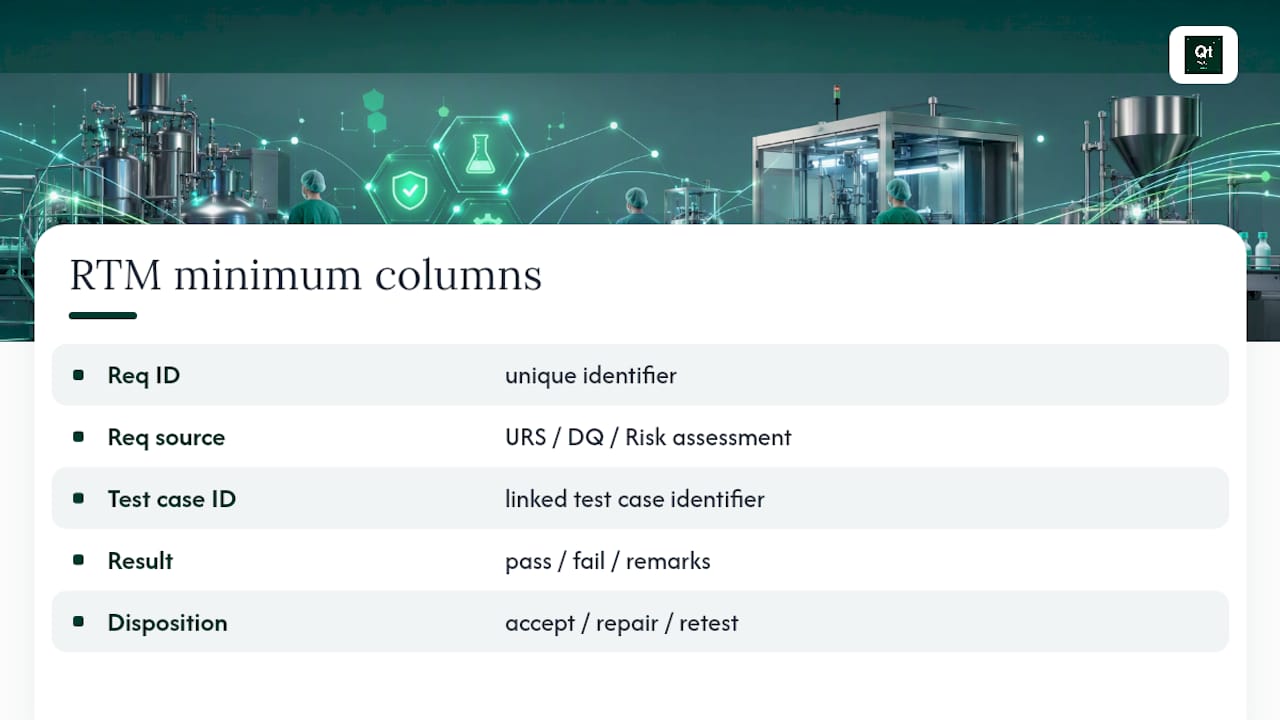
Finally, every test case needs a home in your Requirements Traceability Matrix (RTM): requirement, test case, result, disposition. No orphan tests, no untraced requirements.
Pro Tip: Write your RTM columns before you write a single test case. If you can't state which URS line a test case proves, you don't have a test case yet, you have an idea for one.
How Do You Decide Which Test Techniques to Use?
Not every system component deserves the same testing depth, and pretending otherwise is how validation cycles balloon without adding real assurance. The decision starts with quality risk management (QRM), not with a template.
Run a structured risk assessment, FMEA, Preliminary Hazard Analysis (PHA), or HAZOP depending on system complexity, to identify which functions are critical to patient safety, product quality, or data integrity. ICH Q9(R1) on quality risk management treats these tools as the standard mechanism for setting validation extent, and inspectors increasingly expect to see the risk assessment referenced directly in your test rationale, not just filed separately.
Map criticality to test depth using a simple gradient:
- High-risk parameters get full statistical sampling, tight acceptance ranges, and often continuous monitoring during PQ.
- Medium-risk parameters get standard sampling plans with documented rationale for sample size.
- Low-risk, vendor-qualified components can often lean on supplier evidence with a brief confirmatory check.
Statistical rigor should scale with risk. For critical process parameters, Cpk or Ppk calculations, control charts, and formal sample-size justification are the expected toolkit for evaluating validation characteristics, particularly where regulatory guidance on statistical approaches applies to PQ data. A sample size of "n=3 because that's what we always do" won't hold up if a critical attribute is involved.
Conditional approval to proceed to the next stage is sometimes defensible, but only with a documented risk assessment explaining what's outstanding and why it doesn't block downstream testing. WHO's GMP validation guidance explicitly allows this path, provided the justification is documented, not assumed.
Protocol Templates for IQ, OQ, PQ, and CSV Test Cases
You don't need to reinvent your protocol structure for every project. A few reusable patterns cover most equipment, software, and process validation scenarios.
IQ checklist essentials:
- Equipment model, serial number, and calibration status verified against purchase specification
- Installation environment (utilities, space, safety features) matches DQ requirements
- Documentation package (drawings, manuals, spare parts list) present and version-controlled
OQ test case template, one line per test:
- Test step describing the action performed
- Measurement or observation captured
- Pre-defined acceptance criterion
- Linked URS or DQ requirement ID
PQ sampling pattern: define the number of runs or batches (often three consecutive successful cycles as a starting point, adjusted upward for higher-risk processes), the sampling points within each run, and how you'll capture normal operational variability like operator rotation or raw material lot changes.
SST example for an analytical method: specify the parameters tested (resolution, precision, tailing), the control samples used, the numeric acceptance range for each, and a defined path for handling out-of-specification results, including whether a single SST failure invalidates the run or triggers an investigation. For equipment-level qualification, the same layered logic applies whether you're testing a filling line or a cleanroom and utility system.
Making Test Records Audit-Ready and Traceable
Your RTM needs, at minimum, five columns: requirement ID, requirement source (URS, DQ, or risk assessment), linked test case ID, result, and disposition.
ALCOA+ discipline has to happen at two moments, not one. At write-time, every entry needs to be attributable, legible, and contemporaneous. At review-time, a second person confirms the record is original, accurate, and complete before it's accepted as evidence. Retrofitting ALCOA+ compliance during a pre-audit scramble is exactly the failure mode this discipline is meant to prevent.
Audit trail review and version control matter just as much as the test result itself. Deviations and CAPAs need explicit links back to the specific test case and RTM row they affect, not a general reference buried in a summary paragraph. Your Validation Summary Report should close the loop: requirements covered, deviations resolved, and a clear statement of the system's fitness for intended use.
Pro Tip: If a deviation can't be traced to a specific RTM row within thirty seconds, your traceability structure has a gap, regardless of how thorough the narrative summary sounds, highlighting why controlled production environments require stringent test design protocols as outlined in Controlled Production: What Manufacturers Must Know.
A Practitioner's Take on What Actually Moves the Needle
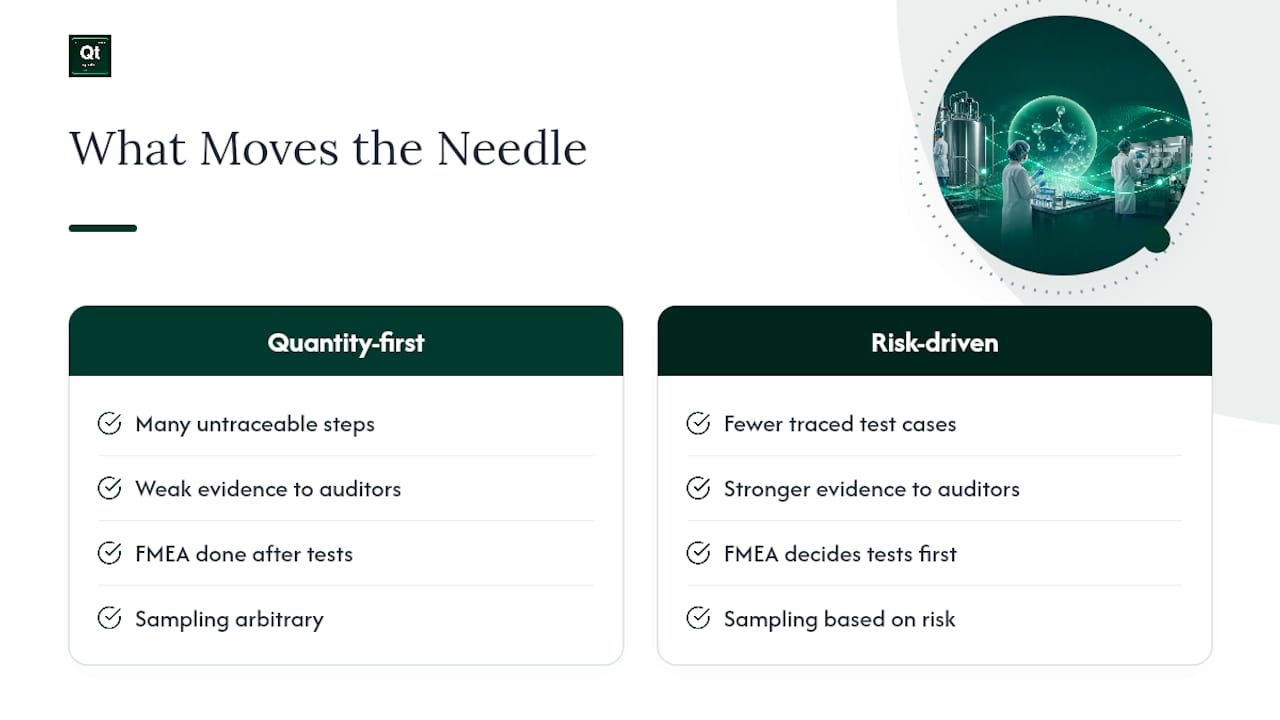
The conventional advice on test design treats more test cases as inherently safer. It isn't. A protocol with two hundred untraceable test steps is weaker evidence than one with sixty test cases, each tied to a documented risk and a clear acceptance criterion. Auditors don't count test cases. They trace a handful of them back to requirements and see whether the chain holds.
Where most teams underinvest is the risk assessment itself. Teams often treat FMEA as a compliance checkbox completed after the test plan is already drafted, when it should be the document that decides what gets tested and how deeply. Do the risk work first, and your sampling plans, your SST acceptance ranges, and your PQ run counts stop being arbitrary.
The reader's real priority should be traceability discipline before technique sophistication. A well-run RTM with modest statistical rigor beats a statistically elaborate protocol with broken links back to the URS. And where automation genuinely helps, it's in enforcing that discipline consistently across every protocol your team writes, not in replacing the risk judgment behind it.
Automating Risk-Based Test Design Without Losing Rigor
Everything above, RTM discipline, ALCOA+ at write-time, SST acceptance criteria, FAT/SAT reuse, is achievable manually. It's also where most validation teams lose weeks to formatting, cross-referencing, and review cycles instead of actual risk analysis.

Qualitum's Validate·AI platform builds these techniques directly into how protocols get authored. Every requirement links automatically into a live RTM, every record is checked against ALCOA+ criteria at both write-time and review-time, and SST parameters carry forward into test execution records instead of being retyped. FAT/SAT evidence imports directly, so your team documents the gap analysis instead of re-authoring what a supplier already tested. If your next validation cycle needs to move faster without cutting the traceability corners an auditor will find, book a working session to see how it maps to your current protocol structure.
Sources
- WHO TRS1019 annex 3 — GMP validation
- ICH Q14 — Analytical procedure development (and reference to ICH Q2)
FAQ
What Are the Main Test Design Techniques Used in Validation?
The core techniques are boundary and limit testing, system suitability testing, risk-based sampling using Cpk/Ppk, and FMEA-driven scoping to decide test depth per parameter.
How Does Risk Management Fit Into Test Design?
Quality risk management tools like FMEA, PHA, and HAZOP identify critical parameters first, and that criticality then determines sampling intensity and acceptance-criteria tightness, per ICH Q9(R1).
Can FAT/SAT Evidence Replace On-Site Testing?
Supplier FAT/SAT evidence can reduce or replace duplicate on-site testing when the gap between test conditions is documented and justified, a practice supported by GAMP 5 guidance.
What Makes a Traceability Matrix Audit-Ready?
An audit-ready RTM links requirement ID, source, test case, result, and disposition in one continuous chain, with no orphan requirements or untraced test cases.
How Can Automation Help With CSV Test Design?
Automation platforms like Qualitum's Validate·AI can enforce ALCOA+ checks at write-time, auto-link requirements into a live RTM, and cut authoring time significantly while keeping evidence traceable.
Recommended
- How to Test Data Integrity: A Practitioner's Guide · Qualitum blog
- Qualitum · The agentic validation platform for life sciences
- Investigate·AI · Qualitum
FAQ
What Are the Main Test Design Techniques Used in Validation?
The core techniques are boundary and limit testing, system suitability testing, risk-based sampling using Cpk/Ppk, and FMEA-driven scoping to decide test depth per parameter.
How Does Risk Management Fit Into Test Design?
Quality risk management tools like FMEA, PHA, and HAZOP identify critical parameters first, and that criticality then determines sampling intensity and acceptance-criteria tightness, per ICH Q9(R1).
Can FAT/SAT Evidence Replace On-Site Testing?
Supplier FAT/SAT evidence can reduce or replace duplicate on-site testing when the gap between test conditions is documented and justified, a practice supported by GAMP 5 guidance.
What Makes a Traceability Matrix Audit-Ready?
An audit-ready RTM links requirement ID, source, test case, result, and disposition in one continuous chain, with no orphan requirements or untraced test cases.
How Can Automation Help With CSV Test Design?
Automation platforms like Qualitum's Validate·AI can enforce ALCOA+ checks at write-time, auto-link requirements into a live RTM, and cut authoring time significantly while keeping evidence traceable.