To test data integrity means to verify that data remains accurate, complete, consistent, and traceable as it moves through ingestion, transformation, storage, and consumption. The goal is not a one-time audit but continuous enforcement: catching silent corruption, schema drift, and referential breakage before they reach downstream systems or regulators.
First actions to take in the next 24–72 hours:
- Identify your three to five most critical datasets (those feeding reports, models, or regulated outputs)
- Run baseline row counts and schema validation against each
- Check null rates on primary key and critical business fields
- Verify foreign key relationships across your most-used joins
- Enable automated checks on the next scheduled pipeline run
- Record all findings with timestamps so you have a starting audit trail
Table of Contents
- What does data integrity testing actually cover?
- What are the seven core categories of integrity tests?
- How do you design and run an integrity testing process?
- How do you automate integrity checks and integrate them into pipelines?
- What governance and ownership practices sustain integrity over time?
- A practical checklist of copy-ready integrity tests
- What metrics and SLOs should you track for data integrity?
- How do you build audit-ready traceability for regulated teams?
- What are the most common integrity failures and how do you fix them?
- Key Takeaways
- The case for starting small and iterating fast
- Qualitum brings write-time integrity enforcement to regulated validation
- Useful sources
What does data integrity testing actually cover?
Data integrity testing is system-level validation that data remains correct, consistent, and usable across its full lifecycle. It goes beyond schema validation or unit tests on code. The discipline covers five primary goals:
- Accuracy: Data matches the authoritative source or system of record
- Consistency: No contradictions exist across systems, tables, or time periods
- Completeness: No records or required fields are missing
- Referential integrity: Foreign key and primary key relationships hold across joins
- Durability: Data does not silently drift after migrations, backfills, or upstream code changes
Poor data quality costs U.S. companies an extremely high amount annually, with many companies reporting integrity issues that affect analytics outcomes. That figure reframes the problem: integrity testing is not a QA nicety, it is a financial control.
For regulated industries, the ALCOA+ framework adds a sixth dimension. Every data record must be Attributable, Legible, Contemporaneous, Original, Accurate, and additionally Complete, Consistent, Enduring, and Available. Write-time verification against these criteria produces the auditable evidence that regulators expect during inspections.
What are the seven core categories of integrity tests?
Seven functional checks form the industry-standard foundation for any data integrity testing program. Each category targets a distinct failure mode.

| Test category | Example check | Expected outcome | Typical alert threshold |
|---|---|---|---|
| Accuracy / reconciliation | Sum of order totals in warehouse matches source system | Delta < 0.01% | > 0.1% variance triggers review |
| Consistency (cross-system) | Customer status matches across CRM and billing | Zero contradictions | Any mismatch on critical fields |
| Completeness | Null rate on customer_id field | 0% nulls | > 1% null rate |
| Uniqueness | Duplicate primary keys in orders table | Zero duplicates | Any duplicate |
| Referential integrity | Every order.customer_id exists in customers | Zero orphan records | Any orphan FK |
| Business-rule / semantic | No order_date in the future; no negative quantity | All values within domain | Any violation |
| Durability / regression | Row counts and aggregates match pre-migration baseline | < 0.01% deviation | > 1% deviation post-change |
Semantic validation catches values that are technically schema-valid but contextually wrong: a future order date, a negative inventory count, or a status code that exists in the lookup table but contradicts the record's lifecycle stage. Purely schema-based checks miss all of these.
It also helps to separate physical integrity from logical integrity. Physical checks confirm that storage has not corrupted bytes or blocks. Logical integrity checks cover domain constraints, primary key uniqueness, referential FK relationships, and temporal consistency — the layer where most business-breaking failures actually live.
Durability tests matter most around migrations and backfills. A refactor that silently changes a historical aggregate is far harder to detect than a schema error, because the data still loads cleanly.
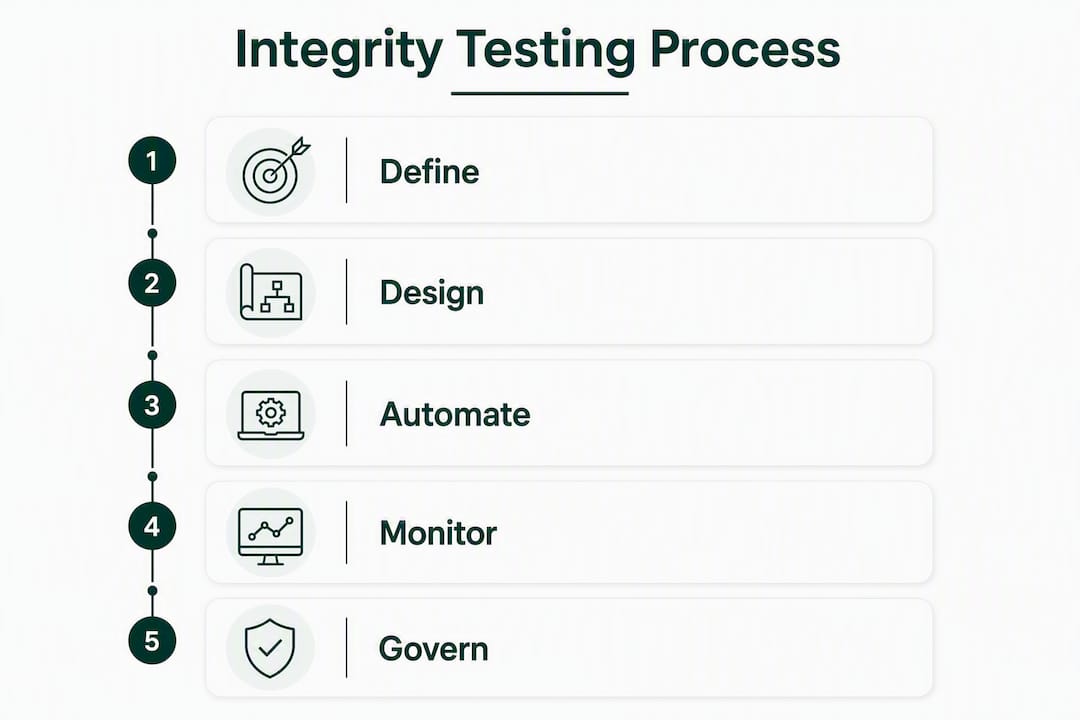
How do you design and run an integrity testing process?
A repeatable workflow prevents the most common failure mode: teams that test once at launch and never revisit until something breaks in production.
- Define data contracts and acceptance criteria. For each dataset, document the expected schema, field-level constraints, acceptable null rates, and cross-system reconciliation tolerances before writing a single test.
- Instrument checks at three levels. Field-level (null, type, domain), record-level (PK uniqueness, FK validity, business rules), and aggregate (row counts, sum reconciliation, distribution baselines).
- Run baseline tests and record results. The first run establishes your ground truth. Store results with timestamps — this is your audit starting point.
- Triage failures by severity. P0 failures (missing PKs, broken FKs, zero-row loads) block downstream use immediately. P1 failures (null rate spikes, reconciliation deltas above threshold) require same-day investigation. P2 failures (distribution drift, minor business-rule violations) queue for the next sprint.
- Root-cause upstream. Most integrity failures originate at ingestion or in upstream source systems, not in the warehouse itself. Trace the lineage before applying a fix.
- Repair and re-run. After fixing the upstream source or transformation logic, re-run the full test suite against the corrected data to confirm resolution.
- Document and close. Record what changed, who approved it, and when. For regulated contexts, this documentation is the remediation evidence an auditor will request.
On sampling versus full scans: full scans are necessary for PK uniqueness and FK checks, where a single violation matters. For distribution checks and null-rate monitoring, sampling recent rows trades speed for breadth and is acceptable as a fast-feedback diagnostic, provided you run full scans on a scheduled cadence.
Remediation checklist:
- Assign a named owner to every open failure (not a team, a person)
- Document the rollback pattern if a fix introduces new risk
- Apply temporary workarounds only with an expiry date and a ticket to remove them
- Annotate every correction in the audit log with the reason, the approver, and the ruleset version that caught it
How do you automate integrity checks and integrate them into pipelines?
Treating data integrity as a lifecycle requirement enforced at point of entry is the single most effective structural change a team can make. Shift-left validation prevents accumulating "data debt" that becomes exponentially more expensive to clean downstream.
Practical integration patterns run at five stages:
- Write-time validation: Enforce type, domain, and business-rule constraints at the moment data is written or ingested, before it reaches any downstream table
- Ingress-layer checks: Run schema validation and null-rate checks at the pipeline entry point using orchestration tools like Apache Airflow to gate downstream tasks on pass/fail results
- Transformation-stage checks: Validate intermediate outputs after each dbt model or SQL transform runs, catching logic errors before they propagate
- Post-load reconciliation: Compare aggregate counts and sums between source and target after each load cycle
- Pre-deployment CI checks: Include SQL linting and rule-validation tests in pull request pipelines so schema or logic changes trigger test failures reviewable before merge
Managing validation rules as code in JSON, TypeScript, or SQL repositories makes them auditable, diffable, and includable in CI pipelines. A rule change becomes a pull request with a reviewer, a diff, and a merge timestamp — exactly the traceability that auditors and compliance teams need.
Pro Tip: Version-control your validation rulesets in the same repository as your transformation code. When a schema change breaks a rule, the CI pipeline surfaces the failure in the PR before it reaches production, and the merge history documents exactly when the rule was updated and who approved it.
What governance and ownership practices sustain integrity over time?
Tooling without ownership degrades. The most common pattern is a team that builds solid checks at launch, then watches them silently fail for months because no one is responsible for acting on alerts.

| Role | Core responsibilities |
|---|---|
| Data owner | Defines acceptance criteria, approves data contracts, signs off on remediation |
| Data steward | Monitors daily metrics, triages alerts, coordinates fixes with upstream teams |
| SRE / Ops | Maintains pipeline infrastructure, manages alert routing, owns incident response |
| QA engineer | Authors and maintains test rulesets, reviews rule changes in CI |
| Compliance / Regulatory | Reviews audit evidence, confirms ALCOA+ adherence, approves regulated dataset changes |
Beyond roles, four policy defaults prevent recurring failures:
- Enforce data contracts at the API or pipeline boundary so upstream producers cannot change schemas without a versioned agreement
- Require staged rollouts for schema migrations: canary to a subset of data first, validate, then promote
- Mandate audit metadata on every correction: who, what, why, and when, stored in an immutable log
- Version-control all rulesets so every rule change is reviewable and the history is preserved
Treating validation rulesets as code is the governance mechanism that ties all of these together. It converts an informal practice into a reviewable, auditable artifact.
A practical checklist of copy-ready integrity tests
Tier your test suite by priority so the most critical checks run daily and never get skipped for performance reasons.
P0 — Run daily, block on failure:
SELECT COUNT(*) FROM orderscompared to yesterday's count (alert on > 5% drop or zero)SELECT COUNT(*) FROM orders WHERE order_id IS NULL(expected: 0)SELECT order_id, COUNT() FROM orders GROUP BY order_id HAVING COUNT() > 1(expected: empty)SELECT COUNT(*) FROM order_items oi LEFT JOIN orders o ON oi.order_id = o.order_id WHERE o.order_id IS NULL(expected: 0)
P1 — Run daily, alert and investigate same day:
- Null rate on critical fields:
SELECT SUM(CASE WHEN customer_id IS NULL THEN 1 ELSE 0 END) * 1.0 / COUNT(*) FROM orders(threshold: < 0.01) - Reconciliation delta: sum of
order_totalin warehouse vs. source system (threshold: < 0.1%) - Business-rule check for semantic violations:
SELECT COUNT() FROM orders WHERE order_date > CURRENT_DATE(expected: 0);SELECT COUNT() FROM order_items WHERE quantity < 0(expected: 0)
P2 — Run weekly or on event (deploy, migration, backfill):
- Distribution drift on
order_total: compare mean and standard deviation against a 30-day rolling baseline - Cross-system reconciliation at aggregate level: total revenue in warehouse vs. finance system (weekly close)
- Durability baseline comparison post-migration: row counts and key aggregates before and after, stored as a versioned snapshot
What metrics and SLOs should you track for data integrity?
Metrics give you a signal. SLOs give that signal a consequence.
Core metrics to instrument:
- Null rate per critical field (daily, per dataset)
- Duplicate rate on primary keys (daily)
- Reconciliation delta as both a percentage and an absolute value (daily)
- Distribution divergence using KS distance or Wasserstein distance against a rolling baseline (weekly or on deploy)
- Schema-change events (count per week, with diff logged)
- Mean time to resolution for integrity failures (monthly trend)
Sample SLOs worth adopting: less than 1% null rate on critical customer fields; 99.9% daily reconciliation pass rate; zero unresolved P0 failures older than four hours.
Statistical thresholds and distribution-shift detection catch silent drift that hard pass/fail unit tests miss entirely. A dataset where every row passes schema validation but whose value distribution has shifted 40% from baseline is a real integrity problem — and a hard threshold will never surface it.
Alerting playbook:
- P0 alerts page the on-call engineer immediately and block downstream jobs
- P1 alerts notify the data steward via Slack or PagerDuty with a runbook link; require acknowledgment within two hours
- P2 alerts create a ticket automatically, assigned to the data owner, with a five-day SLA
- Tag every alert with the dataset, the ruleset version that triggered it, and the last-known-good timestamp so triage starts with context, not a blank screen
How do you build audit-ready traceability for regulated teams?
For teams operating under 21 CFR Part 11, GAMP 5, or EudraLex Annex 11, integrity testing is not just an engineering practice. It is a regulatory obligation with specific evidentiary requirements.
ALCOA+ defines the standard: every data record must be Attributable, Legible, Contemporaneous, Original, and Accurate, with the additional properties of being Complete, Consistent, Enduring, and Available. Write-time verification enforcing ALCOA+ principles at the point of data capture, combined with immutable audit logs, produces defensible validation evidence that survives regulatory inspection.
Audit documentation checklist:
- Record who changed what data, under which ruleset version, and why
- Store test results with the exact ruleset version that ran them (not just a test name)
- Log the offending values, not just a pass/fail flag, so reviewers can assess impact
- Document remediation steps with approver names and timestamps
- Preserve chain-of-custody metadata through every transformation stage
Practical tips for life-sciences teams:
- Integrate validation evidence directly into your quality management system (QMS) rather than maintaining a separate documentation trail
- Enforce ALCOA+ at both write time and review time so no record enters the system without a complete audit footprint
- Use versioned rulesets so an auditor can reconstruct exactly which rules were active on any given date
- Treat deviation and CAPA records as first-class integrity artifacts, not afterthoughts
What are the most common integrity failures and how do you fix them?
Most integrity failures fall into four patterns, and each has a faster path to resolution than a full investigation.
Silent distribution drift occurs when an upstream code change alters value distributions without breaking schemas. The symptom is analytics results that "feel off" but pass all hard checks. The triage step is to compare current distributions against a 30-day baseline using KS distance. The short-term fix is to revert the upstream change or apply a corrective transform. The long-term prevention is automated distribution-shift alerting with adaptive thresholds tied to historical variance.
Schema mismatch after a source system upgrade is the most disruptive failure. Downstream jobs fail with type errors or silently coerce values. Triage by diffing the current schema against the last versioned snapshot. Fix by updating the ingestion contract and re-running affected loads. Prevent it with enforced data contracts and CI schema-validation checks on every deploy.
Partial batch ingestion leaves a dataset in a half-loaded state. Row counts drop, aggregates are wrong, and FK checks fail because referenced records are missing. Triage by comparing load manifests against expected record counts. Fix by replaying the failed batch. Prevent it with idempotent load patterns and post-load row-count gates that block downstream jobs until the full batch validates.
Incorrect backfills silently overwrite historical data with wrong values. This is the hardest failure to detect because the data looks complete. Run durability tests before and after any backfill, storing a versioned baseline snapshot so deviations are immediately visible.
Anti-patterns to avoid:
- Relying on manual spot checks as the primary detection mechanism
- Using hard-coded thresholds that never adapt to seasonal volume changes
- Assigning integrity ownership to "the team" rather than a named individual
Key Takeaways
Effective data integrity testing requires continuous, automated validation across every pipeline stage, with versioned rulesets, named ownership, and audit-ready evidence at every remediation step.
| Point | Details |
|---|---|
| Shift validation left | Enforce checks at ingestion, not after load, to prevent data debt from accumulating downstream. |
| Version-control rulesets | Store validation rules as code in your repository so every change is reviewable, diffable, and auditable. |
| Tier your tests by priority | Run P0 checks (row counts, PK uniqueness, FK integrity) daily and block on failure; reserve distribution checks for weekly cadence. |
| Use statistical alerting | Hard thresholds miss silent drift; add KS or Wasserstein distance monitoring against rolling baselines for critical datasets. |
| Qualitum for regulated teams | Qualitum enforces ALCOA+ at write time and review time, producing versioned, audit-ready validation evidence integrated with existing QMS workflows. |
The case for starting small and iterating fast
The most persistent mistake in data integrity programs is waiting for a complete framework before running a single check. Teams spend months designing the perfect ruleset architecture while production pipelines accumulate unchecked drift. By the time the framework launches, the backlog of integrity debt has grown large enough to undermine confidence in the whole effort.
A better approach: pick your three highest-risk datasets, instrument P0 checks this week, and run a 30-day pilot with documented SLOs and a single named remediation owner. The feedback loop from even a minimal automated suite will surface more real failures in 30 days than a year of manual spot checks. From there, expand coverage incrementally, add distribution monitoring, and fold ruleset versioning into your CI pipeline as a second phase.
The teams that build durable integrity programs share one trait: they treat the first check as a proof of concept, not a commitment to a finished system. Automation compounds. A ruleset you write today will catch failures you have not imagined yet, because it runs every time the pipeline runs, not only when someone remembers to look.
Qualitum brings write-time integrity enforcement to regulated validation
For pharmaceutical, biotech, and medical device teams, the gap between "we have integrity checks" and "we have audit-ready integrity evidence" is where most validation programs fall short. Qualitum closes that gap by enforcing ALCOA+ at the moment data is written and reviewed, not as a retrospective audit exercise.

Every record processed through Qualitum carries a complete, immutable audit footprint: who created it, which ruleset version validated it, what the exact values were, and what remediation was taken if a check failed. Validation rulesets are versioned and integrated with existing quality management systems, eliminating the duplicate documentation burden that consumes validation teams before every inspection. The result is a validation cycle that runs faster, produces defensible evidence automatically, and does not require a fire drill before an audit.
If your team is responsible for CSV, CSA, or any regulated data lifecycle under 21 CFR Part 11 or GAMP 5, see how Qualitum automates audit-ready validation and request a pilot scoped to your highest-risk systems.
Useful sources
- Data Integrity Testing in Software Testing — GeeksforGeeks: Accessible overview of integrity testing within the SDLC, useful for teams new to formalizing their QA process.
- Validate Your Data in AI Assistant — Adobe Experience Cloud: Documents sampling-based validation approaches and field-level diagnostic outputs for fast-scan use cases.
- Apache Airflow Documentation: Reference for orchestrating pipeline-integrated integrity checks with task dependencies and alerting hooks.
- Qualitum — The Agentic Validation Platform for Life Sciences: Platform documentation covering ALCOA+ enforcement, versioned validation evidence, and QMS integration for regulated industries.