Sterilization validation is a documented lifecycle program that proves your sterilization process reproducibly achieves the required Sterility Assurance Level, typically SAL ≤10^-6; learn practical compliance steps in the medical device validation guide. It is not a single test or a one-time autoclave qualification. It's an ongoing body of evidence: cycle design, performance qualification, and continuous monitoring, all tied together with a defensible rationale.
If you're starting or restarting a validation program, three decisions come first:
- Choose your strategy: overkill or bioburden-based, depending on how the product tolerates heat or chemical exposure.
- Characterize your load and draft the user requirements specification before touching equipment.
- Schedule IQ/OQ/PQ activities with realistic timelines. Regulators including FDA, EMA, and Health Canada all expect this staged approach, not a rushed final run.
Pro Tip: Don't let cycle development and documentation happen in parallel silos. The teams that pass audits cleanly write protocols and acceptance criteria before the first thermal mapping study runs, not after.
Key Takeaways
Sterilization validation succeeds when process design, performance qualification, and ongoing verification are documented as one continuous, risk-based lifecycle rather than isolated events.
| Point | Details |
|---|---|
| Define your SAL strategy early | Choose overkill or bioburden-based validation before cycle development starts, based on product and packaging tolerance. |
| Document three consecutive runs | Regulators expect PQ summaries showing at least three consecutive successful cycles confirming SAL ≤10^-6. |
| Treat requalification as risk-based | Set intervals using equipment criticality and process stability, not a default annual calendar. |
| Investigate deviations, don't just retest | Impact assessment and CAPA documentation are mandatory; naive retesting draws critical audit findings. |
| Automate documentation with Qualitum | Qualitum authors IQ/OQ/PQ and sterilization records with built-in ALCOA+ checks, cutting authoring time by over 70%. |
Table of Contents
- What Does the Sterilization Validation Lifecycle Look Like?
- Which Sterilization Validation Strategy Fits Your Product?
- What Belongs in an IQ/OQ/PQ Checklist?
- How Do Bioburden and Biological Indicators Establish SAL?
- What Do Regulators Expect in a Validation Submission?
- How Often Should Validated Sterilization Be Requalified?
- How Should You Handle Deviations During Validation?
- How Automation Changes the Validation Documentation Burden
- What the Data Actually Supports
- Get Your Sterilization Validation Program Audit-Ready Faster
- Sources
- FAQ
What Does the Sterilization Validation Lifecycle Look Like?
Regulators and industry guidance frame validation as three connected phases, not a checklist you complete once.
- Process design. This phase covers the user requirements specification, load characterization, and cycle development. You're deciding what "worst case" means for your product: densest load configuration, coldest spot in the chamber, hardest-to-penetrate packaging.
- Process performance qualification (PQ). Here you run the cycle under real conditions and prove it works consistently. Guidance from Health Canada and other lifecycle frameworks call for at least three consecutive successful runs confirming SAL ≤10^-6 before you call the cycle validated.
- Ongoing process verification. Validation doesn't end at PQ sign-off. You trend physical parameters, monitor biological and chemical indicator results over time, and route any process change through change control before it touches the validated cycle.
Skipping straight to PQ without solid process design is the single most common reason cycles fail requalification years later.
Which Sterilization Validation Strategy Fits Your Product?
The choice between overkill and bioburden-based validation shapes everything downstream, from your biological indicator selection to your submission narrative.
Overkill approaches apply a fixed, conservative lethality target, commonly a 12-log reduction of a highly resistant organism, regardless of your actual bioburden. This works well when the product and packaging tolerate harsher heat or radiation exposure without degrading. It's the simpler regulatory story: you're not relying on tight bioburden control to justify sterility.
Bioburden-based approaches fit products that can't survive an overkill cycle, think heat-sensitive polymers, certain biologics, or complex device assemblies. Here, you calculate required lethality from your maximum recovered bioburden and the D-value of your biological indicator organism, then validate that the cycle delivers at least that much lethality with margin. Health Canada's guidance on terminal sterilization walks through this calculation directly, including combined BI/bioburden approaches that blend both philosophies.
Before locking in a strategy, work through this checklist:
- Does the packaging material survive the target exposure time and temperature?
- Will the product formulation degrade under overkill conditions?
- What does your routine bioburden monitoring actually show, not what you assume it shows?
- Can you defend the approach to an auditor with data, not just precedent?
Pro Tip: If your bioburden data is more than a year old or came from a different manufacturing line, don't lean on it for a bioburden-based justification. Auditors ask for recent, representative data every time.
What Belongs in an IQ/OQ/PQ Checklist?
Equipment qualification is where a lot of validation programs quietly lose credibility, usually through gaps that don't surface until an inspector asks for the thermocouple placement rationale.
- Installation Qualification (IQ): Confirm the sterilizer is installed per specification. Leverage factory acceptance testing (FAT) and site acceptance testing (SAT) records rather than duplicating that work. Document utility connections, safety interlocks, and as-built drawings.
- Operational Qualification (OQ): Calibrate all instrumentation, verify steam quality (dryness, superheat, non-condensable gases for steam sterilizers), and run empty-chamber thermal mapping to identify cold spots. PDA Technical Report No. 48 outlines thermocouple placement density and acceptance limits for moist heat systems in detail.
- Performance Qualification (PQ): Test worst-case loads, not average ones. Run biological challenge studies alongside thermal monitors and confirm the required number of consecutive successful runs before sign-off.
A few things worth double-checking before you call OQ complete:
- Thermocouples placed at the coldest identified location, not just convenient spots.
- Steam quality tested under load, not just at startup.
- Calibration records traceable to a recognized standard, with no expired certificates lurking in the file.
How Do Bioburden and Biological Indicators Establish SAL?
Bioburden testing and sterility testing answer different questions, and mixing them up in your validation narrative is a fast way to draw auditor scrutiny. Bioburden testing is quantitative: it counts the microbial population on or in a product before sterilization. Sterility testing is qualitative: it asks whether a sample, tested under compendial methods like USP <71> or EP 2.6.1, shows growth at all. Because sterility testing only samples a fraction of a batch, the World Health Organization is direct about this: sterility assurance comes from the validated process, not from testing every unit.

Biological indicators (BIs) carry known populations of resistant spores, usually Geobacillus stearothermophilus for steam cycles, characterized by a D-value, the time needed to reduce the population by one log at a given temperature. Chemical indicators (CIs), particularly Class 5 and Class 6 types under ISO 11140, confirm that critical cycle parameters were met but don't replace biological challenge data.
To justify SAL ≤10^-6, you combine your maximum recovered bioburden count with the BI's D-value to calculate the log reduction your cycle must deliver, then validate against that target with margin.
What Do Regulators Expect in a Validation Submission?
Submission packages get rejected less often for bad science than for incomplete documentation. FDA guidance is specific about what needs to be there:
- Cycle descriptions with autoclave or equipment identifiers.
- Load pattern diagrams showing exactly how product was arranged during PQ runs.
- Heat penetration and thermal monitor summaries, not just pass/fail statements.
- BI and CI results tied to specific load positions.
- A summary of at least three consecutive successful qualification runs.
The EMA's guideline on sterilization of medicinal products asks for the same core elements under Ph. Eur. 5.1.1, plus explicit correlation between physical and biological cycle confirmation. Health Canada's GUI-0074 reinforces the lifecycle framing across all three regions. Cross-reference your protocols and SOPs directly in the submission narrative, and state your rationale for run counts rather than assuming the number speaks for itself.
How Often Should Validated Sterilization Be Requalified?
Once a cycle is validated, the real work is keeping it that way. Routine controls include physical parameter monitoring (temperature, pressure, exposure time), scheduled BI and CI use at a defined frequency, and trending that data over time rather than reviewing it run by run in isolation.
Parametric release, releasing product based on validated physical parameters instead of end-product sterility testing, is achievable but earns its way in gradually. An AAMI case study on a healthcare facility's steam sterilization program shows a practical path: quarterly validation runs sustained over one full year, then a shift to annual revalidation once the process demonstrated consistent control.
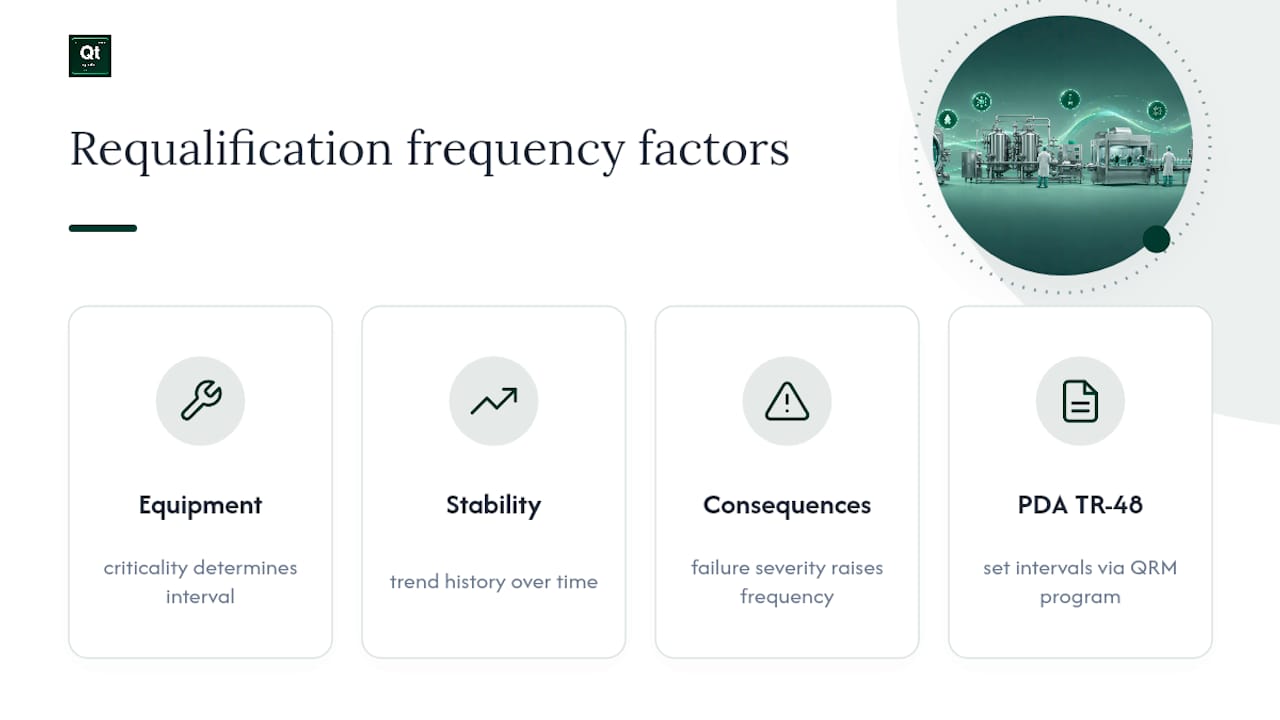
Requalification frequency itself should be risk-based, not calendar-based by default. Equipment criticality, process stability history, and the consequences of failure all factor in. PDA Technical Report No. 48 recommends defining these intervals through a formal quality risk management program rather than defaulting to an annual cycle out of habit.
Pro Tip: If a sterilizer has had two or more excursions in the past year, don't wait for the next scheduled requalification. Move it up. Repeated excursions are a leading indicator, not background noise.
How Should You Handle Deviations During Validation?
A failed BI, an out-of-range thermocouple reading, or a load mapping anomaly demands more than a retest. FDA's inspection guidance on sterilization process controls treats naive retesting, running the cycle again and moving on if it passes, as a critical finding in itself.
- Assess impact first. Determine what the deviation means for product already sterilized under that cycle, not just the run in question.
- Investigate root cause. The usual suspects are load configuration drift, thermocouple placement errors, and calibration gaps that crept in between checks.
- Document a CAPA. Show the corrective action, the preventive action, and the evidence that both actually closed the gap.
- Cross-reference everything. Your deviation report should point to the specific protocol, SOP, and prior validation data it affects.
Audit-ready records follow ALCOA+ principles: attributable, legible, contemporaneous, original, accurate, plus complete, consistent, enduring, and available. Missing traceability between a deviation and its resolution is one of the fastest ways to turn a minor finding into a Form 483 observation.
How Automation Changes the Validation Documentation Burden
Every phase above generates paperwork: URS documents, load mapping diagrams, thermal summaries, deviation reports, CAPA records. Manually authoring and cross-referencing all of it is where validation timelines usually stall.
Qualitum's multi-agent platform authors validation documentation directly, including IQ/OQ/PQ protocols and cleaning and sterilization records, with every entry checked against ALCOA+ at write-time and again at review-time. That dual check is what closes the audit trail gaps that manual documentation tends to leave behind.
- Authoring time drops by over 70% compared to manual protocol writing.
- A live traceability matrix keeps protocols, deviations, and CAPA records cross-referenced automatically.
- Integration with existing quality management systems means teams don't rebuild their document flow from scratch.
For validation leads managing multiple sterilizer qualifications at once, that time savings compounds fast across a portfolio.
What the Data Actually Supports
Most sterilization validation advice treats regulatory compliance and operational efficiency as competing priorities. They aren't. The programs that pass inspections cleanly are usually the ones that documented their rationale early, not the ones that ran the most extra cycles for reassurance.
The overlooked failure point isn't cycle science. Teams tend to invest heavily in thermal mapping and BI selection, and that's appropriate, but they underinvest in the connective tissue: cross-referencing protocols, tracing deviations back to root cause, keeping bioburden data current enough to defend a bioburden-based strategy. FDA's own inspection guidance singles out naive retesting as a critical finding precisely because it signals weak connective tissue, not weak science.
If you take one thing from this guide, prioritize documentation architecture before you prioritize additional testing. A well-designed cycle with sloppy traceability fails audits. A defensible cycle with tight, cross-referenced records survives them, even when a deviation shows up. That's not a popular message in a field obsessed with D-values and F0 calculations, but it's what actually separates programs that sail through inspections from ones that don't.
— Matt
Get Your Sterilization Validation Program Audit-Ready Faster
Qualitum is the alternative to weeks of manual protocol writing for teams validating steam, EO, radiation, or vaporized hydrogen peroxide cycles. Instead of authoring IQ/OQ/PQ documents, load mapping records, and CAPA reports by hand across spreadsheets and templates, Qualitum's agents draft that evidence directly, with ALCOA+ compliance checks built into every write and review step.

That matters most for teams juggling multiple sterilizer qualifications or requalification cycles at once, where manual cross-referencing between protocols and deviation reports is exactly where things fall apart before an audit. Qualitum integrates with the quality management systems you already run, so the traceability matrix stays live instead of becoming a separate reconciliation project. If your team is heading into a validation cycle, EO, steam, or radiation, book a working session to see how the platform maps onto your current sterilization validation workflow.
Sources
- Submission Documentation for Sterilization Process Validation in Applications for Human and Veterinary Drug Products | FDA
- Guide to validation of terminal sterilization process of drugs (GUI-0074)
- Guideline on sterilisation of the medicinal product, active substance, excipient and primary container | EMA
- Sterility testing | WHO
- Steam sterilization validation for implementation of parametric release at a healthcare facility | AAMI
FAQ
How Do You Validate a Sterilization Process?
You validate a sterilization process through a three-phase lifecycle: process design (load characterization, cycle development), performance qualification (at least three consecutive successful runs demonstrating SAL ≤10^-6), and ongoing verification through trending and risk-based requalification.
What Are the FDA Requirements for Sterilization Process Validation?
FDA guidance requires submission of cycle descriptions, load pattern diagrams, heat penetration studies, biological and chemical indicator data, and a summary of at least three consecutive successful qualification runs.
What Are the FDA Guidelines for Autoclave Validation?
Autoclave validation under FDA expectations follows the same IQ/OQ/PQ framework as other steam sterilization equipment: installation verification, calibration and thermal mapping during OQ, and worst-case load testing with biological challenge studies during PQ.
How Often Should an Autoclave Be Validated?
Requalification frequency should be risk-based, factoring in equipment criticality and process stability, though annual requalification is common practice unless a process change or repeated excursion calls for earlier action.
Can Automation Help With Sterilization Validation Documentation?
Yes. Platforms like Qualitum author IQ/OQ/PQ and sterilization validation protocols with ALCOA+ compliance checks built in, reducing manual documentation time and keeping traceability between protocols and deviations current.
Recommended
- Cleaning validation · Validate·AI · Qualitum
- Cleanroom & utility qualification · Validate·AI · Qualitum
- Validate·AI · Qualitum
- Qualitum · The agentic validation platform for life sciences
FAQ
How Do You Validate a Sterilization Process?
You validate a sterilization process through a three-phase lifecycle: process design (load characterization, cycle development), performance qualification (at least three consecutive successful runs demonstrating SAL ≤10^-6), and ongoing verification through trending and risk-based requalification.
What Are the FDA Requirements for Sterilization Process Validation?
FDA guidance requires submission of cycle descriptions, load pattern diagrams, heat penetration studies, biological and chemical indicator data, and a summary of at least three consecutive successful qualification runs.
What Are the FDA Guidelines for Autoclave Validation?
Autoclave validation under FDA expectations follows the same IQ/OQ/PQ framework as other steam sterilization equipment: installation verification, calibration and thermal mapping during OQ, and worst-case load testing with biological challenge studies during PQ.
How Often Should an Autoclave Be Validated?
Requalification frequency should be risk-based, factoring in equipment criticality and process stability, though annual requalification is common practice unless a process change or repeated excursion calls for earlier action.
Can Automation Help With Sterilization Validation Documentation?
Yes. Platforms like Qualitum author IQ/OQ/PQ and sterilization validation protocols with ALCOA+ compliance checks built in, reducing manual documentation time and keeping traceability between protocols and deviations current.