For validation-heavy life sciences teams, Qualitum is the recommended replacement or augmentation layer when CSV velocity and ALCOA+ evidence are the primary drivers. If your organization needs a full eQMS replacement with broader quality module coverage, the shortlist below maps each category to the buyer profile it fits best.
- Validation-first platform (Qualitum): best for validation leads and heads of QA in pharma, biotech, and medical device who need to accelerate CSV cycles and produce defensible 21 CFR Part 11 audit evidence without manual documentation overhead.
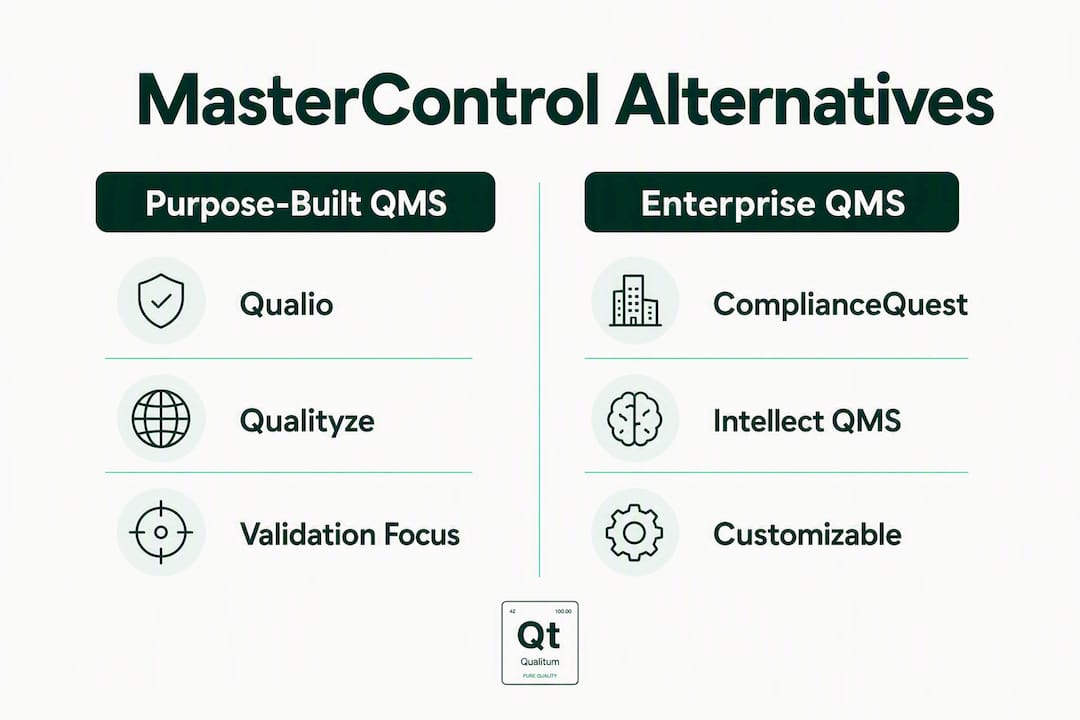
- Life sciences purpose-built eQMS (e.g., Qualio, Qualityze): best for growing biotech or medical device teams that need out-of-the-box GxP workflows and faster time-to-compliance than a configurable enterprise platform delivers.
- Configurable enterprise QMS (e.g., Intellect QMS, AssurX, ComplianceQuest): best for mid-to-large regulated organizations that need deep workflow customization across quality, supplier, and product domains.
- ERP/PLM-centric QMS (SAP Cloud ERP, Oracle PLM): best for large enterprises where quality data must live inside an existing SAP or Oracle ecosystem.
- Lightweight cloud QMS (QT9 QMS, Propel): best for smaller teams or contract manufacturers that need affordable, fast-to-deploy quality management without heavy validation infrastructure.
For a deeper look at how these categories compare on validation support, integrations, and implementation timelines, the Gartner alternatives page for MasterControl and Capterra's verified reviews are useful starting points.
Table of Contents
- How do the top MasterControl alternatives compare side by side?
- Vendor profiles: what each alternative actually provides
- How to choose the right MasterControl alternative for your organization
- Migration, CSV, and integration considerations when switching from MasterControl
- What is MasterControl, and why do organizations look for alternatives?
- How does customer support quality vary across QMS vendors?
- What training and onboarding resources should you expect from a QMS vendor?
- Key Takeaways
- When does Qualitum recommend its own platform vs. a full QMS replacement?
- Qualitum for teams replacing or augmenting MasterControl
- Authoritative sources and further reading
- FAQ
How do the top MasterControl alternatives compare side by side?
The table below uses generic category labels rather than vendor names so you can evaluate the structural tradeoffs before narrowing to specific products.
| Category | Best for / buyer profile | Target industry & size | Core modules | Deployment | Validation / CSV support | Integrations | Pricing model | Implementation time | Key differentiator |
|---|---|---|---|---|---|---|---|---|---|
| Validation-first platform | Validation leads, QA heads in pharma/biotech/device | Pharma, biotech, medical device — mid to enterprise | Validation lifecycle (URS, IQ, OQ, PQ), CAPA, audit trails, traceability matrix | SaaS / validated private cloud | Native ALCOA+ enforcement, agent-authored CSV artifacts, 21 CFR Part 11 | ERP, LIMS, QMS, identity/SSO | Subscription by agentic system; annual | Pilot in weeks; enterprise rollout in months | Automated validation authoring; 70%+ time savings in CSV cycles |
| Life sciences purpose-built eQMS | QA managers at growth-stage biotech or device firms | Life sciences — SMB to mid-market | Document control, CAPA, training, audits, change control | SaaS / cloud | Pre-configured GxP workflows; IQ/OQ/PQ templates | ERP, EHR, e-signature | Per-seat SaaS; tiered | 2–4 months | Fast time-to-compliance; minimal configuration needed |
| Configurable enterprise QMS | Quality directors at complex multi-site organizations | Pharma, manufacturing, aerospace — mid to large | Full quality suite: CAPA, supplier quality, audits, NCR, complaints | SaaS or on-prem | Configurable CSV support; requires SI partner for validation | ERP, PLM, CRM | Modular licensing; higher TCO | 4–9 months | Deep workflow customization; broad module coverage |
| ERP/PLM-centric QMS | IT-led procurement at large enterprises with existing SAP/Oracle | Pharma, discrete manufacturing — enterprise | Quality embedded in ERP/PLM; document control, CAPA, change management | Cloud ERP / on-prem | Validation support via SI partners; complex CSV effort | Native ERP/PLM; limited third-party | Enterprise licensing; high | 9–18 months | Single data model across quality, supply chain, and finance |
| Lightweight cloud QMS | QA leads at small manufacturers or CROs | Medical device, contract manufacturing — SMB | Document control, CAPA, training, basic audits | SaaS / cloud | Limited native CSV support; relies on user-built validation | Limited; API-based | Low-cost SaaS; per-seat | 1–3 months | Affordable, fast deployment; low IT overhead |
Practical tradeoffs to keep in mind:
- A validation-first platform produces defensible CSV artifacts natively; a configurable enterprise QMS requires significant SI effort to reach the same evidence standard.
- Life sciences purpose-built eQMS options offer faster time-to-compliance but less flexibility for complex multi-site quality programs.
- ERP/PLM-centric options give you a unified data model across the enterprise, but implementation timelines stretch significantly for quality-specific configuration.
- Lightweight cloud QMS tools reduce procurement friction but typically require manual validation work that adds hidden cost for regulated teams.
- Connected quality — linking product, process, and supplier data in a single system — is increasingly a decisive selection factor, not a nice-to-have.
Vendor profiles: what each alternative actually provides

Qualitum (recommended for validation-first teams)
Qualitum is an agentic validation platform built specifically for pharmaceutical, biotech, and medical device organizations. Its multi-agent system authors validation lifecycle deliverables (URS, FS, DQ, IQ, OQ, PQ, cleaning and sterilization protocols, risk assessments) and enforces ALCOA+ data integrity at both write-time and review-time. Every record carries a defensible audit trail without manual documentation effort. Qualitum integrates with existing QMS, ERP, LIMS, and identity systems, and deploys in a validated private cloud. The engagement model starts with a paid pilot, then scales to enterprise rollout under an annual subscription priced by agentic systems activated, not per seat.
Ideal buyer: Heads of Validation, QA leads, and Compliance Officers at pharma, biotech, or medical device companies who need to cut CSV cycle time and produce audit-ready evidence without expanding headcount.
Life sciences purpose-built eQMS
These platforms (Qualio and Qualityze are representative examples) ship with GxP-aligned workflows pre-configured for document control, CAPA, training management, and audit readiness. Setup is faster than a configurable enterprise platform because the regulatory logic is already built in. The tradeoff is limited flexibility: organizations with complex multi-site quality programs or deep supplier quality requirements often outgrow them. Include this category in your RFP if your team is scaling from startup to mid-market and needs to be audit-ready within a quarter.
Configurable enterprise QMS

Platforms like ComplianceQuest, Intellect QMS, and AssurX offer broad module coverage and deep workflow customization. They can handle complex supplier quality, product quality, and process quality in a single system, which is why large regulated manufacturers favor them. The cost is a longer implementation (typically 4–9 months) and a heavier reliance on system integrator partners to configure validation-specific workflows. Evaluate this category when your quality program spans multiple sites, product lines, or regulatory jurisdictions and you need a single system of record for all quality events.
ERP/PLM-centric QMS
SAP Cloud ERP and Oracle PLM embed quality management inside the same data model that runs your supply chain and product development. For large enterprises already standardized on SAP or Oracle, this eliminates integration complexity between quality and operations. The practical downside is that quality-specific configuration — particularly CSV and 21 CFR Part 11 compliance — requires experienced SI partners and extended timelines. Add this category to your PoC only if IT leadership has mandated a single-vendor ERP strategy and the quality team has the budget and timeline to match.
Lightweight cloud QMS
QT9 QMS and Propel serve smaller teams and contract manufacturers that need affordable, fast-to-deploy quality management. Deployment can happen in one to three months, and per-seat pricing keeps costs predictable at lower volumes. The gap for regulated life sciences teams is validation infrastructure: these platforms typically lack native CSV support, so teams must build and maintain their own validation documentation. Consider this category for non-critical quality workflows or as a bridge system while a larger QMS procurement is underway.
Pro Tip: Before issuing an RFP, map your top three quality events from the past 12 months (most common CAPA sources, audit findings, or deviations) and verify that each shortlisted platform has a native workflow for them. A platform that handles 80% of your volume out of the box will almost always outperform a more configurable one that requires six months of setup to reach the same coverage.
How to choose the right MasterControl alternative for your organization
Decision criteria checklist
Prioritize these dimensions in the order they appear — the top items carry the most regulatory risk if you get them wrong.
- Validation / CSV support: Does the platform produce 21 CFR Part 11-compliant audit evidence natively, or does that require a separate validation effort by your team?
- ALCOA+ data integrity: Are records attributable, legible, contemporaneous, original, and accurate at the system level, not just by policy?
- Integration depth: Can the platform connect to your ERP, LIMS, PLM, and identity provider without custom middleware?
- Data migration: Does the vendor provide a documented migration methodology, including data mapping and reconciliation reports?
- Scalability: Will the platform support additional sites, product lines, or regulatory jurisdictions without a re-implementation?
- Security and identity: Does it support SSO, role-based access control, and audit-log immutability?
- Partner ecosystem: Are there qualified SI partners with life sciences validation experience, or will your team carry the implementation alone?
- Global support: Does the vendor offer support coverage aligned with your operating hours and regulatory regions (FDA, EMA, PMDA)?
Ten questions to ask vendors in RFPs and demos
- How do you produce 21 CFR Part 11-compliant audit evidence for CSV activities, and can you show a sample deliverable?
- What is your documented IQ/OQ/PQ process for your own platform, and can we review it?
- Which ERP, LIMS, and PLM systems do you have pre-built connectors for, and what is the integration maintenance model?
- How do you handle data migration from a legacy QMS, and what reconciliation evidence do you provide?
- What is your typical go-live timeline for an organization of our size, and what are the most common causes of delay?
- How is pricing structured — per seat, per module, or per system — and what triggers a contract renegotiation?
- Who are your SI partners with validated life sciences implementations, and can you provide references?
- How do you manage platform upgrades without breaking our validated state?
- What does your customer support model look like during and after implementation (SLA, escalation path, named CSM)?
- How do you support multi-site or multi-jurisdiction deployments where regulatory requirements differ?
Red flags to watch for
- Pricing opacity: no published model and resistance to sharing total cost of ownership estimates before contract.
- No documented CSV support: the vendor cannot produce a sample validation package or references from regulated customers.
- Limited APIs: integrations require custom development with no maintained connector library.
- Thin partner ecosystem: fewer than a handful of SI partners with life sciences experience means your team absorbs implementation risk.
- Upgrade-triggered revalidation with no vendor support: every platform update forces a full revalidation cycle that your team must execute alone.
Rough cost and implementation ranges by category
Enterprise QMS deployments commonly start at a mid-range annual cost for typical packages, with costs rising as seats and modules are added. Across categories:
- Validation-first platform (Qualitum): — subscription by agentic system; pilot in weeks, enterprise rollout in months.
Migration, CSV, and integration considerations when switching from MasterControl
Typical implementation phases
| Phase | Activities | Typical duration |
|---|---|---|
| Discovery & scoping | Current-state mapping, gap analysis, regulatory risk assessment | Weeks 1–4 |
| Data mapping | Record inventory, field mapping, migration scripts, data cleansing | Weeks 3–8 |
| CSV planning | Validation strategy, URS authoring, risk classification per GAMP 5 | Weeks 4–10 |
| IQ / OQ / PQ execution | Installation qualification, operational qualification, performance qualification | Weeks 8–18 |
| Cutover & parallel run | Dry-run cutover, reconciliation reports, parallel operation period | Weeks 18–24 |
| Retrospective & closure | Validation summary report, lessons learned, hypercare support | Weeks 24–28 |
CSV checklist for migration
- Complete a data inventory: document every record type (SOPs, CAPAs, training records, audit reports) and its regulatory retention requirement.
- Build a traceability matrix linking each migrated record to its source, transformation rule, and destination field.
- Author IQ/OQ/PQ test cases that cover data integrity, access control, audit trail completeness, and e-signature compliance under 21 CFR Part 11.
- Collect supplier evidence: obtain the new platform's IQ documentation, penetration test reports, and SOC 2 or equivalent attestation.
- Produce validation deliverables aligned to GAMP 5 risk categories — do not treat a SaaS QMS as a Category 1 tool if it executes GxP-critical workflows.
- Execute a reconciliation report post-migration confirming record counts, checksums, and audit trail continuity.
- Archive the original MasterControl data in a read-only, accessible format for the regulatory retention period before decommissioning.
Practical migration best practices
A phased migration almost always outperforms a big-bang cutover in regulated environments. Start with lower-risk record types (training records, non-critical SOPs) to validate your migration scripts before moving CAPA records and audit evidence. Run a cutover dry run at least once in a staging environment and document the results as part of your validation package. For CROs and clinical labs, integrating diagnostic data flows early in the migration plan prevents reconciliation gaps that surface during inspections.
Pro Tip: Assign an ALCOA+ checkpoint to every migration batch: before each batch loads into the new system, verify that timestamps are preserved from the source record, the originating user identity is retained or documented, and no data has been silently transformed. Inspectors will ask for this evidence; building it into the migration process costs far less than reconstructing it post-cutover.
What is MasterControl, and why do organizations look for alternatives?
MasterControl is a commercial closed-loop quality management system used by regulated organizations to manage document control, CAPA, training, and audit workflows. It is not an FDA system; the FDA does not operate or endorse it as a required platform. Many regulated companies adopted it as an on-premise or hosted QMS before cloud-native alternatives existed, and it remains widely deployed in pharma and medical device.
The reasons teams search for alternatives to MasterControl cluster around a few consistent pain points:
- Total cost of ownership: Deployments commonly start at $25,000+ per year for typical enterprise packages, with costs rising sharply as seats and modules are added. Many organizations find the TCO difficult to justify when newer platforms offer comparable compliance coverage at lower cost.
- Usability: — Reviewer feedback on platforms like Gartner and Capterra frequently cites a steep learning curve and dated UI as barriers to adoption across quality teams.
- Connected quality: Buyers increasingly prefer systems that link product, process, and supplier quality in a unified data model rather than managing siloed modules.
Pricing note: The annual pricing figure reflects typical enterprise package costs reported in public sources. Actual costs vary by seat count, modules, and negotiated terms — always request a detailed TCO breakdown before signing.
How does customer support quality vary across QMS vendors?
Support quality is one of the sharpest differentiators between QMS categories, and it tends to be underweighted in RFP scoring until something goes wrong during an inspection.
Life sciences purpose-built eQMS vendors typically offer named customer success managers and regulatory-aware support teams who understand GxP context. That matters when a support ticket involves an audit trail discrepancy rather than a generic software bug. Configurable enterprise QMS vendors often route support through SI partners, which adds a layer of latency but can provide deeper technical expertise for complex configurations.
Verified reviews on Gartner and Capterra consistently flag response time and regulatory knowledge as the two dimensions where QMS vendors diverge most. A vendor with a strong user community (active forums, peer-to-peer knowledge bases, annual user conferences) reduces your dependency on formal support channels for routine questions. Ask for SLA documentation and escalation paths before contract, not after.
What training and onboarding resources should you expect from a QMS vendor?
Onboarding quality directly affects how quickly your team reaches a validated, productive state. The gap between vendors is wider than most buyers expect.
Purpose-built life sciences eQMS platforms tend to offer structured onboarding programs with role-based training tracks (QA manager, document author, auditor), pre-built training curricula inside the platform itself, and sandbox environments for practice before go-live. That structure compresses the learning curve significantly for teams new to the system.
Enterprise configurable QMS vendors typically provide formal training through SI partners or vendor-run academies, with certification programs for administrators. The depth is there, but the timeline to full team proficiency is longer. For healthcare and CRO organizations evaluating QMS options with clinical workflow integration, onboarding resources that cover diagnostic data handling and integration configuration are particularly relevant.
Qualitum's onboarding model is structured around the pilot engagement: your validation team works through real validation deliverables during the pilot, which means the learning happens on actual work product rather than synthetic exercises. By the time the pilot closes, the team has produced defensible CSV artifacts and understands the platform's ALCOA+ enforcement model from direct experience.
Key Takeaways
For most validation-heavy life sciences teams, the choice of QMS alternative comes down to two non-negotiable criteria: native CSV/21 CFR Part 11 readiness and integration depth with existing ERP, LIMS, and PLM systems.
| Point | Details |
|---|---|
| Recommended pick for CSV-heavy teams | Qualitum's agentic validation platform cuts authoring time by over 70% and enforces ALCOA+ at the system level. |
| Top selection criteria | Prioritize native 21 CFR Part 11 audit evidence and pre-built ERP/LIMS/PLM integrations above all other features. |
| Cost baseline to plan around | Enterprise QMS deployments commonly start at $25,000+ per year; validate total cost of ownership before shortlisting. |
| Migration risk mitigation | Use phased data migration with ALCOA+ checkpoints on every batch to produce defensible audit trail evidence. |
| Qualitum's engagement model | Start with a paid pilot producing real CSV deliverables; scale to enterprise rollout under an annual subscription. |
When does Qualitum recommend its own platform vs. a full QMS replacement?
The honest answer is that these are not always competing choices. Most organizations that contact Qualitum already have a QMS in place — whether MasterControl, a purpose-built eQMS, or an ERP-embedded quality module. The question is rarely "which QMS should we buy?" It is more often "why does our validation process still consume so much time and produce evidence that makes auditors nervous?"
Qualitum's position is that automated validation is a layer, not a replacement, in most cases. If your existing QMS handles document control, CAPA, and training adequately, adding Qualitum's agentic validation layer accelerates CSV cycles and produces ALCOA+-enforced evidence without a full system migration. That is a faster, lower-risk path to audit readiness than a complete QMS replacement.
A full QMS replacement makes sense when the existing system has fundamental integration gaps, a prohibitive TCO, or a validation posture that cannot be remediated without rebuilding the configuration from scratch. In those cases, Qualitum can serve as the validation backbone while a new eQMS handles broader quality workflows.
Qualitum for teams replacing or augmenting MasterControl
Cutting CSV cycle time by over 70% in authoring is the headline. The mechanism behind it is Qualitum's multi-agent system, which authors validation lifecycle deliverables (URS, IQ, OQ, PQ, risk assessments, cleaning and sterilization protocols) with ALCOA+ enforcement built into every record at write-time and review-time. Your team reviews and approves; the platform handles the documentation burden.

For teams moving off MasterControl, Qualitum integrates with the QMS, ERP, LIMS, and identity systems you already operate, so the transition does not require rebuilding your quality infrastructure from scratch. The engagement starts with a paid pilot: your validation team works through real deliverables on your actual systems, producing audit-ready evidence before the enterprise contract is signed.
If your next inspection is closer than your next QMS procurement cycle, that pilot timeline matters. Request a pilot or demo at Qualitum to see what your validation deliverables look like when the documentation burden is removed.
Authoritative sources and further reading
- Top Alternatives to MasterControl Quality Excellence (Gartner): verified peer reviews and analyst commentary on QMS alternatives; useful for trust signals and competitive positioning.
- Best MasterControl Quality Excellence Alternatives 2026 (Capterra): verified user reviews with pricing intelligence and feature comparisons across QMS vendors.
- Top 10 MasterControl QMS Alternatives (G2): crowd-sourced reviews with category ratings for ease of use, support, and implementation.
- MasterControl Alternatives and Competitors (RFP.wiki): RFP-focused commentary on connected quality and integration as selection criteria.
- MasterControl Pricing: Beyond Crazy (OpenRegulatory): independent pricing analysis with context on total cost of ownership for enterprise deployments.
- MasterControl Alternatives and Competitors (CB Insights): market intelligence on enterprise QMS options and implementation complexity.
- QMS Alternatives for Healthcare Organizations (KoHealthLabs): industry-specific selection signals for CRO and clinical lab QMS evaluation.
FAQ
Is MasterControl a quality management system?
Yes. MasterControl is a commercial closed-loop QMS designed for regulated organizations, covering document control, CAPA, training management, and audit workflows. It is not an FDA-operated system.
Who are MasterControl's main competitors?
The main alternatives span several categories: life sciences purpose-built eQMS platforms (Qualio, Qualityze), configurable enterprise QMS solutions (ComplianceQuest, Intellect QMS, AssurX), ERP/PLM-embedded quality modules (SAP, Oracle PLM), and lightweight cloud QMS tools (QT9 QMS, Propel). Qualitum addresses the validation automation layer that most of these platforms require teams to build manually.
How much does MasterControl cost per year?
Publicly reported pricing intelligence indicates enterprise deployments commonly start at $25,000+ per year, with costs rising as seat counts and modules are added. Always request a full TCO breakdown, including implementation and ongoing validation costs, before comparing against alternatives.
Does the FDA use or require MasterControl?
No. The FDA does not operate MasterControl and does not require regulated organizations to use it. The FDA's requirements are defined by 21 CFR Part 11 (electronic records and signatures) and applicable GxP regulations, which any validated QMS or validation platform must satisfy.
Recommended
FAQ
Is MasterControl a quality management system?
Yes. MasterControl is a commercial closed-loop QMS designed for regulated organizations, covering document control, CAPA, training management, and audit workflows. It is not an FDA-operated system.
Who are MasterControl's main competitors?
The main alternatives span several categories: life sciences purpose-built eQMS platforms (Qualio, Qualityze), configurable enterprise QMS solutions (ComplianceQuest, Intellect QMS, AssurX), ERP/PLM-embedded quality modules (SAP, Oracle PLM), and lightweight cloud QMS tools (QT9 QMS, Propel). Qualitum addresses the validation automation layer that most of these platforms require teams to build manually.
How much does MasterControl cost per year?
Publicly reported pricing intelligence indicates enterprise deployments commonly start at $25,000+ per year, with costs rising as seat counts and modules are added. Always request a full TCO breakdown, including implementation and ongoing validation costs, before comparing against alternatives.
Does the FDA use or require MasterControl?
No. The FDA does not operate MasterControl and does not require regulated organizations to use it. The FDA's requirements are defined by 21 CFR Part 11 (electronic records and signatures) and applicable GxP regulations, which any validated QMS or validation platform must satisfy.