GAMP 5 validation is a risk-based, lifecycle approach that lets regulated companies prove computerized systems are fit for their intended use without drowning every project in the same paperwork. If you're starting one now, do five things this week: categorize the system against GAMP's software categories, draft a one-page Validation Master Plan outline, name an SME reviewer, request supplier lifecycle evidence, and confirm your acceptance criteria trace back to user requirements. The ISPE GAMP 5 Guide, Second Edition is your baseline reference, and it now maps cleanly to FDA 21 CFR Part 11 and EU GMP Annex 11 electronic-records expectations.
- Categorize the system (Category 1, 3, 4, or 5) before writing a single requirement.
- Draft a VMP outline covering scope, roles, and acceptance criteria.
- Assign a subject matter expert to own risk decisions.
- Pull supplier lifecycle documentation before testing starts, not after.
- Confirm every test traces back to a documented requirement.
Pro Tip: Teams that categorize first and write requirements second cut rework dramatically, because vague URS documents almost always trace back to a category decision nobody actually made.
Key Takeaways
GAMP 5 validation succeeds when categorization drives scope, supplier evidence reduces redundant testing, and traceability connects every requirement to signed proof it was met.
| Point | Details |
|---|---|
| Categorize before you specify | Assign a GAMP 5 software category with a documented rationale before writing the URS. |
| Right-size testing effort | Match scripted, exploratory, and automated testing to each system's risk tier, not a uniform template. |
| Build traceability early | Maintain a living matrix linking requirements, tests, and evidence rather than reconstructing it at closeout. |
| Preserve the audit trail chain | Confirm ALCOA+ metadata survives every tool integration, not just the source system. |
| Automate evidence capture | Platforms like Qualitum reduce authoring time and keep validation records audit-ready by design. |
Table of Contents
- What Is GAMP 5 Validation and How Does It Relate to GMP?
- What Are the Key Principles Behind Effective GAMP 5 Compliance?
- What Are the Phases of the GAMP 5 Life Cycle?
- What Are the GAMP 5 Software Categories?
- How Do You Plan a GAMP 5 Validation Project?
- What Testing Approaches Work Best for GAMP 5 Compliance?
- How Should GAMP 5 Apply to Agile, SaaS, and AI Systems?
- What Documentation and Data Integrity Standards Apply?
- What Are Common GAMP 5 Validation Challenges?
- GAMP 5 Validation Checklist: From Kickoff to Release
- What Should Validation Teams Prioritize First?
- Where Automated Validation Fits Into a GAMP 5 Program
- Sources
- FAQ
What Is GAMP 5 Validation and How Does It Relate to GMP?
GAMP 5 is guidance, not law. That distinction trips up more validation teams than anything else in the framework. The ISPE GAMP 5 Guide, Second Edition sets out a risk-based life cycle for GxP computerized systems, built on the premise that not every system deserves the same validation rigor. A warehouse temperature logger and a custom-coded batch release engine carry very different risk profiles, and GAMP 5 gives you a structured way to say so, formally, in a way an auditor will accept.
GAMP 5 has functioned as industry best practice for computerized system validation since its first edition, and the Second Edition brought it current with cloud infrastructure, Agile delivery, and AI/ML tooling. None of that changes your GMP or GxP obligations. Those come from your national regulator. GAMP 5 is the accepted method for demonstrating you met them.
- GAMP 5 provides the "how"; GMP/GxP regulations provide the "what's required."
- Auditors expect GAMP-aligned evidence even though citing GAMP 5 by name isn't a legal requirement.
- Quality risk management under ICH Q9 sits underneath every GAMP 5 decision point.
What Are the Key Principles Behind Effective GAMP 5 Compliance?
Every GAMP 5 principle exists to answer one question: how much validation effort does this specific system actually need? The Second Edition sharpens this by putting critical thinking, not procedure-following, at the center of every decision.
The core principles work together rather than in isolation:
- Risk-based approach. Effort scales with patient safety impact, product quality risk, and data integrity exposure, not with how nervous a project sponsor feels.
- Product life cycle. Validation isn't a one-time event before go-live. It spans concept through retirement.
- Supplier involvement. Documented supplier evidence can replace redundant customer-side testing.
- Scalable, right-sized activities. A configured MES gets more scrutiny than a standalone thermometer app, and the documentation should show why.
- Critical thinking by SMEs. GAMP 5 explicitly rejects rigid checklist compliance in favor of documented, defensible judgment calls.
- QRM alignment. Every categorization and testing decision should trace to a quality risk management rationale consistent with ICH Q9.
Here's where it gets practical. A Category 3 system, an off-the-shelf application used without configuration, typically needs supplier audit evidence plus confirmation testing of the functions you actually use. A Category 5 system, custom-coded logic controlling a critical process, needs full life cycle documentation: design specifications, code review evidence, structural testing, and a much deeper traceability matrix. Same framework, radically different effort.
Pro Tip: When a system sits on the border between Category 4 and Category 5, categorize based on the configured logic's complexity and criticality, not on the vendor's marketing label. A "configurable" platform with custom scripting embedded in workflow rules behaves like Category 5 for validation purposes, regardless of what the sales sheet calls it.
What Are the Phases of the GAMP 5 Life Cycle?
The GAMP 5 life cycle runs from concept through retirement, and each phase has expected deliverables and an accountable owner. Skipping a phase doesn't save time. It just moves the missing documentation problem to your next audit.
| Life Cycle Phase | Core Deliverables | Typical Owner |
|---|---|---|
| Concept & planning | Validation Master Plan (VMP), system inventory entry, categorization record | Validation lead, QA |
| Requirements & specification | User Requirements Specification (URS), Functional Specification (FS), risk assessment | User/business owner, SME |
| Design & configuration | Design Specification, configuration records, supplier design evidence | Supplier, IT |
| Verification & testing | IQ/OQ/PQ protocols and results, traceability matrix | QA, validation SME |
| Release & operation | Validation Summary Report (VSR), release approval, SOPs | QA approval, system owner |
| Maintenance & change | Change control records, periodic review, re-validation triggers | IT, QA, system owner |
| Retirement | Data migration/archival plan, decommissioning record | System owner, QA |
The Validation Master Plan governs the whole sequence; the Validation Summary Report closes it out and confirms the system met its acceptance criteria. Traceability has to run both directions: every requirement should map forward to a test, and every test result should map backward to the requirement it verifies. An auditor pulling any single test case should be able to name the requirement it satisfies within seconds.
Minimum artifact checklist for any GAMP-categorized system above Category 1:
- URS and risk assessment on file before design work begins
- Supplier evidence collected before or alongside verification, not after
- Signed IQ/OQ/PQ (or risk-appropriate equivalent) results
- A traceability matrix connecting requirements, tests, and evidence
- A Validation Summary Report with explicit sign-off
What Are the GAMP 5 Software Categories?
GAMP 5 software categories determine how much validation work a system actually requires, and getting the category wrong is the single most common source of over- or under-validated systems. The framework uses four working categories after retiring the old Category 2 for firmware in the current edition's practical application.
- Category 1: Infrastructure software. Operating systems, database engines, network hardware. Validated indirectly through infrastructure qualification, not full CSV.
- Category 3: Non-configured products. Off-the-shelf software used exactly as delivered, with no configuration beyond basic setup. A standard, unmodified instrument control application typically fits here.
- Category 4: Configured products. Commercial platforms configured to your workflows, think LIMS, MES, or a SaaS CMMS with custom fields and business rules. These need configuration testing, supplier lifecycle evidence, and full traceability.
- Category 5: Custom applications. Bespoke code or heavily scripted logic requiring design review, structural testing, and the deepest life cycle controls GAMP 5 describes.
For hybrid systems, categorize by component, not by product name. A Category 4 LIMS platform with a custom-coded interface to a manufacturing execution system should treat that interface as Category 5, even though the base platform stays Category 4. Independent implementer guidance consistently points to early categorization, backed by a documented process risk analysis, as the step that prevents scope creep later in the project.
How Do You Plan a GAMP 5 Validation Project?
A validation project without a documented Validation Master Plan is a validation project without a defense strategy. The VMP is the single document an inspector reaches for first, and it needs to answer, in writing, who decided what and why.
Your VMP should cover:
- Scope and system inventory, including which systems are in and explicitly out of scope
- Categorization criteria and the risk assessment methodology applied
- Acceptance criteria and testing strategy per risk tier
- Periodic review schedule and re-validation triggers
- Change control approach, referenced but not duplicated from your quality system
Roles need to be explicit, not implied. A compact roles table prevents the most common governance failure: nobody remembering who was supposed to sign off before testing started.
| Role | Primary Responsibility | Approves |
|---|---|---|
| User organization / system owner | Defines business requirements, owns risk decisions | URS, risk assessment |
| Quality Assurance | Oversees compliance, reviews evidence, approves release | VMP, protocols, VSR |
| IT / infrastructure | Manages technical environment and access controls | Infrastructure qualification |
| Supplier | Provides lifecycle evidence, design documentation, test records | Supplier audit evidence |
| Validation SME | Executes risk-based test strategy, maintains traceability | Test protocols, traceability matrix |
Governance should escalate cleanly: technical review by the SME, quality review by QA, and final sign-off by the system owner, in that sequence, every time. Skipping the technical review to save a week almost always costs two weeks later, when QA sends the protocol back with questions the SME could have answered up front. For a typical Category 4 system, budget several weeks for planning and requirements, and expect testing and evidence review to take longer than the testing itself.
What Testing Approaches Work Best for GAMP 5 Compliance?
Scripted testing alone doesn't catch what exploratory testing catches, and GAMP 5's Second Edition, along with FDA's Computer Software Assurance guidance, explicitly makes room for both. The question isn't scripted versus exploratory. It's which test strategy fits which risk tier.
| Testing Approach | Best Used For | Evidence Produced |
|---|---|---|
| Scripted IQ/OQ/PQ | High-risk functions with defined pass/fail criteria | Signed protocols, step-by-step results |
| Exploratory testing | Complex workflows, edge cases, usability risks scripted tests miss | Session notes, screen captures, tester observations |
| Automated regression testing | Repetitive verification after configuration changes | Tool-generated logs, pass/fail reports, execution timestamps |
Build your traceability matrix early, not as a post-hoc reconciliation exercise. Each row should link a requirement to its test case, its evidence, and any change record that later touched it. Peer-reviewed research on computerized system validation strategies supports pairing exploratory testing with scripted approaches specifically because scripted tests alone tend to miss defects that only surface under realistic usage patterns.
When something fails, follow a consistent sequence: record the deviation immediately, assess its risk against patient safety and data integrity, disposition it with documented rationale, and link it to a CAPA if the root cause points to a systemic gap. Inspectors don't expect zero deviations. They expect a clean, traceable story for every one that occurred.
Pro Tip: Automated test execution records and tool-generated logs can replace traditional paper test scripts, provided the tool's own audit trail captures who ran the test, when, and what the system returned. The evidence quality matters more than the format.
How Should GAMP 5 Apply to Agile, SaaS, and AI Systems?
GAMP 5's Second Edition was rewritten with modern delivery models in mind, and it explicitly supports iterative and incremental Agile development without forcing teams to bolt a waterfall V-model on top of every sprint. What has to survive the transition to Agile is traceability, documented acceptance criteria per user story, and testing evidence, not the specific document format.
GAMP 5's Second Edition describes how to align Agile activities with life cycle responsibilities without layering unnecessary V-model duplication on top of sprint-based delivery. The goal is preserved evidence, not preserved paperwork format.
For SaaS and cloud platforms, responsibility splits between you and your supplier, and getting that split wrong is a recurring audit finding. Request supplier SDLC documentation, test records, and change control evidence before go-live, not during an inspection.
Modern validation checklist:
- Preserve traceability between user stories, acceptance criteria, and test evidence in Agile sprints
- Request supplier SDLC and test evidence for every SaaS/cloud system before categorization is finalized
- Map audit trail and electronic signature controls to 21 CFR Part 11 and EU Annex 11 requirements
- Treat AI/ML components as higher-scrutiny elements pending model validation approach and change control for retraining
What Documentation and Data Integrity Standards Apply?
ALCOA+ is the data integrity backbone auditors check first, and it applies to every computerized record your validated system produces, not just your validation documentation itself. The principles: attributable, legible, contemporaneous, original, accurate, plus complete, consistent, enduring, and available.

For computerized systems, that translates directly into audit trail requirements: every record change needs a timestamp, a user ID, and a reason code where applicable, permanently and immutably captured.
Evidence auditors typically expect to see:
- Audit trail exports covering the review period, not just a screenshot
- Configuration snapshots taken at go-live and after each significant change
- Signed test results with reviewer signatures, not just executor signatures
- Backup and recovery records demonstrating data can actually be restored
The most common pitfall is losing the evidence chain across tool integrations, where data moves from a supplier's system into your quality management system and the audit trail doesn't travel with it. Confirm before go-live, not during an audit, that your integrations preserve metadata end to end. Practical guidance on testing data integrity covers this gap in more depth.
Pro Tip: When integrating a validated system with your QMS, verify that timestamps and user attribution survive the handoff. A record that's compliant in the source system but arrives in your QMS stripped of its audit trail metadata is a data integrity failure, even though nothing was technically deleted.
What Are Common GAMP 5 Validation Challenges?
Most GAMP 5 validation failures trace back to five recurring problems, and every one of them shows up early enough to catch if you know the red flag.
- Late QA involvement. Red flag: QA sees the URS for the first time during protocol review. Mitigation: require QA sign-off on the URS itself, before design work starts.
- Vague URS language. Red flag: requirements written as "the system shall be user-friendly" with no measurable acceptance criteria. Mitigation: rewrite every requirement as a testable statement.
- Insufficient supplier evidence. Red flag: no supplier audit or documented SDLC evidence on file. Mitigation: request it during vendor selection, not after contract signature. Herbi Labs' compliance checklist offers a useful parallel framework for lab-based documentation discipline.
- Unclear categorization. Red flag: the same system gets categorized differently by two different team members. Mitigation: document the categorization rationale, not just the conclusion.
- Poor change control. Red flag: configuration changes made without a documented impact assessment. Mitigation: tie every change to a risk-based re-validation decision.
When multiple problems appear at once, fix categorization first. Everything downstream, testing scope, supplier evidence requirements, documentation depth, depends on getting that decision right.
GAMP 5 Validation Checklist: From Kickoff to Release
- Add the system to your validated system inventory and confirm it isn't a duplicate entry.
- Run and document the GAMP 5 category assessment with a stated rationale.
- Draft the system-specific Validation Master Plan or reference the program-level VMP.
- Write the URS with testable, measurable acceptance criteria.
- Request and review supplier lifecycle and SDLC evidence.
- Draft Functional and Design Specifications where the category requires them.
- Build the traceability matrix linking requirements to planned tests.
- Execute IQ/OQ/PQ or risk-appropriate testing, mixing scripted and exploratory methods.
- Document and disposition any deviations found during testing.
- Compile the Validation Summary Report and route for QA sign-off.
- Confirm operational controls (access management, backup, periodic review schedule) are active.
- Release the system and schedule the first periodic review.
Timing note: steps 1 through 4 typically belong to the system owner and validation lead; steps 5 through 9 involve the supplier and validation SME jointly; QA owns final sign-off at step 10.
What Should Validation Teams Prioritize First?
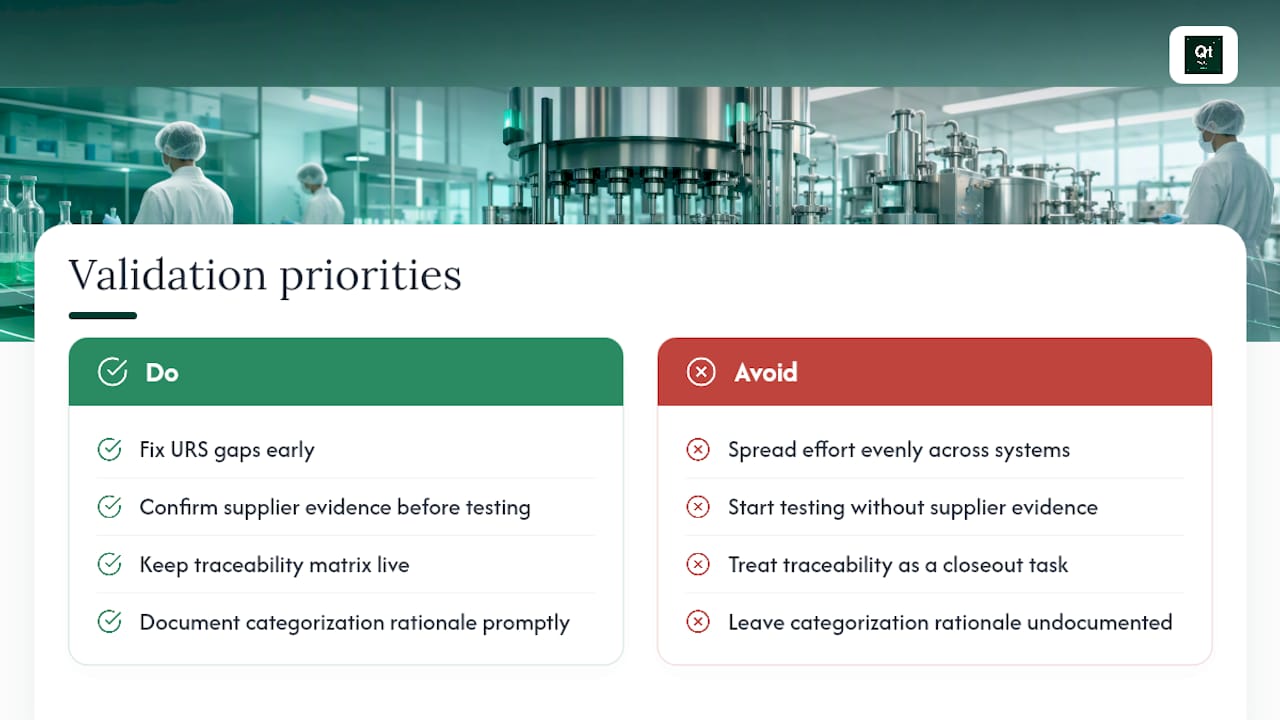
Three things separate a defensible GAMP 5 program from one that collapses under audit pressure: fixing URS gaps before they become test gaps, confirming supplier evidence exists before testing starts rather than scrambling for it afterward, and building the traceability matrix as a living document instead of a closeout exercise.
Resource effort should never be flat across your system inventory. Category 5 custom applications and any system touching product release decisions deserve the deepest scrutiny; Category 1 infrastructure deserves a fraction of that effort. Teams that spread effort evenly across every system in the inventory usually under-validate the systems that matter most while over-documenting the ones that don't.
For inspection readiness, the strongest position is being able to explain, out loud and without notes, why a system was categorized the way it was. If that rationale isn't written down somewhere in the validation package, it doesn't count as a defense during an audit. Write it down at categorization time, not after someone asks.
Where Automated Validation Fits Into a GAMP 5 Program
Qualitum gives validation teams a way to cut authoring time on GAMP 5 deliverables without cutting corners on evidence. Instead of a validation engineer manually drafting URS, FS, and test protocols document by document, Qualitum's multi-agent system authors the lifecycle artifacts directly, with every record checked against ALCOA+ at write-time and again at review-time.

That matters most in the areas this guide just covered: system inventory and categorization, a traceability matrix that stays current instead of going stale between audits, and test artifact capture that holds up when an inspector asks to see the chain of evidence. Qualitum reports significant time savings in authoring effort, which shows up as faster CSV cycles rather than skipped validation steps. The platform integrates with existing quality management systems, so evidence doesn't get orphaned in a separate tool the way it can with disconnected point solutions.
If your team is planning a GAMP 5 validation project and wants to see how Validate·AI handles protocol authoring and evidence generation, book a working session to walk through your system inventory and see where automation removes the most manual burden first.
Sources
- GAMP 5 Guide 2nd Edition | ISPE | International Society for Pharmaceutical Engineering
- European Commission: Annex 11 consultation guideline (download)
- Ecfr
- FDA material on Computer Software Assurance (CSA) approaches (media/188844/download)
- Peer-reviewed article on computerized systems validation and test strategies (PMC)
This article is general information, not a substitute for advice from a qualified lawyer. Consult a qualified legal professional about your own circumstances before acting on anything here.
FAQ
What Does GAMP Mean in Pharma?
GAMP stands for Good Automated Manufacturing Practice, a risk-based framework published by ISPE for validating computerized systems in regulated life sciences environments.
What Are the GAMP 5 Categories?
The working software categories are Category 1 (infrastructure), Category 3 (non-configured products), Category 4 (configured products), and Category 5 (custom applications), with effort scaling up from Category 1 to Category 5.
Why Are Three Batches Commonly Used for Process Validation?
Three consecutive successful batches is a traditional convention for demonstrating process consistency and reproducibility, though it applies to process validation rather than computerized system validation, where evidence requirements are risk-based instead of batch-count based.
What Are the Four Types of Validation?
The four recognized types are prospective, concurrent, retrospective, and revalidation, referring to when validation activities occur relative to routine production or system use.
Can Automated Testing Replace Traditional Paper Test Scripts in GAMP 5?
Yes, provided the tool's own audit trail captures who executed the test, when, and the result, since evidence quality matters more than document format under both GAMP 5 and FDA CSA guidance.
How Does GAMP 5 Support Agile and SaaS Development?
GAMP 5's Second Edition explicitly supports iterative development by preserving traceability and acceptance criteria per user story instead of requiring a full V-model per sprint, while SaaS systems require supplier lifecycle evidence to fill the gap the user organization can't test directly.
Recommended
- Qualitum · The agentic validation platform for life sciences
- Cleaning validation · Validate·AI · Qualitum
- Validate·AI · Qualitum
- Platform · Qualitum
FAQ
What Does GAMP Mean in Pharma?
GAMP stands for Good Automated Manufacturing Practice, a risk-based framework published by ISPE for validating computerized systems in regulated life sciences environments.
What Are the GAMP 5 Categories?
The working software categories are Category 1 (infrastructure), Category 3 (non-configured products), Category 4 (configured products), and Category 5 (custom applications), with effort scaling up from Category 1 to Category 5.
Why Are Three Batches Commonly Used for Process Validation?
Three consecutive successful batches is a traditional convention for demonstrating process consistency and reproducibility, though it applies to process validation rather than computerized system validation, where evidence requirements are risk-based instead of batch-count based.
What Are the Four Types of Validation?
The four recognized types are prospective, concurrent, retrospective, and revalidation, referring to when validation activities occur relative to routine production or system use.
Can Automated Testing Replace Traditional Paper Test Scripts in GAMP 5?
Yes, provided the tool's own audit trail captures who executed the test, when, and the result, since evidence quality matters more than document format under both GAMP 5 and FDA CSA guidance.
How Does GAMP 5 Support Agile and SaaS Development?
GAMP 5's Second Edition explicitly supports iterative development by preserving traceability and acceptance criteria per user story instead of requiring a full V-model per sprint, while SaaS systems require supplier lifecycle evidence to fill the gap the user organization can't test directly.