GAMP 5 requires proportionate, risk-based validation that focuses testing and documentation where failures could affect patient safety, product quality, or data integrity, following the frameworks set out in ISPE GAMP 5, ICH Q9, and EU Annex 11. In practice, this means validation teams size their verification effort to a system's actual GxP impact and complexity rather than applying the same testing depth to every application. The practical outcome: a low-risk spreadsheet tool gets a fraction of the scrutiny given to a batch record system, and every scaling decision needs a documented rationale you can defend at audit.
TL;DR:
>
- Validation efforts are scaled based on the system's actual GxP impact and complexity, with risk assessments starting early in the design phase.
- Using supplier documentation and automation tools is encouraged to streamline evidence collection, but companies remain responsible for overall validation quality.
- Proper categorization of systems and rigorous risk scoring via RPN guides testing scope, with high-risk functions requiring full end-to-end verification.
- Risk assessments and traceability records must be well-documented, linking requirements, risk scores, testing, and results to withstand audit scrutiny.
- Applying the risk-based approach early, maintaining consistent thresholds, and leveraging automation can reduce validation time by over 70 percent.
Table of Contents
- What Does a Risk-Based Approach Mean in GAMP 5?
- The Five Key GAMP 5 Principles That Drive Risk-Based Decisions
- How Do GAMP Categories Determine GxP Relevance?
- What Does a Practical Risk Assessment Workflow Look Like?
- How Do You Scale Verification Effort to Risk Level?
- When Can You Rely on Supplier or Cloud Evidence?
- What Records and Traceability Does an Auditor Expect?
- What Are the Common Pitfalls in Risk-Based Validation?
- A Step-by-Step Checklist for Applying GAMP 5's Risk-Based Approach
- How Automation Supports GAMP 5 Risk-Based Validation
- An Implementation Leader's Quick Advice on GAMP 5
- Put GAMP 5's Risk-Based Approach Into Practice Faster
- Sources
- FAQ
What Does a Risk-Based Approach Mean in GAMP 5?
Risk-based validation in GAMP 5 terms means matching verification effort to GxP impact instead of running the full validation playbook on every system regardless of its actual footprint. A system that only logs environmental temperature for trend-watching does not warrant the same scrutiny as one that releases batches. GAMP 5 asks you to make that distinction explicit, early, and documented.
The ISPE GAMP 5 Guide (Second Edition) updated the original framework to reflect how validation actually happens now: heavier reliance on supplier documentation, iterative and Agile development cycles instead of pure waterfall builds, and a much bigger role for automation and software tooling in generating evidence. That update matters because the original GAMP 5 assumed a world of custom-built, monolithic systems. Today's validation teams are managing SaaS platforms with quarterly release cycles, configured cloud applications, and vendor-controlled infrastructure, none of which fit neatly into a rigid, document-heavy validation model.
GAMP 5 does not operate in isolation. It sits alongside two other reference points every compliance professional should know:
- ICH Q9 provides the quality risk management philosophy, covering how to identify, analyze, and control risk across a product's lifecycle.
- EU Annex 11 sets the regulatory expectations specifically for computerized systems within the EU GMP framework, covering validation, data integrity, and electronic records.
- GAMP 5 translates both into an operational method: how to actually categorize systems, assess risk, and scale verification activities for computerized systems specifically.
Think of ICH Q9 as the principle, Annex 11 as the regulation, and GAMP 5 as the how-to guide that connects the two to real validation work.
The Five Key GAMP 5 Principles That Drive Risk-Based Decisions
Every risk-based decision in GAMP 5 traces back to five principles. The ISPE guide frames these as the foundation for the entire approach, and understanding them is what separates a defensible risk assessment from a checkbox exercise.
- Product and process understanding. You cannot assess risk on a system you do not understand functionally. Validation starts by mapping what the system actually does within the business process, not just what the vendor's brochure claims.
- Lifecycle approach within a quality management system. Validation is not a one-time event before go-live. It runs from initial concept through retirement, with the QMS providing the governance structure that ties it all together.
- Scalable lifecycle activities. This is the operational core of risk-based thinking. Verification depth, documentation volume, and testing rigor should scale up or down based on risk and complexity, not a fixed template applied uniformly.
- Science-based quality risk management. Risk decisions need a rationale grounded in actual failure modes and their consequences, echoing the ICH Q9 approach to risk identification, analysis, and control.
- Leveraging supplier involvement. Where a supplier has already generated credible evidence of quality, GAMP 5 supports using it instead of duplicating the work internally, provided you document why you accepted it.
These five principles are not abstract theory. Every category assignment, RPN calculation, and testing decision covered below is an application of one or more of them.
How Do GAMP Categories Determine GxP Relevance?
System categorization is the first filter for scaling validation effort, and getting it wrong throws off everything downstream. GAMP 5 groups software into categories that reflect how much configuration or custom development sits between the vendor's code and your specific use case.
- Category 1 (Infrastructure software). Operating systems, database engines, and network components. These typically get qualified as infrastructure rather than validated as standalone applications, with verification focused on configuration and patching controls.
- Category 3 (Non-configured products). Off-the-shelf software used exactly as the vendor built it, with no configuration affecting GxP functions. A simple instrument-reading utility with fixed output formatting often falls here.
- Category 4 (Configured products). Commercial software configured to fit your process, such as a laboratory information management system with custom workflows, user roles, and calculation logic. Configuration introduces risk that the vendor cannot fully anticipate, so verification needs to cover your specific setup.
- Category 5 (Custom applications). Bespoke code written for your specific business process. This carries the highest inherent risk because there is no vendor track record or installed base to lean on, so verification burden falls almost entirely on your organization.
GxP relevance runs as a separate but related question: does this system directly affect patient safety, product quality, or data integrity, or is its influence indirect? A batch release system has direct GxP relevance. A facilities scheduling tool used only for meeting rooms typically does not, even if it happens to reside on the same network as regulated systems. A manufacturing execution system controlling process parameters is Category 4 with high direct GxP relevance; a document-management repository storing SOPs, while important operationally, usually carries lower direct relevance unless it controls approval workflows for GxP records.
What Does a Practical Risk Assessment Workflow Look Like?
GAMP 5 risk assessment works best as a structured, repeatable sequence rather than an ad hoc judgment call, and it needs to start earlier than most teams assume.
- Identify. Begin at the user requirements specification (URS) stage, not after the system is built. This is where you list what could go wrong: unwanted effects, failure modes, and the functions where a defect would matter most. Engineering mitigations into requirements at this stage reduces the verification burden later, because controls designed in from the start need less OQ and PQ testing to prove.
- Analyze. Score each identified risk against variables that typically include severity or impact, probability of occurrence, and detectability, or in GAMP-specific terms, GxP relevance combined with system category.
- Evaluate. Combine those scores into a usable metric, most commonly a risk priority number (RPN), and set thresholds that dictate what level of mitigation and testing each band requires.
A practical scoring method described by GMP Publishing calculates RPN as GAMP category multiplied by GxP relevance, giving a fast triage signal without requiring a full failure mode and effects analysis on every requirement.
Pro Tip: Run the RPN exercise as a group session with the process owner, the system owner, and a QA representative in the room together. Scores assigned by a single person in isolation rarely survive audit scrutiny, because the rationale behind each number needs more than one perspective to hold up.

Here's how that plays out numerically. Say a Category 4 configured system (score 4) controls a function with high GxP relevance (score 4). That gives an RPN of 16, landing in the high-risk band, which typically triggers required mitigation and full OQ/PQ testing with independent review. A Category 3 non-configured tool (score 3) touching a function with low GxP relevance (score 1) yields an RPN of 3, usually falling into a low-risk band where minimal testing and lighter documentation suffice. A mid-range combination, say a Category 4 system with medium relevance (score 2), produces an RPN of 8, often sitting in a medium band where recommended but not mandatory additional testing applies.
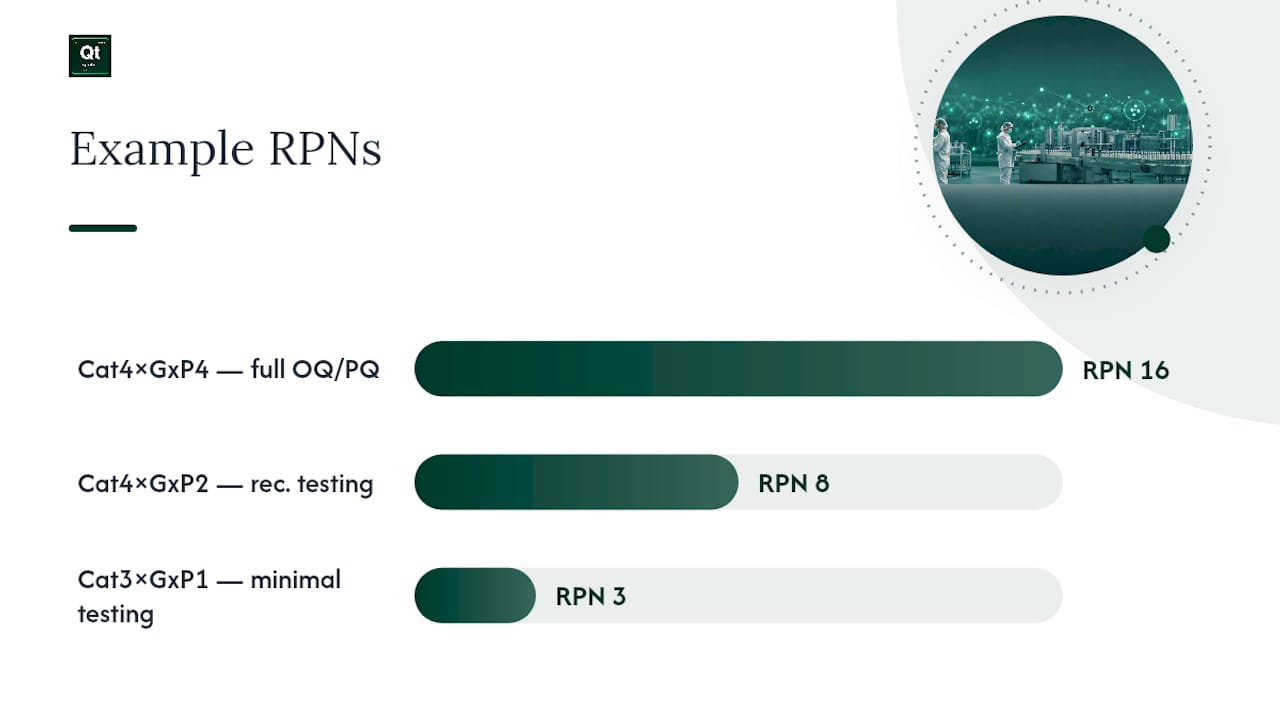
The bands themselves are not fixed by regulation. Each organization defines its own thresholds and documents the rationale, then applies them consistently across every risk assessment. That consistency is what auditors actually check.
How Do You Scale Verification Effort to Risk Level?
Verification depth should track directly with the risk band a function lands in, and this is where the scalable lifecycle activities principle becomes tangible rather than theoretical.
- Low-risk functions typically need a functional test confirming the feature works as intended, light documentation, and no independent OQ or PQ cycle. A read-only reporting dashboard pulling from validated source systems often sits here.
- Medium-risk functions usually warrant integration testing alongside functional testing, moderate documentation depth, and OQ coverage focused on the specific configured logic rather than the entire application.
- High-risk functions call for full OQ and PQ testing, independent review of test scripts and results, and documentation detailed enough to reconstruct the decision trail years later during an inspection.
The V-model still underpins most GAMP 5 thinking, mapping each specification phase (URS, functional specification, design specification) to a corresponding verification phase. But GAMP 5's Second Edition explicitly accommodates iterative and Agile development, recognizing that many systems today ship in sprints rather than single monolithic releases. Iterative projects can still satisfy V-model intent by validating each increment against its own risk-scored requirements rather than waiting for a final release to test everything at once.
Residual risk, the risk remaining after mitigation and testing, needs explicit acceptance by someone with the authority to own that decision, not a silent assumption buried in a test summary. And risk assessments are not a one-time artifact. They need periodic review as the system changes, as usage patterns shift, or as new failure modes surface in production, keeping the risk record aligned with how the system actually behaves over time.
When Can You Rely on Supplier or Cloud Evidence?
Duplicating a supplier's own testing wastes effort GAMP 5 explicitly says you don't have to spend. The guide supports leveraging supplier documentation and evidence where it is credible and relevant, but the regulated company always retains ultimate responsibility for overall assurance.
- Accept supplier design documents, test evidence, and audit reports when the supplier has a demonstrable quality system and the evidence covers your actual configuration, not a generic baseline build.
- Supplement supplier evidence with your own testing wherever configuration, integration points, or your specific business process introduce risk the supplier's generic testing didn't cover.
- For SaaS, PaaS, and IaaS models, map control boundaries explicitly: what the provider owns (infrastructure patching, uptime, underlying platform security) versus what you own (configuration, user access, business logic). Auditors expect that ownership map documented, not implied.
- Use automation and software tools to reduce the manual documentation burden, but only where the tooling preserves ALCOA+ attributes and full traceability back to the originating requirement.
Pro Tip: Ask suppliers for their SOC 2 or ISO 27001 certification scope documents up front. A certification that doesn't cover the specific service you're consuming is a common gap teams miss until an auditor asks the exact question.
What Records and Traceability Does an Auditor Expect?
Documentation is where risk-based decisions either hold up or fall apart under scrutiny, because a decision that isn't written down did not, from an auditor's perspective, actually happen.
A complete risk-based validation package includes:
- The risk assessment itself, with scoring rationale for every RPN or equivalent metric assigned.
- Written justification for every scaling decision, why a function got light testing versus full OQ/PQ.
- Supplier evidence accepted in lieu of internal testing, along with the rationale for accepting it.
- Test summaries covering execution results, deviations, and their resolutions.
- Residual risk acceptance records, signed by someone with the authority to own that decision.
The traceability matrix is the backbone that ties all of this together. It should link each URS requirement to its assigned risk score, to the tests that verified it, and to the results confirming it passed or the deviation that explains why it didn't. A matrix with gaps, a requirement with no linked test, or a test with no linked requirement, is one of the first things an experienced auditor will flag.
Record retention policies need to match your regulatory environment's requirements, and change control has to capture how the risk assessment itself gets revisited when the system changes materially. At audit, the strongest position is being able to pull the full chain, requirement, risk score, rationale, test, result, in minutes rather than reconstructing it from scattered emails and spreadsheets.
What Are the Common Pitfalls in Risk-Based Validation?
"Risk-based" gets misused often enough that auditors have learned to probe for it specifically. The most common failure is treating the label as license to skip work rather than as a framework for targeting it correctly.
- Late risk assessments. Running the risk analysis after the system is built defeats the purpose. Mitigations that should have been engineered into the design now require compensating controls or rework instead.
- Missing scaling rationale. A validation plan that says "low risk, minimal testing" with no documented reasoning behind that call reads as an excuse, not an assessment.
- Undocumented supplier reliance. Accepting a vendor's test results without recording why they were deemed sufficient leaves a gap an auditor will exploit immediately.
- Under-tested high-risk functions. The inverse pitfall: labeling something medium risk to avoid the testing burden that a high-risk classification would honestly require.
Red flags auditors look for include risk records with no link back to the originating URS requirement, RPN scoring that shifts methodology between systems with no explanation, and residual risk that appears accepted nowhere in writing. Remediation is usually straightforward once identified: retroactively document the rationale that should have existed, close the traceability gaps, and tighten the scoring methodology so it applies consistently going forward.
A Step-by-Step Checklist for Applying GAMP 5's Risk-Based Approach
Turning the principles above into a repeatable project sequence keeps risk-based validation from becoming a one-off exercise reinvented on every new system.
- Establish scope and GxP impact. Confirm what the system does and whether it touches patient safety, product quality, or data integrity, directly or indirectly.
- Write the URS with risk capture built in. Document unwanted effects and failure modes as you write requirements, not after.
- Categorize system components. Assign GAMP categories to each functional area, since a single system can mix Category 3, 4, and 5 elements.
- Run the risk analysis and set thresholds. Score severity, probability, and GxP relevance, then apply your organization's RPN bands consistently.
- Define verification scope and produce evidence. Match testing depth to the risk band and generate the test summary and traceability links as you go.
- Accept residual risk and monitor. Get sign-off from an accountable owner, then schedule periodic review rather than treating the assessment as closed permanently.
At each step, produce a specific artifact: the risk register at steps 1 and 4, the traceability matrix from step 3 onward, and the test summary at step 5. SME critical thinking checkpoints belong at steps 1, 4, and 6, where a subject matter expert's judgment call, not a template, determines whether the classification actually fits the real-world function.
How Automation Supports GAMP 5 Risk-Based Validation
Manual documentation is where risk-based validation most often breaks down in practice, not because teams don't understand the principles, but because writing and cross-referencing the evidence for every scaling decision takes far longer than the risk analysis itself. This is the operational gap automated validation platforms are built to close.
Qualitum's agentic validation platform applies its Risk·AI module to generate risk assessments and RPN scoring directly from URS content, capturing risk decisions at the requirements stage rather than reconstructing them after the fact. Every record it produces is checked against ALCOA+ criteria at write-time and again at review-time, which directly addresses the documentation and traceability gaps auditors flag most often. That structure keeps the traceability matrix current automatically as requirements, risk scores, and test evidence get generated, instead of asking a validation engineer to stitch it together manually across spreadsheets.
An Implementation Leader's Quick Advice on GAMP 5
Most teams treat risk assessment as paperwork that happens after the real validation work is done. That gets the sequence backward, and it's the single biggest reason validation cycles run longer than they need to.
Push the risk conversation to the URS stage and get your subject matter experts in the room before requirements are finalized, not after. A function's real failure modes are obvious to an SME looking at draft requirements; they get expensive to fix once code is written and testing is underway.
Supplier evidence is a legitimate shortcut, but only if you write down why you trusted it. "The vendor is well known" is not a rationale an auditor will accept. Neither is skipping documentation because the RPN came out low, if nobody can explain how that score was calculated.
Set your RPN thresholds early, apply them the same way across every system, and let the numbers do the arguing for you when someone asks why a function got less testing than they expected.
— Matt
Put GAMP 5's Risk-Based Approach Into Practice Faster
Applying everything above by hand, URS-linked risk capture, RPN scoring, a live traceability matrix, ALCOA+ checked documentation, is exactly the workload that turns validation cycles into months-long projects. Qualitum built its platform specifically for this: agent-authored risk assessments, protocols, and traceability records generated directly from requirements, with every record checked for data integrity at write-time and review-time instead of caught in a pre-audit scramble.

That means your team spends its time on judgment calls, SME critical-thinking checkpoints, residual risk acceptance, scaling rationale, rather than reformatting evidence into templates. Qualitum integrates with existing quality management systems and has driven over 70% time savings in validation authoring for pharmaceutical, biotech, and medical device teams applying exactly the risk-based workflow described here. If you're planning your next system validation and want to see how Validate·AI handles URS-linked risk capture in practice, you can book a working session to walk through it against a real system in your pipeline.
Sources
- ISPE GAMP® 5: A Risk-Based Approach to Compliant GxP Computerized Systems (Second Edition) | ISPE
- Alternative Approach to Risk Assessment of Computerised Systems | GMP Publishing
FAQ
What are the five key principles of GAMP 5?
The five principles are product and process understanding, a lifecycle approach within a quality management system, scalable lifecycle activities, science-based quality risk management, and leveraging supplier involvement, as ISPE's guide outlines.
What is the GAMP 5 risk-based approach to compliant GxP computerized systems?
It's a method for scaling validation effort, testing depth, and documentation to a system's actual impact on patient safety, product quality, and data integrity, rather than applying uniform validation rigor to every system regardless of risk.
What are the key differences between GAMP 4 and GAMP 5?
GAMP 5 shifted the focus from category-driven, document-heavy validation toward risk and business-process-driven scaling, and its Second Edition further expanded that shift to account for supplier reliance, iterative development, and automation tooling that GAMP 4 never addressed.
What are the five GAMP software categories, with examples?
Category 1 covers infrastructure software like operating systems; Category 3 covers non-configured off-the-shelf products; Category 4 covers configured products such as a configured LIMS; and Category 5 covers custom applications built specifically for one organization's process. Category 2 (firmware) appeared in earlier editions but is generally treated as a subset of infrastructure or embedded components under current guidance.
Recommended
- Platform · Qualitum
- Qualitum · The agentic validation platform for life sciences
- Validate·AI · Qualitum
- Operate·AI · Qualitum
FAQ
What are the five key principles of GAMP 5?
The five principles are product and process understanding, a lifecycle approach within a quality management system, scalable lifecycle activities, science-based quality risk management, and leveraging supplier involvement, as ISPE's guide outlines.
What is the GAMP 5 risk-based approach to compliant GxP computerized systems?
It's a method for scaling validation effort, testing depth, and documentation to a system's actual impact on patient safety, product quality, and data integrity, rather than applying uniform validation rigor to every system regardless of risk.
What are the key differences between GAMP 4 and GAMP 5?
GAMP 5 shifted the focus from category-driven, document-heavy validation toward risk and business-process-driven scaling, and its Second Edition further expanded that shift to account for supplier reliance, iterative development, and automation tooling that GAMP 4 never addressed.
What are the five GAMP software categories, with examples?
Category 1 covers infrastructure software like operating systems; Category 3 covers non-configured off-the-shelf products; Category 4 covers configured products such as a configured LIMS; and Category 5 covers custom applications built specifically for one organization's process. Category 2 (firmware) appeared in earlier editions but is generally treated as a subset of infrastructure or embedded components under current guidance.