Choose HAZOP when your question is "what process deviations could occur and what are their consequences?" Choose FMEA when your question is "which components or procedure steps could fail, and how do we prioritize fixes?" The two methods are complementary, not competing, and the right choice depends on where you are in the project lifecycle and what decision you need to make.
Three decision heuristics that hold across most regulated industries:
- If you are reviewing a new or modified continuous process design (chemical, pharma, oil and gas) and need to identify operability hazards before commissioning, then schedule a HAZOP. IEC 61882 and CCPS guidance both position HAZOP as the standard technique for this question.
- If you are analyzing equipment reliability, control system logic, or a manufacturing procedure for failure modes and maintenance prioritization, then run an FMEA. SAE J1739 and the AIAG–VDA FMEA handbook govern automotive applications; FDA process-validation guidance supports FMEA for risk-based scoping in life sciences.
- If you need both process-deviation coverage and component-level reliability data, then run HAZOP first to surface systemic hazards, then use FMEA downstream to test the reliability of the safeguards HAZOP identified.
Key Takeaways
HAZOP and FMEA answer different risk questions, and choosing the right method at the right lifecycle stage is what makes the analysis worth running.
| Point | Details |
|---|---|
| HAZOP for process deviations | Use HAZOP at detailed design to identify operability hazards in continuous or semi-continuous processes. |
| FMEA for component failures | Use FMEA to prioritize equipment or procedure failure modes for maintenance, validation, or reliability programs. |
| Sequence them, don't choose | Run HAZOP first to surface systemic hazards, then FMEA on the safeguards and critical components HAZOP identified. |
| Documentation drives audit value | Every action needs an owner, a due date, and a linked verification record; without that, the analysis cannot be audited. |
| Qualitum for traceability | Qualitum's Risk·AI and Validate·AI automate input assembly, version control, and action tracking for FMEA and HAZOP outputs. |
Table of Contents
- How FMEA and HAZOP compare across key dimensions
- How FMEA works: steps, scoring, and a practical RPN example
- How HAZOP works: nodes, guide words, and a worked example
- How to decide: a practical checklist for choosing between the two methods
- Where FMEA and HAZOP fit in the broader PHA toolkit
- What regulated industries require: pharma, biotech, and medical devices
- Common pitfalls and how to avoid them
- A practitioner's perspective on how teams actually use these methods
- Qualitum reduces the documentation burden so your team can focus on the analysis
- Useful sources and further reading
- FAQ
How FMEA and HAZOP compare across key dimensions
FMEA uses severity, occurrence, and detectability scoring to calculate an RPN for prioritization, while HAZOP uses guide words on nodes to identify process deviations; each method suits different lifecycle questions.
| Dimension | FMEA | HAZOP |
|---|---|---|
| Primary purpose | Identify component/step failure modes and prioritize corrective actions | Identify process deviations, operability hazards, and their consequences |
| Approach | Bottom-up: start at the component or task level | Deviation-based: apply guide words to process nodes |
| Scope and detail | Granular; one row per failure mode | Broad; one row per deviation at each node |
| Timing in lifecycle | Design, commissioning, operations, maintenance | Detailed design and pre-commissioning; periodic revalidation |
| Inputs required | P&IDs, BOMs, maintenance logs, design specs | HAZOP-ready P&IDs, operating limits, alarm lists, PFDs |
| Outputs | FMEA table with RPNs, ranked action items | Deviation log, recommendations, safeguard register |
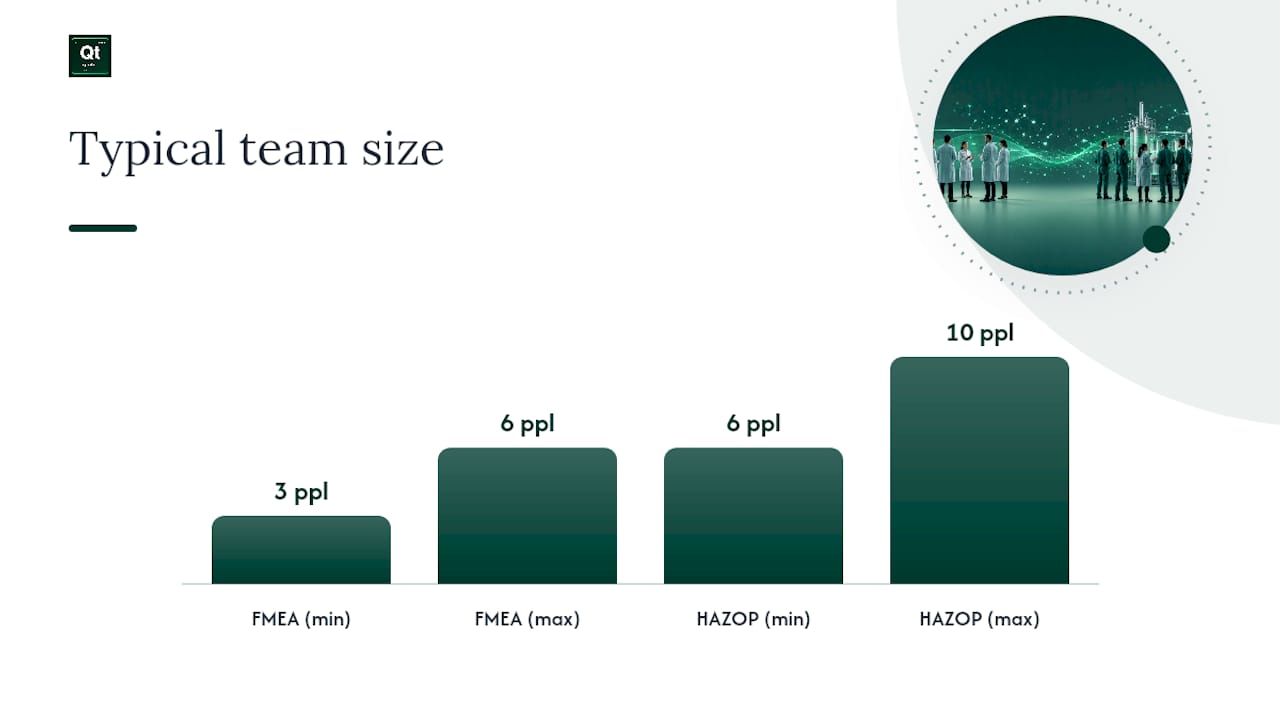
| Team and facilitation | Cross-functional; engineer-led; 3–6 participants typical | Multi-discipline; independent facilitator required; 6–10 participants typical |
| Typical industries | Automotive, aerospace, pharma/biotech, medical devices, manufacturing | Chemical, oil and gas, pharma, water treatment, power generation |
| Strengths | Structured, traceable, links directly to maintenance and validation | Systematic deviation coverage; forces teams to consider overlooked scenarios |
| Limitations | RPN can mislead if scoring is inconsistent; scope can balloon | Time-intensive; requires mature P&IDs; less useful for discrete equipment |
| Data and time intensity | Moderate; can be completed in days for a focused system | High; a full HAZOP for a complex unit may take several weeks |
Two quick examples to anchor the table:
- FMEA RPN row: Pump seal failure | Effect: process fluid loss, contamination | Severity: 7 | Occurrence: 4 | Detection: 3 | RPN: 84 | Action: add redundant seal, inspect quarterly.
- HAZOP node example: Node: Feed line to reactor | Parameter: Flow | Guide word: No Flow | Cause: pump failure or valve closed | Consequence: reactant starvation, runaway risk | Safeguard: low-flow alarm, automatic shutdown.
HAZOP systematically applies guide words to process parameters at defined nodes, producing deviation → cause → consequence → safeguard records that are ideal for complex continuous processes.
How FMEA works: steps, scoring, and a practical RPN example
FMEA is a bottom-up, inductive method. You start at the component or procedure-step level, ask what could go wrong, and work upward to understand effects on the system and the end user.
Core steps:
- Define scope: identify the system boundary, the functions to analyze, and the team.
- List components or process steps within that boundary.
- For each item, identify all credible failure modes (how it could fail to perform its function).
- Determine the effect of each failure mode on the next level and on the end user.
- Score each failure mode on three scales, typically 1–10: Severity (S), Occurrence (O), and Detection (D).
- Calculate the Risk Priority Number: RPN = S × O × D.
- Rank failure modes by RPN, set a threshold or relative cutoff, and assign corrective actions with owners and due dates.
- Verify action completion and re-score where appropriate.
Typical inputs: P&IDs, bills of materials, design specifications, maintenance history, and failure-rate data where available.
Typical outputs: A structured FMEA table with ranked RPNs, a prioritized action list, and a re-scored residual-risk register after actions are closed.
Pro Tip: Scoring consistency is the single biggest threat to RPN validity. Establish a scoring rubric before the workshop and have the team calibrate on two or three known failure modes before scoring the full list. An RPN of 84 means nothing if two reviewers would score the same failure mode as 120 or 48.
A note on FMECA: When qualitative RPN ranking is not sufficient, FMECA (Failure Mode, Effects, and Criticality Analysis) extends FMEA by adding a quantitative criticality analysis using failure rates and probability models. FMECA combines FMEA with quantitative criticality analysis and is used in defense and aerospace applications where criticality classification drives spares stocking, redundancy decisions, and safety-case arguments.
How HAZOP works: nodes, guide words, and a worked example
HAZOP (Hazard and Operability Study) is a structured, team-based technique that systematically examines a process design for deviations from design intent. It does not start with a list of components; it starts with the process itself, divided into manageable sections called nodes.
Core steps:
- Assemble HAZOP-ready P&IDs, process flow diagrams, operating procedures, alarm lists, and design-basis documents.
- Define nodes: discrete sections of the process (a line, a vessel, a heat exchanger) with a clear design intent.
- For each node, apply guide words (No, More, Less, Reverse, As Well As, Other Than, Part Of) to each relevant process parameter (flow, temperature, pressure, composition, level).
- For each deviation, capture: cause(s), consequence(s), existing safeguards, and recommendations.
- Assign recommendations to owners with target dates.
- Close out and verify recommendations before commissioning or revalidation sign-off.
Typical inputs: Finalized or near-final P&IDs, operating limits, cause-and-effect matrices, alarm philosophy documents, and material safety data.
Typical outputs: A deviation log (the HAZOP worksheet), a recommendations register with owners and status, and a safeguard inventory that feeds into subsequent LOPA or Bow-Tie analysis.
Worked node example:
Node: Cooling water supply to reactor jacket | Parameter: Temperature | Guide word: More Than | Cause: Cooling tower failure or cross-contamination with hot utility | Consequence: Reactor temperature rises above control limit; potential runaway or product degradation | Existing safeguard: High-temperature alarm (TAH-101) | Recommendation: Add independent high-high temperature interlock (TAHH-101) with automatic feed cutoff.
Pro Tip: Keep nodes small enough that the team can hold the design intent in mind for the full discussion, but not so small that you spend three days on a single pipe run. A common rule of thumb is one node per major equipment item or per distinct operating step. Resist the urge to run LOPA calculations during the HAZOP workshop itself; that level of quantification belongs in a separate session after the deviation log is complete.
How to decide: a practical checklist for choosing between the two methods
The decision is rarely about which method is "better." It is about which question you are trying to answer and where you are in the project.
Choose HAZOP when:
- The system is a continuous or semi-continuous process (chemical reactor, bioreactor, utilities loop).
- You are at detailed design or pre-commissioning and P&IDs are substantially complete.
- The primary question is: "What deviations from design intent could cause a hazard or operability problem?"
- Regulatory or industry practice requires a formal PHA (e.g., OSHA PSM, EPA RMP, CCPS guidance).
- HAZOP is generally preferred in process industries and detailed design reviews; FMEA is more common for equipment reliability, control systems, and maintenance-driven analyses.
Choose FMEA when:
- The system is discrete equipment, a control system, or a documented procedure.
- You need to prioritize failure modes for maintenance, inspection, or validation scoping.
- The primary question is: "Which components or steps are most likely to fail, and what do we do about it?"
- You are in a regulated life-sciences context where risk-based validation scoping is expected.
Choose both, in sequence, when:
- A complex process system has both operability hazards (HAZOP territory) and critical equipment whose reliability must be independently verified (FMEA territory).
- HAZOP identifies a safeguard (e.g., a safety instrumented function); FMEA then tests whether that safeguard's components are reliable enough to perform on demand.
A minimal decision flow:
- Is the primary question about process deviations? → HAZOP.
- Does the HAZOP identify barriers whose reliability needs quantification? → LOPA or Bow-Tie.
- Is the primary question about component or task failure modes? → FMEA.
- Does the FMEA scope include safety-critical components requiring criticality ranking? → Escalate to FMECA or FTA.
Where FMEA and HAZOP fit in the broader PHA toolkit
No single method covers every risk question. Select the method by the decision question: HAZOP for process deviations, Bow-Tie for barrier assurance around a known top event, and FMEA for component or task failure modes.
Adjacent tools and their roles:
- HAZID (Hazard Identification): A coarse-grained, early-stage technique applied at conceptual or FEED design. It identifies hazard categories before P&IDs are mature. HAZID findings scope the subsequent HAZOP.
- Bow-Tie: Maps threats and consequences around a single top event, with barriers on both sides. Best for communicating risk control to executives or regulators; not a substitute for the systematic deviation coverage of HAZOP.
- LOPA (Layer of Protection Analysis): A semi-quantitative method applied after HAZOP to determine whether existing independent protection layers are sufficient. It answers the question HAZOP cannot: "Is this safeguard good enough?"
- FTA (Fault Tree Analysis): A top-down, deductive logic model. Use it when you need to understand the combination of failures that could produce a specific top event, particularly for safety-case arguments or SIL verification.
- FMECA: The quantitative extension of FMEA, adding failure-rate data and criticality matrices. Preferred in defense, aerospace, and high-reliability manufacturing where qualitative RPN ranking is insufficient.
A practical PHA sequence for a new process unit:
- HAZID at conceptual design: identify major hazard categories and flag high-level risks.
- HAZOP at detailed design: systematic deviation analysis; produce recommendations register.
- LOPA or Bow-Tie for high-consequence scenarios: verify protection layer adequacy; support SIL determination.
- FMEA or FMECA for critical equipment and control systems: test barrier reliability; feed maintenance and inspection programs.
- FTA where logic modeling of specific top events is required for the safety case.
Running FMEA downstream of HAZOP is particularly productive when HAZOP identifies a safety instrumented function as the primary safeguard. The FMEA then examines the SIF's components (sensors, logic solver, final elements) to confirm the required probability of failure on demand is achievable.
What regulated industries require: pharma, biotech, and medical devices
In pharmaceutical and biotech settings, FMEA is the workhorse risk method for process validation and quality system compliance. FDA's 2011 process-validation guidance explicitly calls for a science- and risk-based approach to defining validation scope, and FMEA is the most commonly used tool to operationalize that requirement.
A process FMEA has been used in biopharma process validation to compute RPNs and set inclusion thresholds for unit operations, supporting risk-based scoping of validation activities. In practice, this means setting an RPN threshold (a common example is 30) and including in the validation protocol only those unit operations that meet or exceed it, with documented rationale for the cutoff.
FMEA is commonly used as the primary risk-analysis method during validation activities; its outputs should map to mitigation measures and verification evidence required for qualification.
Documentation checklist for audit readiness:
- Scope statement: system boundary, product or process covered, regulatory context.
- Team roster: names, roles, and disciplines of all participants.
- Inputs used: P&IDs, BOMs, batch records, prior deviation history, referenced standards.
- FMEA or HAZOP worksheet: complete, version-controlled, with all rows populated.
- Action register: each recommendation has an owner, due date, and status.
- Verification evidence: closed actions linked to test records, updated procedures, or engineering change orders.
- Re-assessment record: residual risk scored after actions are verified.
Standards and guidance to cite for US regulatory audiences:
- FDA Guidance for Industry: Process Validation (2011) for life-sciences FMEA applications.
- ICH Q9(R1) for pharmaceutical quality risk management principles.
- IEC 61882 for HAZOP methodology.
- SAE J1739 and AIAG–VDA FMEA handbook for automotive and manufacturing FMEA.
- CCPS Guidelines for Hazard Evaluation Procedures for process-industry PHA.
Pro Tip: Traceability is what separates an audit-ready FMEA from a paper exercise. Every action item must link forward to a verification record and backward to the failure mode that generated it. If an auditor asks "how do you know this control works?" the answer should be a document number, not a verbal explanation.
Common pitfalls and how to avoid them
Both methods fail in predictable ways. Most failures are organizational, not methodological.
Top pitfalls:
- RPN false precision: Teams treat RPN as an objective score when it is a consensus estimate. A difference of 10 RPN points between two failure modes is not statistically meaningful. Use RPN for relative ranking within a session, not for cross-system comparisons.
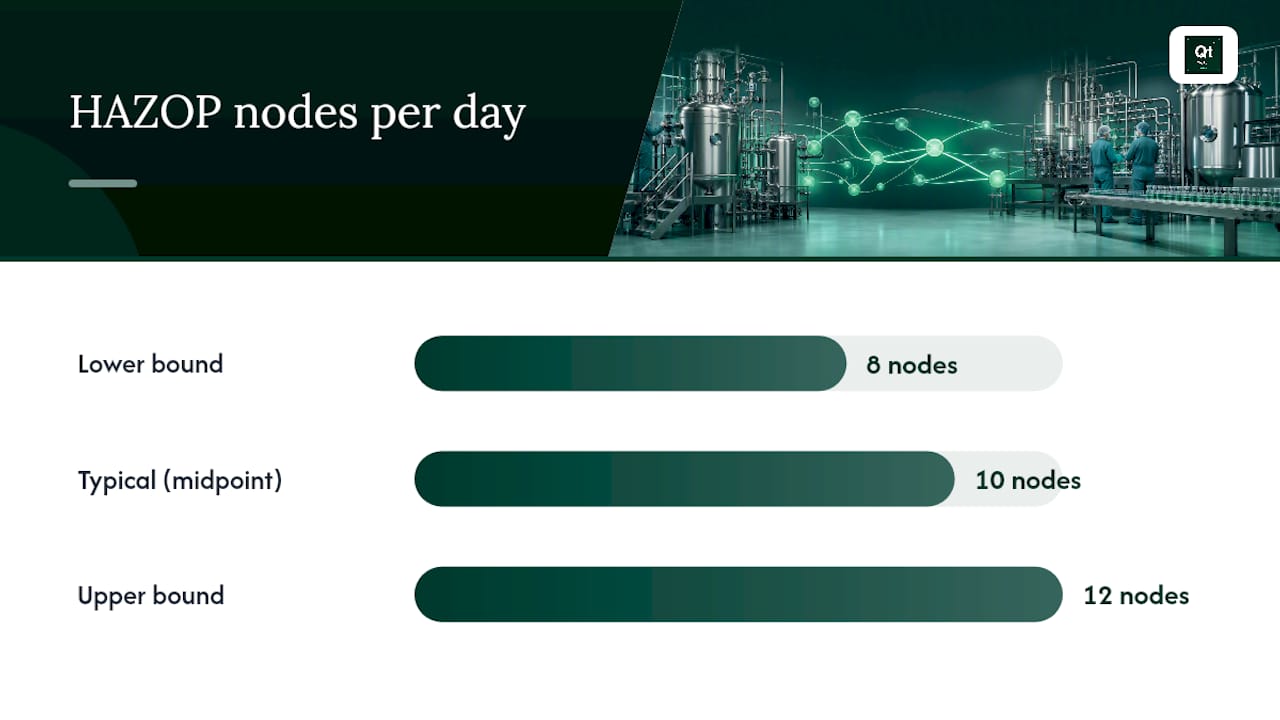
- Scope creep: HAZOP teams that try to cover too many nodes per day lose quality rapidly. A full day of HAZOP typically covers 8–12 nodes for a moderately complex system; plan accordingly.
- Inconsistent scoring: Without a pre-agreed rubric, two reviewers will score the same failure mode differently. Calibrate before you score.
- Weak action close-out: The most common audit finding is an FMEA or HAZOP with open recommendations and no evidence of follow-up. The analysis is only as good as its action register.
- Inadequate facilitation: HAZOP requires a trained, independent facilitator who can manage group dynamics, keep the team on the guide-word structure, and prevent premature solution-jumping. Using a process engineer who also has a stake in the design outcome is a conflict of interest.
Facilitation best practices:
- Distribute pre-read packages (P&IDs, operating limits, prior incident data) at least one week before the workshop.
- Size nodes before the session, not during it.
- Timebox each node: if a deviation generates more than 15 minutes of discussion, park it and return.
- Require a scribe separate from the facilitator; the facilitator's job is to drive the guide-word structure, not to type.
- Compose the team with at minimum: process engineer, operations representative, instrument and control engineer, safety engineer, and a maintenance or reliability representative.
Pro Tip: Make every recommendation verifiable. "Improve operator training" is not a recommendation; "Revise SOP-042 to include low-flow response procedure; training records to be completed by [date] and filed in QMS" is. The difference determines whether the action can be closed and audited.
A practitioner's perspective on how teams actually use these methods
The formal descriptions of FMEA and HAZOP make them sound more separate than they are in practice. Most experienced risk teams run them as a sequence, not as alternatives.
The pattern that tends to work well: HAZOP at detailed design to surface systemic hazards and build the safeguard register, then FMEA on the critical equipment and control systems that HAZOP identified as load-bearing. This avoids the trap of running a standalone FMEA on a complex process system, where the bottom-up structure can miss system-level interactions that a guide-word approach catches naturally.
One practical tip that rarely appears in methodology guides: share the HAZOP deviation log with the FMEA team before they start. The HAZOP will have already identified which failure modes matter most at the system level. The FMEA team can then focus their scoring effort on the components that carry the highest consequence load, rather than treating every component as equally important. That targeted approach cuts workshop time and produces a more defensible priority list.
The other underappreciated point is participant fatigue. A HAZOP for a complex unit can run five to eight days. Adding an FMEA workshop immediately afterward with the same team produces diminishing returns. Stagger the sessions, rotate participants where the scope allows, and use pre-work to reduce live workshop time.
Qualitum reduces the documentation burden so your team can focus on the analysis
The most time-consuming part of running FMEA and HAZOP is rarely the workshop itself. It is assembling the inputs, version-controlling the worksheets, tracking action close-out, and generating audit-ready evidence packages. That documentation load is where regulated-industry teams lose weeks.

Qualitum's Risk·AI capability automates the assembly of risk-assessment inputs, maintains versioned FMEA and HAZOP outputs with full ALCOA+ traceability, and links every action item to its verification evidence in a live traceability matrix. When an auditor asks for the risk basis behind a validation decision, the answer is a traceable record, not a search through shared drives. The Validate·AI module connects FMEA outputs directly to validation protocols, so RPN-based scoping decisions are documented and defensible from day one. Qualitum does not replace facilitator judgment or methodology expertise; it removes the manual overhead that prevents teams from acting on what the analysis found. Book a working session to see how the platform handles your current FMEA or HAZOP workflow.
Useful sources and further reading
- FDA Guidance for Industry: Process Validation (2011) — The US regulatory basis for risk-based process validation; supports FMEA as the risk-scoping tool.
- ICH Q9(R1) — Pharmaceutical quality risk management guideline; defines FMEA and HAZOP as recognized risk tools for GMP applications.
- SmartQHSE: HAZOP vs FMEA — Practical comparison of method selection criteria for safety practitioners.
- Process Engineering Hub: HAZOP, LOPA, and FMEA guide — Detailed methodology walkthrough including guide-word examples and node-sizing guidance.
- US Validation Services: FMEA Risk Analysis — Practical guidance on FMEA documentation and validation integration for US-regulated environments.
FAQ
What comes first, HAZOP or HAZID?
HAZID comes first. It is a coarse-grained, early-stage technique applied at conceptual or front-end engineering design to identify major hazard categories before P&IDs are complete. HAZOP follows at detailed design, once P&IDs are mature enough to define nodes and design intent precisely.
What are the main differences between HAZOP, HAZID, and FMEA?
HAZID identifies broad hazard categories early in design. HAZOP systematically examines process deviations at defined nodes using guide words, producing a deviation log with causes, consequences, and safeguards. FMEA starts at the component or task level, identifies failure modes, and prioritizes them using RPN scoring. Each method answers a different risk question at a different project stage.
Is FMEA part of Six Sigma?
FMEA is used within Six Sigma programs, particularly in the DMAIC "Analyze" and "Improve" phases, but it is not exclusive to Six Sigma. It originated in US military and aerospace reliability engineering and is now a standard risk tool across automotive (SAE J1739), pharmaceutical (ICH Q9), and process industries independently of Six Sigma frameworks.
When should the HAZOP method be used?
HAZOP is most appropriate when you are reviewing a continuous or semi-continuous process at detailed design or pre-commissioning, when P&IDs are substantially complete, and when the primary question is what deviations from design intent could cause a hazard or operability problem. It is also used for periodic revalidation of existing processes after significant modifications.
Can FMEA and HAZOP be used together on the same project?
Yes, and for complex process systems, using both is often the most defensible approach. Run HAZOP first to identify systemic hazards and the safeguards that control them, then run FMEA on the critical equipment and control systems that those safeguards depend on. This sequence avoids duplication while ensuring both process-level and component-level risks are covered.
Recommended
- Investigate·AI · Qualitum
- Cleaning validation · Validate·AI · Qualitum
- Cleanroom & utility qualification · Validate·AI · Qualitum
- Validate·AI · Qualitum
FAQ
What comes first, HAZOP or HAZID?
HAZID comes first. It is a coarse-grained, early-stage technique applied at conceptual or front-end engineering design to identify major hazard categories before P&IDs are complete. HAZOP follows at detailed design, once P&IDs are mature enough to define nodes and design intent precisely.
What are the main differences between HAZOP, HAZID, and FMEA?
HAZID identifies broad hazard categories early in design. HAZOP systematically examines process deviations at defined nodes using guide words, producing a deviation log with causes, consequences, and safeguards. FMEA starts at the component or task level, identifies failure modes, and prioritizes them using RPN scoring. Each method answers a different risk question at a different project stage.
Is FMEA part of Six Sigma?
FMEA is used within Six Sigma programs, particularly in the DMAIC "Analyze" and "Improve" phases, but it is not exclusive to Six Sigma. It originated in US military and aerospace reliability engineering and is now a standard risk tool across automotive (SAE J1739), pharmaceutical (ICH Q9), and process industries independently of Six Sigma frameworks.
When should the HAZOP method be used?
HAZOP is most appropriate when you are reviewing a continuous or semi-continuous process at detailed design or pre-commissioning, when P&IDs are substantially complete, and when the primary question is what deviations from design intent could cause a hazard or operability problem. It is also used for periodic revalidation of existing processes after significant modifications.
Can FMEA and HAZOP be used together on the same project?
Yes, and for complex process systems, using both is often the most defensible approach. Run HAZOP first to identify systemic hazards and the safeguards that control them, then run FMEA on the critical equipment and control systems that those safeguards depend on. This sequence avoids duplication while ensuring both process-level and component-level risks are covered.