A successful data migration validation proves one thing above all: every migrated record still carries the same value and the same meaning it had in the source system, with ALCOA+ intact from origin to destination. That proof requires a minimal evidence package — a mapping specification, reconciliation reports with counts and checksums, audit trail continuity evidence, and documented acceptance criteria. The accepted method for building that package is a risk-based, tiered test design, not exhaustive line-by-line verification.
TL;DR:
>
- Data migration validation must prove records retain ALCOA+ attributes and their original meaning, not just that data fields are copied.
- A risk-based, tiered testing approach covers from basic file integrity checks to high-risk semantic and functional validation of critical records.
- Validation protocols require controlled mapping specifications, counts and checksums for reconciliation, risk-weighted sampling, and documented audit trails.
- Migrating as-is and fixing only mechanical defects downstream is safest; in-flight corrections are only defensible if the defect is deterministic and fully retrievable.
- Automated validation platforms can generate comprehensive, traceable evidence at write-time, reducing authoring effort by over 70% and ensuring audit-ready documentation.
Table of Contents
- What Do Regulators Expect From Migration Validation?
- How Should You Design a Tiered Migration Test Strategy?
- What Belongs in the Migration Validation Protocol?
- What Do You Do With Legacy Data Defects?
- What Deliverables Will the Quality Unit Expect?
- What Actually Breaks Migration Validations
- A Faster Path to Defensible Migration Evidence
- Sources
- FAQ
What Do Regulators Expect From Migration Validation?
Inspectors don't treat a data migration as a background IT task. They treat it as a GxP event that can quietly corrupt the record on which every other decision depends. The compliance bar rests on four reference points.
ALCOA+ sets the attribute checklist: migrated data must remain attributable, legible, contemporaneous, original, accurate, complete, consistent, enduring, and available. A migration that changes a timestamp format or drops a user ID from an audit log fails this test even if every field still contains a value.
EU GMP Annex 11 goes further, requiring explicit checks that data are "not altered in value or meaning" during transfer, with audit trails and contextual metadata staying linked to the record rather than orphaned in a separate file, according to the Annex 11 consultation guideline.pdf).
FDA's data integrity guidance expects the same outcome. Migration evidence should include a mapping specification, reconciliation reports covering record counts and hash totals, and proof that audit trails survived the move.
- ALCOA+ attributes must be verifiable, not assumed
- Value and meaning preservation, not just field-for-field copying
- Risk-based lifecycle alignment per GAMP 5 Second Edition, which frames migration in Appendix D7 as its own lifecycle activity
- Proportional assurance under FDA's Computer Software Assurance thinking, scaling test rigor to risk rather than testing everything equally
Our practical guide to GAMP 5 risk-based validation breaks down how that scaling actually gets applied to a validation plan.
How Should You Design a Tiered Migration Test Strategy?
Most migration failures aren't transport failures. Records move, counts match, and the project looks clean until someone recomputes a derived field or reads an old code list against the new one and finds it doesn't map. That's a semantic failure, and mechanical checks never catch it. A four-tier regression design closes that gap deliberately, moving from cheap, high-volume checks to expensive, targeted ones.
- Tier 1, mechanical checks. Record counts, file checksums, and extract/restore proof confirm the data physically arrived. This tier is fast, automatable, and catches truncation or dropped records, but it says nothing about whether the values still mean the same thing.
- Tier 2, field-level comparisons. Automated scripts compare critical data elements between source and target row by row. This is where unit conversions, precision loss, and null-handling errors surface.
- Tier 3, sampled contextual review. Human reviewers examine a risk-weighted sample for semantic integrity: derived fields, code lists, timestamp shifts, and anything a script can flag but not judge.
- Tier 4, functional and decision-level validation. For the highest-risk records, recompute critical outcomes or run source and target systems in parallel to confirm they produce the same operational decisions.
This structure follows the tiered regression testing model documented by Sakara Digital, which specifically targets the "meaning versus value" gap that generic IT migration testing overlooks.
Treat every comparison script as GxP software, not a throwaway utility. Version it, qualify it proportional to its risk tier, and retain the run logs, the parameters used, and who executed each pass. A query that only checks row counts still produces a record that must be attributable and archived.
Pro Tip: Run each tier against a small mock dataset before the full migration executes. If your Tier 3 semantic checks can't catch a deliberately planted code-list error in the mock run, they won't catch a real one in production either.
What Belongs in the Migration Validation Protocol?
A defensible protocol rests on four operational pillars, and skipping any one of them tends to be exactly where audit findings land.
The mapping specification is the authoritative record of every transformation rule: source field, target field, data type conversion, and the business logic behind any derived value. Retain it as controlled documentation, not a working spreadsheet someone can edit after go-live. Auditors will ask for it by name.
Reconciliation relies on counts, checksums, and hash totals to confirm nothing was silently dropped or duplicated. Define acceptable tolerances before execution, not after you see the results. Where automated checksums aren't feasible, Annex 11 guidance requires manual verification as a compensating control.
Sampling strategy determines which records get the Tier 3 human review. Weight the sample toward high-criticality records — batch release data, adverse event fields, anything feeding a regulatory submission — rather than a flat random pull, and document the rationale alongside the findings.
- Mapping spec: retained as controlled, authoritative evidence
- Reconciliation: counts, checksums, hashing, documented tolerances
- Sampling: risk-weighted, not purely random
- Audit trail strategy: migrate trails intact where possible; where the legacy system can't export a linked trail, document a compensating control such as a signed manual reconciliation log
Practical examples of what "verifiable" actually looks like at the field level are worth reviewing in our ALCOA+ examples guide before you finalize sampling criteria.
What Do You Do With Legacy Data Defects?
Every legacy system carries defects: mistyped units, inconsistent date formats, records that predate a validation rule the current system now enforces. The temptation is to "fix it on the way through." Resist that instinct as the default.
The defensible position is migrate-as-is, then remediate in the target system under normal change control. In-flight correction during migration is only appropriate when all four conditions hold at once:
- The defect is mechanical, not a judgment call (a date stored as text, not a disputed clinical value)
- Affected records can be counted and identified before execution begins
- The correction rule is deterministic and applies identically every time
- The original, uncorrected value remains retrievable after the fix
If the target system can't store that pre-correction value, correction in flight is rarely defensible. Migrate as-is and fix it downstream instead.
Maintain a known-defect register that logs each issue, its impact analysis, the CAPA assigned, and the audit evidence tying the three together.
Pro Tip: If you can't answer "how many records does this affect?" before you start the migration, you don't have a deterministic correction rule yet. Stop and profile the data first.
What Deliverables Will the Quality Unit Expect?
The quality unit isn't grading effort. It's checking for a specific, inspector-ready evidence set that proves the migration was controlled from plan to release.
- Data Migration Validation Protocol (DMVP), approved before execution
- Mapping specification with version history
- Test scripts, their version history, and qualification records
- Run logs showing who executed what, when, and with which parameters
- Reconciliation reports (counts, checksums, tolerances applied)
- Deviation and CAPA records tied to the known-defect register
- Summary report with a statement of fitness for intended use
Minimal acceptance criteria typically combine a hard reconciliation match (counts and checksums within defined tolerance) with sampled semantic verification passing at a pre-agreed rate. A short, well-organized deliverable set reduces audit friction far more than a thick binder of loosely related evidence.
Plan retention and retrievability from day one. Records need to survive not just the audit next quarter but a regulatory inspection years out, which means archiving in a format the organization can still read after the source system is retired.
What Actually Breaks Migration Validations
The pattern shows up project after project: teams pour their effort into Tier 1 and Tier 2 checks because they're easy to automate, then treat semantic review as an afterthought squeezed into the last week before go-live. That's backwards. Counts and checksums confirm transport. They say nothing about whether a recoded lookup table still means what it used to mean.
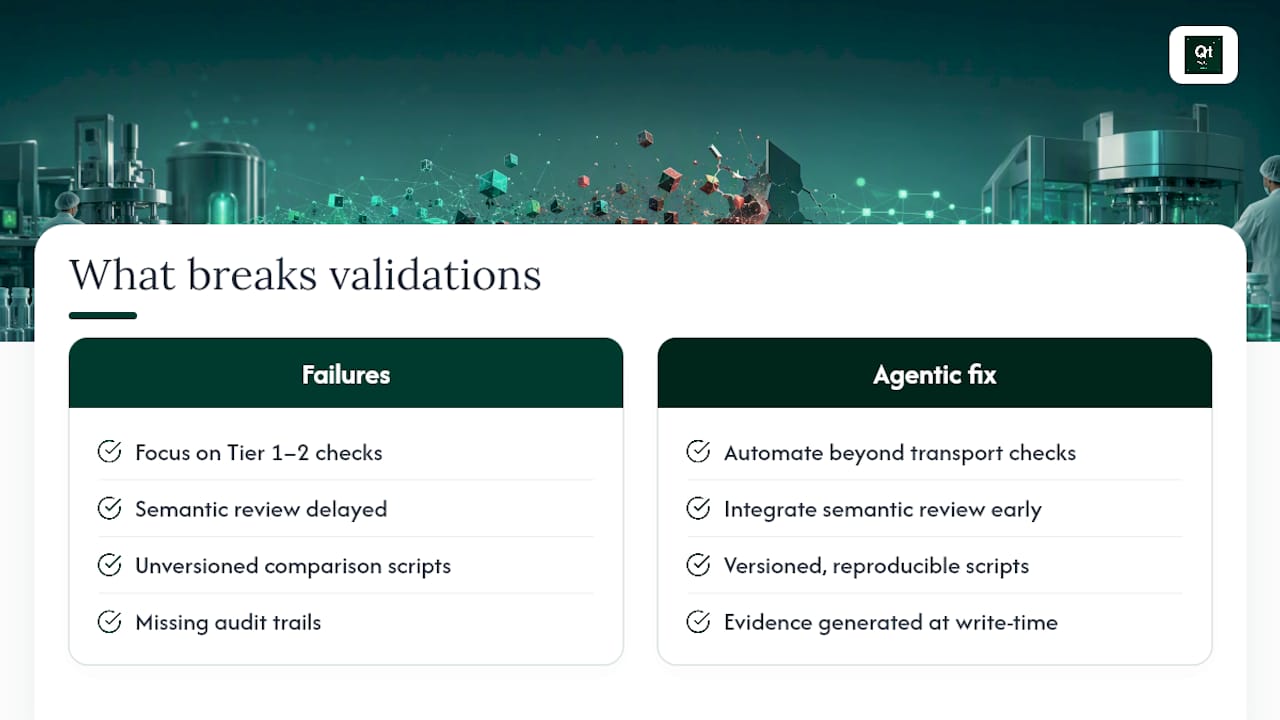
The second recurring failure is under-controlled comparison scripts. Teams write a quick SQL query to check field values, run it once, and never version it again. When someone asks six months later exactly how that reconciliation was performed, nobody can reproduce it. Audit trail gaps compound the problem: legacy systems that can't export a linked trail get migrated anyway, with the assumption that "we'll deal with it later."
Automation changes the economics of this problem more than most teams expect. An agentic validation approach that checks every record against ALCOA+ criteria at write-time and again at review-time removes the manual authoring burden that causes teams to shortcut Tier 3 and Tier 4 testing in the first place. The evidence gets generated as a byproduct of the process rather than reconstructed afterward under audit pressure. That shift, more than any single tool feature, is what separates migration projects that pass inspection cleanly from ones that spend months in remediation.
— Matt
A Faster Path to Defensible Migration Evidence
Building the evidence package described above by hand, mapping specs, reconciliation reports, version-controlled scripts, known-defect registers, takes weeks of authoring time most validation teams don't have to spare. An agentic validation platform can check every migrated record against ALCOA+ criteria at write-time and again at review-time, generating traceable, defensible evidence automatically instead of leaving your team to assemble it after the fact.

The platform integrates with existing quality management systems and has helped teams cut authoring time by over 70% across validation cycles, time that goes back into semantic review and legacy-defect analysis instead of formatting protocols. If you want a clear picture of where your own migration evidence has gaps before an inspector finds them, request a free validation gap report or book a working session with the Qualitum team to walk through your migration scope directly.
Sources
FAQ
What Is Data Migration Validation in a GxP Context?
It's the documented proof, backed by mapping specs, reconciliation reports, and audit trail evidence, that records moved between GxP systems retain their original ALCOA+ value and meaning.
How Do You Validate Data Migration Without Testing Every Record?
You apply a risk-based tiered test design: mechanical checks (counts, checksums) across everything, then progressively targeted field-level, sampled semantic, and functional testing focused on the highest-risk data elements, per GAMP 5's Appendix D7 approach.
Can You Correct Legacy Data Errors During Migration?
Only when the defect is mechanical, the affected records are fully countable beforehand, the correction rule is deterministic, and the original value remains retrievable after the fix; otherwise migrate as-is and remediate under change control afterward.
What Documents Does an Auditor Ask for First?
Typically the mapping specification and the reconciliation report, followed by test script version history and the known-defect register with its linked CAPA records.
Can Automation Reduce Migration Validation Effort?
Yes. Platforms like Qualitum apply ALCOA+ checks at write-time and review-time automatically, which has cut authoring time by over 70% in validation cycles by generating traceable evidence as part of the process rather than after it.
Recommended
- GAMP 5's Risk-Based Approach to Computerized System Validation
- Risk-Based Validation: A Practical Guide for QA Leads
- Risk-Based Test Design Techniques for IQ/OQ/PQ Validation
- Backup Restore Validation for GxP Systems: What Auditors Want
FAQ
What Is Data Migration Validation in a GxP Context?
It's the documented proof, backed by mapping specs, reconciliation reports, and audit trail evidence, that records moved between GxP systems retain their original ALCOA+ value and meaning.
How Do You Validate Data Migration Without Testing Every Record?
You apply a risk-based tiered test design: mechanical checks (counts, checksums) across everything, then progressively targeted field-level, sampled semantic, and functional testing focused on the highest-risk data elements, per GAMP 5's Appendix D7 approach.
Can You Correct Legacy Data Errors During Migration?
Only when the defect is mechanical, the affected records are fully countable beforehand, the correction rule is deterministic, and the original value remains retrievable after the fix; otherwise migrate as-is and remediate under change control afterward.
What Documents Does an Auditor Ask for First?
Typically the mapping specification and the reconciliation report, followed by test script version history and the known-defect register with its linked CAPA records.
Can Automation Reduce Migration Validation Effort?
Yes. Platforms like Qualitum apply ALCOA+ checks at write-time and review-time automatically, which has cut authoring time by over 70% in validation cycles by generating traceable evidence as part of the process rather than after it.