Moving from CSV to CSA means applying the FDA's risk-based Computer Software Assurance framework to meet your existing validation obligations. The validation obligation itself does not disappear. What changes is how you execute it: instead of exhaustive scripted testing and templated documentation for every system, you allocate assurance effort proportional to the risk a software failure poses to product quality or patient safety. For most production and quality system software in U.S.-regulated organizations, the FDA's final CSA guidance is now the recommended path.
The immediate implication for your team: you must document a risk-based rationale and define appropriate assurance activities for every in-scope system. Inspectors are looking for evidence that you made deliberate, defensible decisions, not just that you produced a thick binder.
Three actions to take now:
- Conduct a CSA gap assessment on all in-scope production and quality software systems. Map current documentation to CSA's "appropriate record" elements and identify where your existing evidence is insufficient or over-engineered.
- Tier every system's functions by risk and intended use. A LIMS audit trail function carries different risk than an administrative scheduling module. That distinction drives every downstream decision about testing scope and documentation depth.
- Define a pilot project on a low-risk system. A cloud-based QMS module with strong vendor SDLC evidence is a natural starting point. Pilot wins build organizational confidence and give you a defensible template before you tackle high-risk bespoke control software.
Table of Contents
- What is Computer Software Assurance (CSA) and how the FDA frames it
- How CSV and CSA differ in practice
- How to move from a CSV program to a CSA approach
- Documentation, traceability, and change control under CSA
- Common pitfalls during a CSV to CSA transition
- Practical implementation examples: what CSA looks like in the field
- Key Takeaways
- The transition most teams underestimate
- Qualitum supports your CSA transition from day one
- Authoritative sources and further reading
- FAQ
What is Computer Software Assurance (CSA) and how the FDA frames it
Computer Software Assurance is the FDA's recommended, risk-based approach to establishing and maintaining confidence that software is fit for its intended use. The FDA's final CSA guidance positions CSA not as a replacement for the validation obligation but as a clarification of how to execute assurance activities proportionally.
The FDA frames CSA around four core steps:
- Document confidence through an "appropriate record": — the FDA identifies seven elements every assurance record should contain: intended use, risk rationale, objectives, testing performed, issues found, conclusion, and who performed the activity and when
The practical shift is significant. Under CSA, you can use vendor SDLC artifacts, SOC reports, and automated test logs as primary evidence for lower-risk functions, supplemented by targeted manufacturer testing only where vendor evidence is insufficient. Continuous assurance replaces the periodic revalidation cadence: change impact assessments trigger re-testing when warranted, rather than on a fixed schedule. The FDA's supplementary CSA guidance provides operational examples of acceptable assurance activities and clarifies when unscripted testing is appropriate.
The validation obligation remains. CSA changes the method, not the mandate. Right-sized documentation and risk-based testing are not shortcuts; they are the FDA's preferred execution model for production and quality system software.
How CSV and CSA differ in practice
The differences between CSV and CSA are not cosmetic. They change what your team writes, what you test, and how you respond to change.
| Dimension | Traditional CSV | CSA Approach |
|---|---|---|
| Primary focus | Documentation completeness | Assurance of fitness for intended use |
| Testing approach | Scripted protocols for all functions | Risk-tiered: scripted for high-risk, unscripted where justified |
| Documentation volume | Exhaustive; templated scripts and screenshots | Right-sized; appropriate record elements only |
| Vendor evidence use | Supplementary; often re-tested regardless | Primary evidence for low-risk functions after vendor assessment |
| Cadence | Periodic revalidation on fixed schedule | Continuous assurance; change-triggered re-testing |
| Timeline impact | Months for mid-complexity systems | Weeks for low-risk systems with strong vendor evidence |
What this looks like in execution:
- A high-risk bespoke manufacturing control function (e.g., a custom algorithm controlling a critical process parameter) still warrants full scripted IQ/OQ/PQ protocols, formal acceptance criteria, and retained test evidence. CSA does not reduce rigor here.
- A low-risk administrative function in a commercial QMS (e.g., a document numbering module in a SaaS platform with a mature SDLC and SOC 2 Type II report) may need only a documented intended use statement, a risk rationale, and a brief unscripted test with a recorded conclusion. The vendor's evidence carries most of the weight.
- A LIMS module receiving frequent vendor updates benefits from continuous assurance: automated regression logs, change impact assessments at each update, and targeted re-testing of affected functions rather than full re-qualification.
The FDLI commentary on transitioning to CSA notes that the shift requires teams to make explicit, documented risk judgments rather than defaulting to a one-size-fits-all protocol template. That is the core behavioral change.
How to move from a CSV program to a CSA approach
A CSV to CSA conversion is a program-level change, not a document swap. It requires governance decisions, SOP updates, training, and a phased rollout. The following structure reflects what a mid-sized regulated organization typically needs.
Phase 0: Governance and stakeholder alignment
Before touching a single system, update your SOPs to reflect CSA principles and define roles. QA owns the risk rationale and acceptance criteria. IT owns system configuration and change records. Vendor management owns the supplier assessment process. Without cross-functional sign-off on these boundaries, CSA pilots stall when the first disagreement about evidence sufficiency arises.
Phase 1: Gap assessment
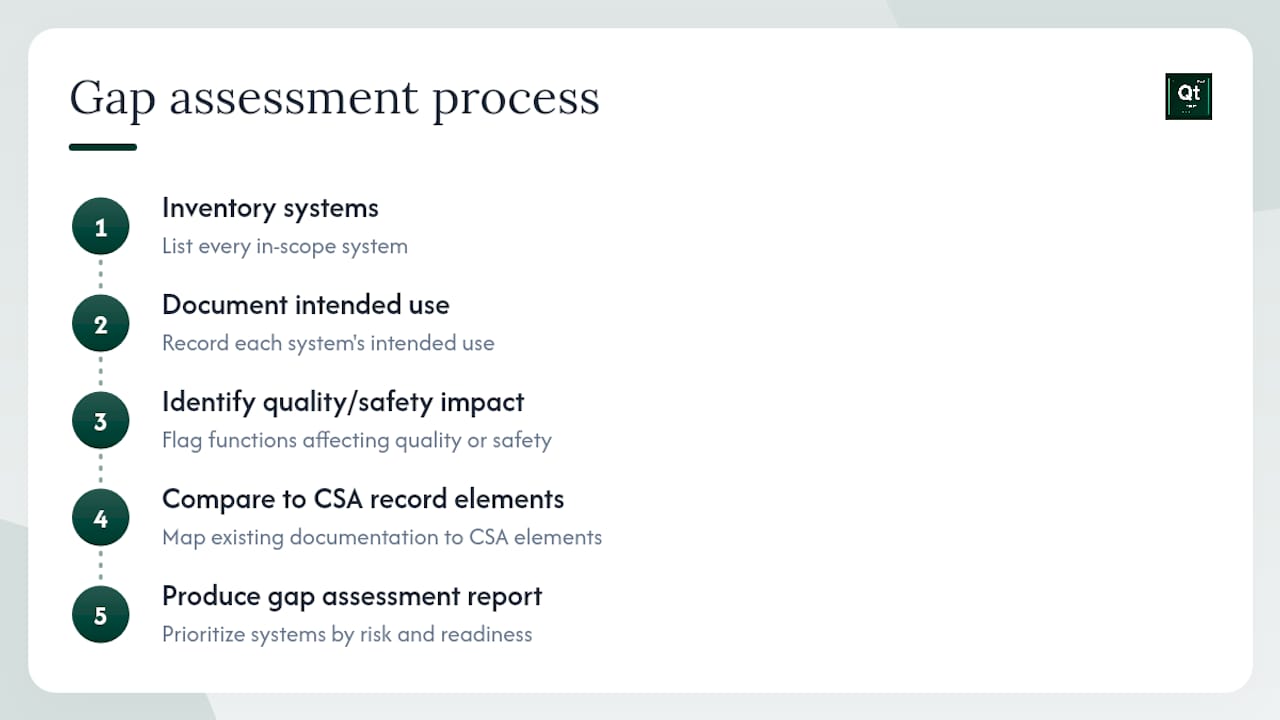
Inventory every in-scope system. For each one, document the intended use, identify which functions affect product quality or patient safety, and compare existing documentation to CSA's appropriate record elements. The output is a gap assessment report that prioritizes systems by risk and readiness.
Phase 2: Pilot selection and planning
Choose one or two low-risk systems with strong vendor evidence as your first CSA pilots. Define assurance activities, acceptance criteria, and evidence sources before you start. A SaaS QMS module with a published SOC 2 Type II report and a mature vendor SDLC is an ideal first candidate.
Phase 3: Execution
Apply risk-based test design. Use vendor outputs as primary evidence where the vendor assessment supports it. Execute targeted regression testing for high-risk functions. Establish continuous monitoring through audit trail reviews and periodic system health checks.
Phase 4: Scale and sustain
Update all relevant SOPs, embed risk-based decision records into your change control process, and run training for QA, IT, and validation engineers. Schedule management reviews of CSA program metrics quarterly.
| Deliverable | Owner | Typical Timeline |
|---|---|---|
| Gap assessment report | QA Lead | Weeks 1–4 |
| CSA validation plan (per system) | Validation Manager | Weeks 3–6 |
| Function risk tiering register | QA + IT | Weeks 4–6 |
| Pilot assurance records | Validation Engineer | Weeks 6–9 |
| Updated SOPs | QA Lead | Weeks 8–9 |
| Training completion records | QA + HR | Weeks 10–12 |
| Assurance activity log (ongoing) | Validation Engineer | Continuous |
For a mid-sized program covering 10–15 systems, the full transition from gap assessment to scaled CSA execution typically runs 6–9 months. The ISPE practitioner guidance on CSA adoption recommends treating the first pilot as a learning exercise, not a compliance deliverable, to give teams room to calibrate their risk judgments before scaling.
Documentation, traceability, and change control under CSA
CSA does not eliminate documentation. It eliminates documentation that serves no assurance purpose.
What to keep from your CSV practices:
- The appropriate record elements (intended use, risk rationale, objectives, testing performed, issues, conclusion, who/when)
- Traceability between functions, risk tiers, assurance activities, and evidence
- Change control records with documented impact assessments
- Retention schedules and tamper-evident storage for electronic records
What to pare back:
- Redundant screenshots that duplicate information already in system logs
- Templated test scripts for low-risk functions where unscripted testing with a documented conclusion is sufficient
- Re-testing of vendor-tested functionality where vendor evidence has been assessed and found adequate
A practical traceability structure for CSA looks like this:
| System Function | Risk Tier | Assurance Activity | Evidence Location | Sign-off |
|---|---|---|---|---|
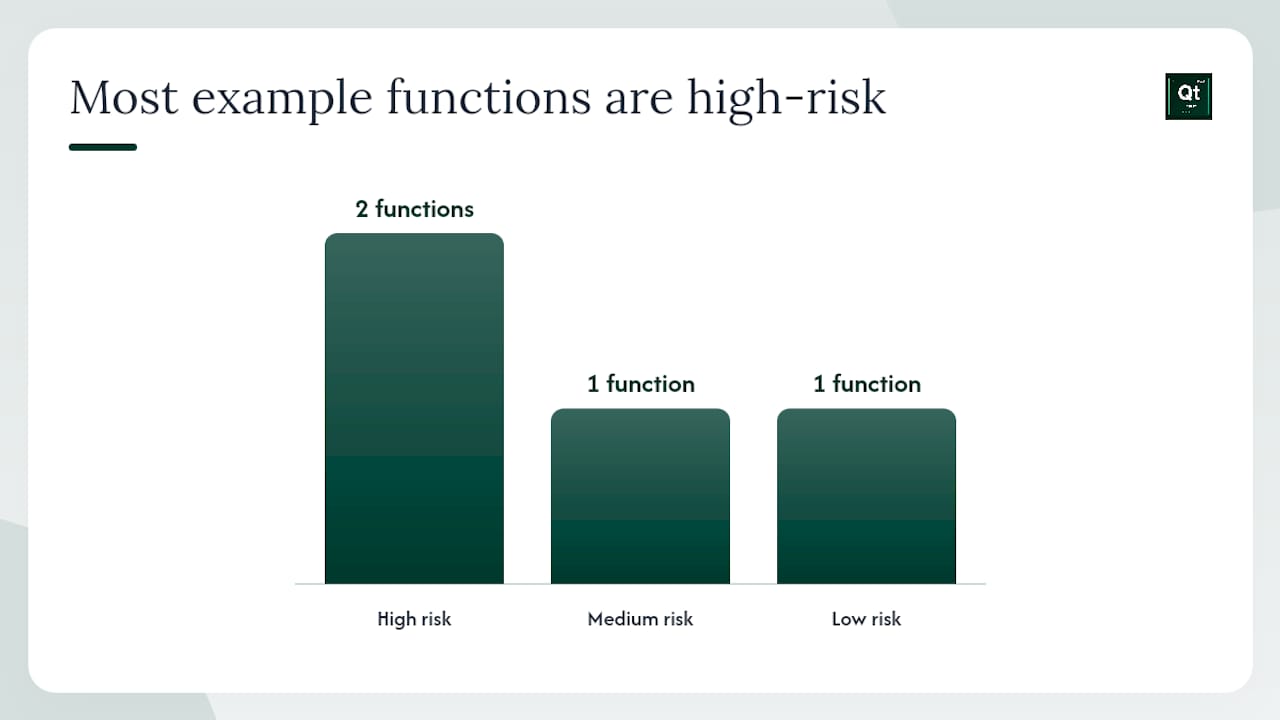
| Batch record generation | High | Scripted OQ protocol + IQ | Validation folder / DMS | QA Lead |
| User access management | Medium | Vendor SOC II + targeted scripted test | Vendor assessment + test log | Validation Engineer |
| Report scheduling module | Low | Unscripted test with documented conclusion | Assurance activity log | Validation Engineer |
| Audit trail integrity | High | Automated log review + periodic sampling | System log archive | QA Lead |
Change control under CSA requires a documented risk assessment for every change to an in-scope system. If the change affects a high-risk function, specify re-testing scope and the evidence you will retain. If it does not, document the rationale for no further testing. That documented rationale is what inspectors look for; the absence of it is what generates observations.
For digital evidence retention, apply 21 CFR Part 11 controls: access restrictions, audit trails on the records themselves, and backup procedures that preserve record integrity. SOC 2 Type II reports from your document management system provider can support the evidence of controls, provided you have assessed their relevance to your specific retention requirements.
Common pitfalls during a CSV to CSA transition
The most expensive mistake teams make is treating CSA as a documentation reduction exercise without building the risk-based decision infrastructure that makes reduced documentation defensible. Inspectors do not object to shorter records. They object to records that cannot explain why a particular level of assurance was chosen.
- Inconsistent training: — QA engineers who understand CSA principles and validation engineers who still default to CSV templates produce inconsistent records across systems. The ISPE article on critical thinking in CSA identifies this training gap as one of the primary barriers to successful adoption.
Red flags that draw inspector attention: missing acceptance criteria for unscripted tests, vendor evidence decisions that are undocumented or inconsistently applied, and traceability gaps between risk tiers and assurance activities. A peer-reviewed analysis of assurance practices confirms that these three areas account for a disproportionate share of software-related inspection observations.
Mitigations: maintain an audit trail for every risk decision, not just every test. Pilot CSA on a non-critical system first, with cross-functional sign-off on the risk tier assignments. Require QA review of every vendor evidence assessment before it is accepted as primary evidence.
Practical implementation examples: what CSA looks like in the field
Three archetypal scenarios illustrate how CSA changes execution in practice.
Scenario 1: Low-risk LIMS module with strong vendor evidence
A pharmaceutical QC lab upgrades a commercial LIMS module used for scheduling sample analysis. The function has no direct impact on batch release decisions. The vendor provides a comprehensive SDLC package including design specifications, automated test results, and a release note. After a documented vendor assessment confirming the controls are relevant and adequate, the team executes a brief unscripted test of the scheduling function, records the objective and conclusion, and closes the assurance record. Total authoring time: a fraction of what a full OQ protocol would have required. The key success factor: the vendor assessment was completed before the upgrade, not after.
Scenario 2: SaaS QMS module with frequent updates
A biotech company uses a cloud-based QMS for document control. The vendor releases updates quarterly. Under CSV, each update triggered a full re-qualification cycle. Under CSA, the team establishes a continuous assurance model: automated regression logs from the vendor's CI/CD pipeline serve as primary evidence for low-risk functions, and a targeted scripted test covers the document approval workflow (medium risk). Change impact assessments at each update determine whether the targeted test needs to be re-executed. Release cycles that previously took six to eight weeks now close in days for low-risk updates. Qualitum's validation lifecycle platform supports this model by automating the authoring of change impact assessments and maintaining a live traceability matrix that updates as vendor evidence is ingested.
Scenario 3: Bespoke manufacturing control software
A medical device manufacturer uses custom software to control a critical process parameter. The function directly affects product quality and patient safety. Here, CSA does not reduce rigor: full scripted IQ/OQ/PQ protocols, formal acceptance criteria, and retained test evidence remain appropriate. The benefit of CSA in this scenario is precision: the team documents exactly why this function warrants full scripted testing, which makes the rationale defensible and avoids the implicit assumption that everything else in the system requires the same level of scrutiny.
Industry experience with CSA pilots consistently shows that organizations achieve meaningful reductions in validation authoring time for low- and medium-risk systems, while maintaining or increasing rigor for high-risk functions. Qualitum's platform reports over 70% time savings in authoring across its customer base, driven by automated protocol generation and ALCOA+ enforcement at write time.
Key Takeaways
The CSV to CSA transition is a regulatory evolution, not a compliance shortcut: validation obligations remain binding under 21 CFR Part 820 and Part 211, and CSA defines the risk-proportionate method for meeting them.
| Point | Details |
|---|---|
| Obligation unchanged | CSV remains the regulatory requirement; CSA is the FDA-recommended execution method for production and quality software. |
| Risk rationale is mandatory | Every assurance record must document why a specific level of testing was chosen, traceable to intended use and failure consequences. |
| Vendor evidence requires assessment | SOC reports and SDLC artifacts are acceptable primary evidence only after a documented, function-specific vendor assessment. |
| Pilot before scaling | Start with a low-risk system with strong vendor evidence; use the pilot record as your organizational CSA template. |
| Qualitum accelerates adoption | Qualitum's Validate·AI platform automates appropriate record authoring, enforces ALCOA+ at write time, and maintains a live traceability matrix across the validation lifecycle. |
The transition most teams underestimate
The hardest part of moving from CSV to CSA is not the documentation. It is the judgment.
CSV gave QA teams a procedural safety net: follow the template, execute the scripts, fill the binder. Compliance was a function of completeness. CSA asks something more demanding: make a defensible decision about how much assurance is enough, and document your reasoning. That is a different cognitive task, and it requires a different kind of training.
What I have seen derail otherwise well-planned CSA transitions is the gap between what leadership communicates and what engineers actually do at the bench. Leadership announces the shift to risk-based validation. Engineers, under time pressure and without updated SOPs, default to the familiar CSV template because it feels safer. The result is a hybrid that satisfies neither model: it has the documentation volume of CSV without the structured risk rationale that makes CSA defensible.
The organizations that navigate this well do three things consistently. They pilot on a system where the risk tier is genuinely low and the vendor evidence is genuinely strong, so the first CSA record is easy to write and easy to defend. They invest in cross-functional training that includes real examples of risk rationale documents, not just slides about CSA principles. And they build the risk decision into the change control process from day one, so continuous assurance is not a separate activity but a natural output of how changes are managed.
Incremental change, documented rationale, and early wins. That is the playbook.
Qualitum supports your CSA transition from day one
Cutting validation authoring time by over 70% while producing ALCOA+-compliant, inspection-ready records is the concrete outcome Qualitum delivers for regulated organizations moving to CSA. Where traditional approaches require weeks of manual drafting for each system's appropriate record set, Qualitum's agentic platform generates those records from structured inputs, enforces data integrity at write time, and keeps your traceability matrix current as systems and evidence evolve.

Teams that have piloted Qualitum on a single CSA system typically have a complete, defensible appropriate record set within days, not weeks, along with a reusable template for every subsequent system in their program. The platform's validated private deployment and built-in ALCOA+ enforcement mean your records are audit-ready from the moment they are created.
If your team is ready to move from gap assessment to a working CSA pilot, book a working session with Qualitum to map your first system and define your assurance evidence strategy.
Authoritative sources and further reading
The following primary sources and practitioner resources are the foundation for any CSA program in a U.S.-regulated organization.
- FDA: Computer Software Assurance guidance for production and quality management system software
- Peer‑reviewed analysis on software assurance practices (PMC article)
- ISPE practitioner article: Finding assurance with CSA (Sept–Oct 2024)
- ISPE article: Computer software assurance and critical thinking (Mar–Apr 2024)
- FDLI commentary on transitioning to CSA
This article provides general informational guidance on FDA CSA requirements and is not a substitute for legal or regulatory advice. Confirm current regulatory requirements with FDA primary sources or a qualified regulatory professional before implementing changes to your validation program.
FAQ
What does CSV to CSA mean in FDA-regulated industries?
CSV to CSA refers to transitioning from traditional Computer System Validation, which relies on exhaustive scripted testing and templated documentation, to Computer Software Assurance, the FDA's recommended risk-based approach for production and quality system software. The validation obligation remains; CSA defines how to meet it proportionally.
What is CSA in pharma?
Computer Software Assurance (CSA) is the FDA's risk-based framework for establishing confidence that software used in production and quality systems is fit for its intended use. It replaces one-size-fits-all scripted testing with assurance activities scaled to the risk a software failure poses to product quality or patient safety.
What does CSV mean in pharma?
Computer System Validation (CSV) is the documented process of demonstrating that a computerized system performs consistently and reliably for its intended use in a regulated environment, as required by 21 CFR Part 820 and Part 211. It has traditionally involved scripted IQ/OQ/PQ protocols, traceability matrices, and formal validation summary reports.
How do you transition from CSV to CSA?
Start with a gap assessment to map existing documentation against CSA's appropriate record elements, then tier system functions by risk and intended use. Run a pilot on a low-risk system with strong vendor evidence, use that pilot record as your organizational template, and scale the approach across your program with updated SOPs and cross-functional training.
Can vendor evidence replace manufacturer testing under CSA?
Vendor evidence such as SOC Type II reports and SDLC artifacts can serve as primary assurance evidence for lower-risk functions, but only after a documented, risk-based vendor assessment that maps vendor controls to your specific function's risk profile. For high-risk functions, vendor evidence supplements but does not replace manufacturer testing, as the FDA's CSA implementation guidance makes clear.
Recommended
- Operate·AI · Qualitum
- Qualitum · The agentic validation platform for life sciences
- Cleanroom & utility qualification · Validate·AI · Qualitum
- Validate·AI · Qualitum
FAQ
What does CSV to CSA mean in FDA-regulated industries?
CSV to CSA refers to transitioning from traditional Computer System Validation, which relies on exhaustive scripted testing and templated documentation, to Computer Software Assurance, the FDA's recommended risk-based approach for production and quality system software. The validation obligation remains; CSA defines how to meet it proportionally.
What is CSA in pharma?
Computer Software Assurance (CSA) is the FDA's risk-based framework for establishing confidence that software used in production and quality systems is fit for its intended use. It replaces one-size-fits-all scripted testing with assurance activities scaled to the risk a software failure poses to product quality or patient safety.
What does CSV mean in pharma?
Computer System Validation (CSV) is the documented process of demonstrating that a computerized system performs consistently and reliably for its intended use in a regulated environment, as required by 21 CFR Part 820 and Part 211. It has traditionally involved scripted IQ/OQ/PQ protocols, traceability matrices, and formal validation summary reports.
How do you transition from CSV to CSA?
Start with a gap assessment to map existing documentation against CSA's appropriate record elements, then tier system functions by risk and intended use. Run a pilot on a low-risk system with strong vendor evidence, use that pilot record as your organizational template, and scale the approach across your program with updated SOPs and cross-functional training.
Can vendor evidence replace manufacturer testing under CSA?
Vendor evidence such as SOC Type II reports and SDLC artifacts can serve as primary assurance evidence for lower-risk functions, but only after a documented, risk-based vendor assessment that maps vendor controls to your specific function's risk profile. For high-risk functions, vendor evidence supplements but does not replace manufacturer testing, as the FDA's CSA implementation guidance makes clear.